
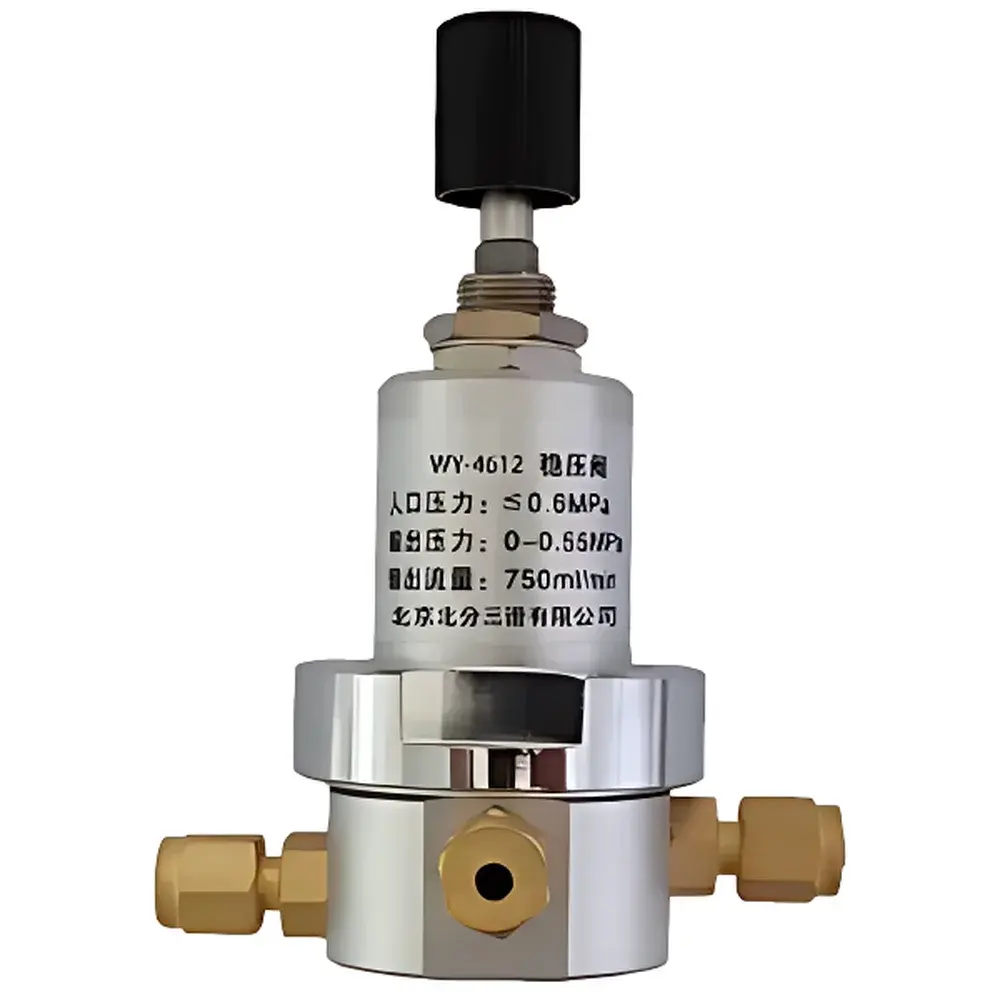
Beifen Sanpu WY-4612 Precision Gas Pressure Regulator
| Brand | Beifen Sanpu |
|---|---|
| Origin | Beijing, China |
| Manufacturer Type | Direct Manufacturer |
| Model | WY-4612 |
| Pressure Accuracy | ±1% (High-Precision Option: ±0.1%) |
| Input Pressure Range | 0–0.60 MPa |
| Output Pressure Range | 0–0.55 MPa |
| Minimum Required Input–Output Differential | ≥0.05 MPa |
| Test Flow Rate | 750 mL/min |
| Maximum Output Flow Rate | 5000 mL/min |
| Operating Temperature Range | 0–100 °C |
| Inlet/Outlet Thread | M8×1 |
| Port Hole Diameter | 13 mm |
| Standard Tubing OD | 3 mm |
| Diaphragm Material | Alloy Membrane |
Overview
The Beifen Sanpu WY-4612 Precision Gas Pressure Regulator is an engineered solution for stable, repeatable, and contamination-resistant gas pressure control in analytical chromatography systems—particularly gas chromatographs (GC). Designed with a high-strength alloy diaphragm actuation mechanism, the WY-4612 operates on direct-acting mechanical regulation principles, eliminating reliance on external power or electronic feedback loops. Its core function is to maintain a constant downstream pressure despite upstream fluctuations—a critical requirement for carrier gas flow stability, detector response linearity, and retention time reproducibility in GC methods. The regulator conforms to fundamental pneumatic design standards for laboratory-grade instrumentation, supporting method robustness in compliance-driven environments such as pharmaceutical QC labs, petrochemical process monitoring, and environmental testing facilities.
Key Features
- Alloy diaphragm-based sensing and actuation system ensures long-term mechanical stability and resistance to fatigue under cyclic loading.
- ±1% full-scale pressure accuracy across the 0–0.55 MPa output range; optional high-accuracy variant achieves ±0.1% for applications demanding tighter control (e.g., trace-level GC analysis or multi-detector configurations).
- Wide input pressure tolerance (0–0.60 MPa) with minimum required differential of 0.05 MPa between inlet and outlet—enabling compatibility with common lab gas cylinders, nitrogen generators, and zero-air sources.
- Rated maximum flow capacity of 5000 mL/min supports dual-column or high-flow detector configurations (e.g., FID, TCD) without pressure droop or hysteresis.
- Mechanically simple adjustment: clockwise rotation increases output pressure; counterclockwise decreases it—providing intuitive, tool-free calibration and fine-tuning.
- Gas-path components are constructed from corrosion-resistant metals; compatible with inert, hydrocarbon, and oxidizing gases when used with clean, dry, particle-free supply streams.
Sample Compatibility & Compliance
The WY-4612 is intended for use with purified, oil-free, and desiccated gases—including helium, hydrogen, nitrogen, argon, and synthetic air—meeting ISO 8573-1 Class 2:2:2 or better for particulate, water, and oil content. It is not rated for corrosive, reactive, or toxic gases (e.g., Cl₂, NH₃, H₂S) without custom material certification. While the regulator itself carries no formal CE, UKCA, or UL listing, its mechanical architecture aligns with functional safety expectations outlined in IEC 61511 for non-electrical pressure control elements in laboratory process chains. When integrated into GC systems validated per USP , ASTM D3612, or ISO 17025, the WY-4612 contributes to documented pressure stability—a key parameter in instrument qualification (IQ/OQ) protocols and GLP/GMP audit readiness.
Software & Data Management
As a purely mechanical, analog pressure control device, the WY-4612 does not incorporate embedded electronics, digital interfaces, or data logging capabilities. It requires no firmware, drivers, or software integration. However, its stable output enables reliable correlation with external digital pressure transducers or flow controllers—facilitating automated recording in chromatography data systems (CDS) such as Thermo Chromeleon, Agilent OpenLab CDS, or Shimadzu LabSolutions. For regulated environments, manual pressure settings and verification logs may be maintained in accordance with 21 CFR Part 11-compliant electronic notebooks or paper-based instrument usage records.
Applications
- Primary carrier gas regulation in benchtop and modular gas chromatographs, ensuring consistent linear velocity and peak shape fidelity.
- Make-up gas and detector gas supply control for FID, ECD, NPD, and TCD detectors where pressure-dependent response must remain invariant across multi-hour runs.
- Gas source conditioning for headspace samplers, purge-and-trap concentrators, and thermal desorption units requiring precise inlet pressure staging.
- Calibration gas delivery in environmental air monitoring stations and refinery flare gas analyzers.
- General-purpose pressure reduction in R&D labs using gas-driven actuators, microfluidic platforms, or vacuum manifold manifolds.
FAQ
What is the minimum pressure differential required between inlet and outlet for stable regulation?
A minimum differential of 0.05 MPa must be maintained; otherwise, the regulator may fail to sustain setpoint pressure or exhibit oscillatory behavior.
Can the WY-4612 be used with hydrogen gas?
Yes—provided the supply gas meets purity specifications (≥99.999% H₂, dew point ≤ –40 °C, oil content <0.01 mg/m³) and all downstream fittings are leak-tested per CGA G-4.1 guidelines.
Is customization available for non-standard port threading or mounting configurations?
Yes; Beifen Sanpu offers OEM mechanical adaptations including alternative thread standards (e.g., 10-32 UNF, G1/8), custom flange mounts, and extended diaphragm housings—subject to minimum order volume and engineering review.
Does the regulator include a built-in pressure gauge?
No—the “G” port is a dedicated 1/8″ NPT gauge connection point; users must supply a calibrated analog or digital pressure indicator compatible with the expected range (0–0.6 MPa recommended).
How often should the WY-4612 be serviced or recalibrated?
Under typical laboratory conditions with clean gas, annual functional verification against a traceable reference standard is recommended; diaphragm replacement intervals exceed 5 years at nominal cycling frequency (≤5 adjustments/day).





