
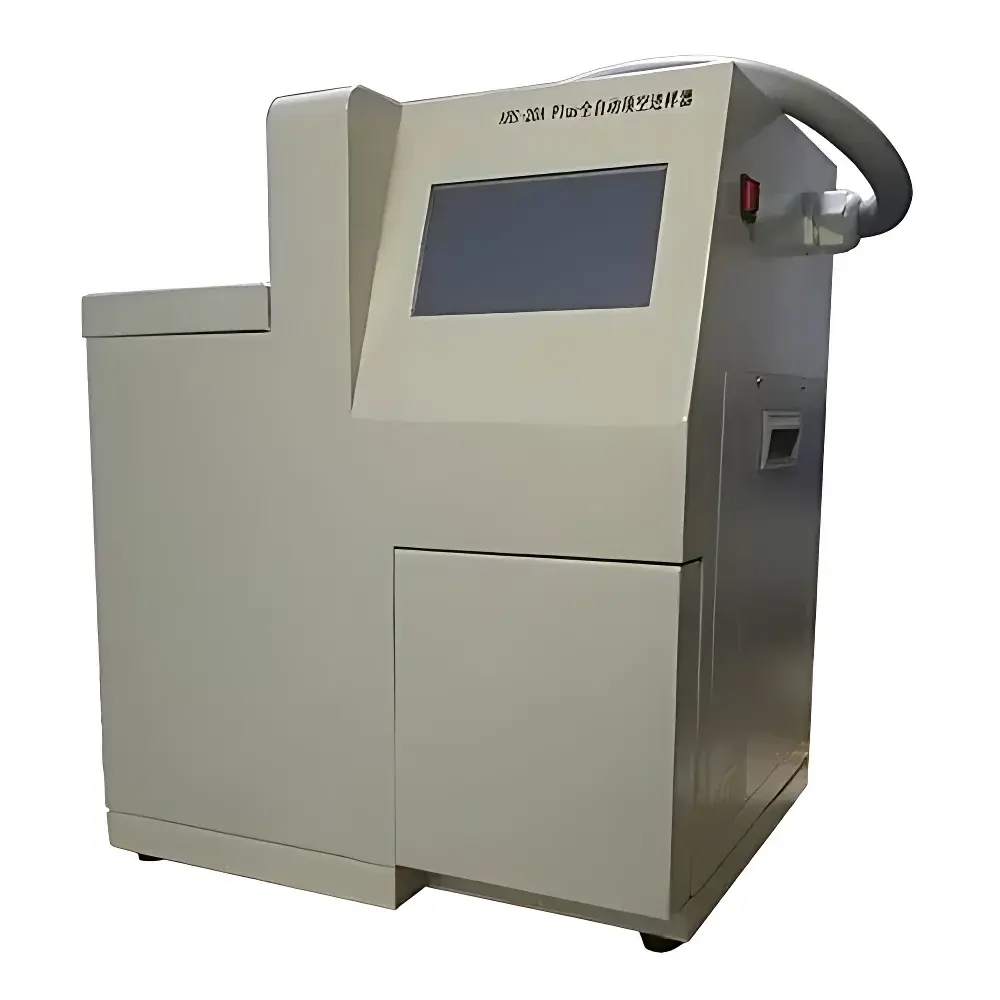
Beifen Sanpu UAHS-20A Plus Fully Automated Headspace Sampler
| Brand | Beifen Sanpu |
|---|---|
| Model | UAHS-20A Plus |
| Origin | Beijing, China |
| Manufacturer Type | Direct Manufacturer |
| Sample Positions | 20 |
| Heating Range (Sample/Valve/Transfer Line) | 40–220 °C (optional to 300 °C) |
| Temperature Accuracy | ±0.5 °C |
| Temperature Stability | < ±0.5 °C |
| Pressure Control Range | 0–0.25 MPa (continuously adjustable) |
| Sampling Time | 0–30 min |
| Injection Time | 0–999 s |
| Pressurization Time | 0–999 s |
| Purge/Clean Time | 0–30 min |
| Minimum Time Resolution | 1 ms |
| Quantitative Loop Volume | 1 mL (customizable: 0.5/2/5 mL) |
| Vial Capacity | 10 mL or 20 mL (customizable: 50/100 mL) |
| Simultaneous Heating | 1 or 2 vials |
| RSD (Ethanol in Water, 100 ppm) | < 1.0% |
| Backflush Flow Rate | 0–100 mL/min (adjustable) |
| Communication Interface | USB |
| Compliance | ASTM D6866, ISO 17025-compatible operation |
Overview
The Beifen Sanpu UAHS-20A Plus Fully Automated Headspace Sampler is an engineered solution for precise, reproducible, and unattended volatile organic compound (VOC) analysis in complex solid and liquid matrices. It operates on the principle of equilibrium headspace sampling—where a sealed sample vial is heated to establish vapor-phase equilibrium between the non-volatile matrix and analytes, followed by pressurized transfer of the equilibrated headspace gas into a gas chromatograph (GC) via a high-inertness quantitative loop and heated six-port valve. Designed for routine QC/QA laboratories, environmental testing facilities, pharmaceutical stability studies, and food safety screening, the UAHS-20A Plus delivers robust automation without compromising analytical integrity. Its fully enclosed thermal management system ensures zero cold spots across all active flow paths—including the valve seat, transfer line, and loop—preserving thermolabile analytes and minimizing carryover.
Key Features
- 20-position carousel with automatic vial recognition and mechanical fault detection—avoids collision during positioning errors or missing vials.
- Independent triple-zone heating (sample oven, valve block, transfer line), each controllable from 40 °C to 220 °C (upgradeable to 300 °C) with ±0.5 °C accuracy and < ±0.5 °C stability over 8-hour operation.
- Motor-driven actuation system—no external carrier gas or pneumatic lines required—reducing maintenance points and enhancing operational safety in regulated environments.
- Electropolished, silanized stainless-steel quantitative loop (standard 1 mL; optional 0.5/2/5 mL) and deactived fused-silica transfer tubing minimize adsorption and memory effects.
- Heated six-port valve mounted inside the thermal zone eliminates condensation at critical junctions, ensuring full analyte transfer and retention time reproducibility.
- Real-time status monitoring via 7-inch TFT LCD interface with animated workflow guidance; supports both front-panel and remote USB-based parameter configuration.
- Configurable sampling protocols: single vial/multiple injections, single vial/single injection, or multi-vial/single injection—enabling method flexibility for validation and method development.
- Integrated EPC (Electronic Pressure Control) module available as factory option for enhanced pressure precision and long-term method robustness.
Sample Compatibility & Compliance
The UAHS-20A Plus accommodates standard 10 mL and 20 mL crimp-top headspace vials (custom 50 mL and 100 mL trays available upon request). It accepts aqueous solutions, polymers, soils, pharmaceutical tablets, beverages, and packaged foods—provided samples remain physically stable under defined incubation conditions. All wetted surfaces are constructed from high-purity, low-bleed materials compliant with USP , ISO 10993-1, and ASTM D6866 requirements for VOC analysis. When operated within validated SOPs and paired with a 21 CFR Part 11–compliant GC data system (e.g., Thermo Chromeleon, Agilent OpenLab CDS), the instrument supports GLP/GMP workflows—including electronic signatures, audit trails, and user-access controls.
Software & Data Management
Native USB 2.0 interface enables bidirectional communication with Windows-based GC control software. All method parameters—including temperature ramps, timing sequences, pressure setpoints, and event triggers—are programmable via PC or locally. The system logs timestamped run metadata (date/time, vial ID, cycle count, error flags) to internal memory and exports CSV-formatted reports for LIMS integration. Optional firmware upgrade supports scheduled auto-calibration routines and remote diagnostics via secure SSH tunneling—facilitating centralized fleet management across multi-site laboratories.
Applications
- Residual solvent analysis per ICH Q3C guidelines in APIs and excipients.
- VOC profiling in drinking water per EPA Method 502.2 and 8260D.
- Flavor and fragrance release kinetics in food packaging headspace.
- Automotive interior material emissions testing (VDA 278, ISO 12219-4).
- Stability-indicating assays for lyophilized biologics and vaccine formulations.
- Forensic toxicology screening for ethanol, acetone, and volatile drugs of abuse.
FAQ
Does the UAHS-20A Plus support method transfer between different GC platforms?
Yes—its universal analog/digital trigger outputs and standardized USB command protocol ensure seamless integration with Agilent, Thermo Fisher, Shimadzu, PerkinElmer, and国产 GC systems. Synchronization is achieved via TTL pulse or software handshake.
Can the instrument be validated per IQ/OQ/PQ requirements?
Absolutely. Documentation packages—including DQ templates, calibration certificates for PT100 sensors, leak test procedures, and RSD verification protocols (using certified ethanol standards)—are provided with each unit.
Is remote monitoring possible without vendor-specific software?
Yes. Raw status registers and event logs are accessible via Modbus RTU over USB-serial emulation, enabling integration into custom SCADA or LabVIEW environments.
What maintenance intervals are recommended for routine operation?
Quarterly inspection of vial tray alignment, semi-annual replacement of septa and O-rings, and annual recalibration of temperature sensors using NIST-traceable dry-block calibrators.





