
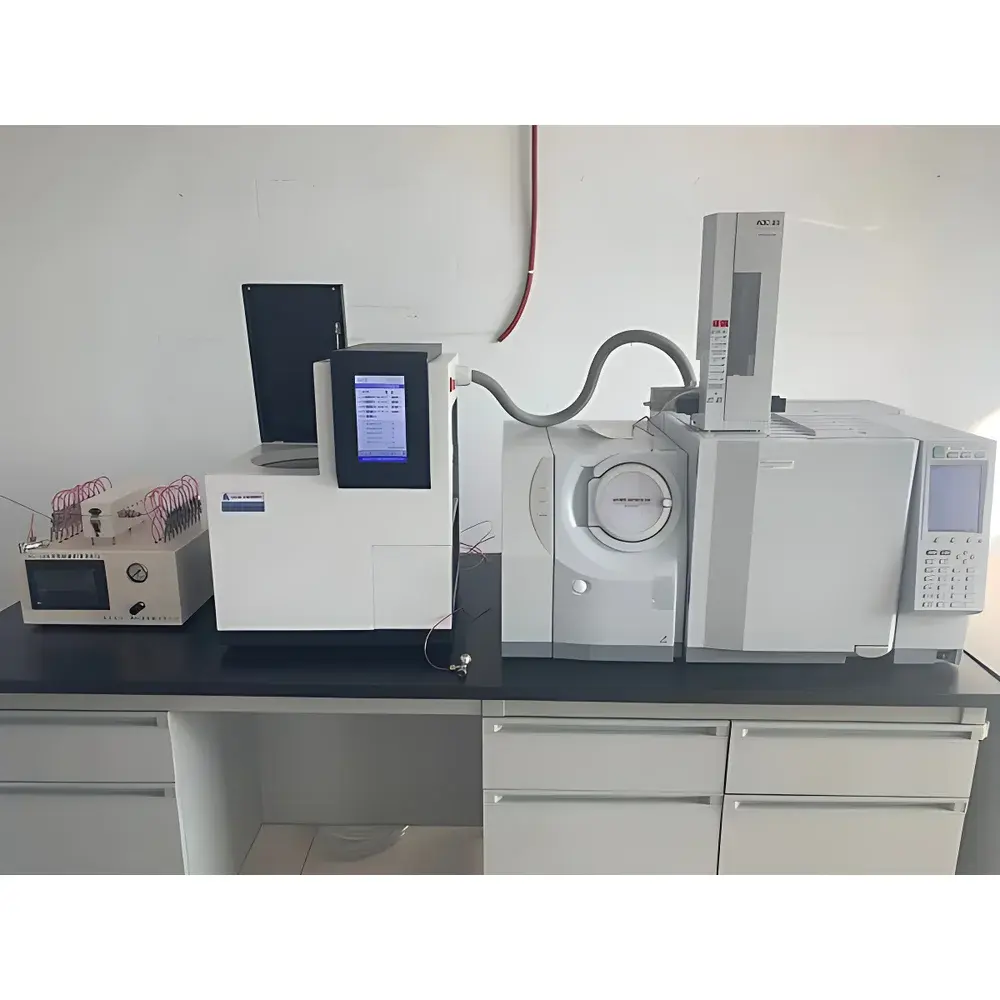
Beifen Sanpu ATDS-20A Fully Automated Two-Stage Thermal Desorber
| Brand | Beifen Sanpu |
|---|---|
| Model | ATDS-20A |
| Instrument Type | Two-Stage Thermal Desorber |
| Primary Desorption Temperature Range | Ambient to 400 °C |
| Secondary Desorption Temperature Range | 100–400 °C |
| Cold Trap Temperature Range | Down to −35 °C |
| Desorption Recovery Rate | >90% |
| Sample Capacity | 20 adsorption tubes |
| Origin | Hebei, China |
| Manufacturer | Beifen Sanpu Instruments Co., Ltd. |
| Compliance | HJ 734–2014, HJ 644–2013 |
Overview
The Beifen Sanpu ATDS-20A is a fully automated two-stage thermal desorber engineered for high-fidelity quantification of volatile organic compounds (VOCs) in environmental and industrial emission matrices. It operates on the principle of sequential thermal desorption: first-stage desorption releases analytes from sorbent-packed sampling tubes under controlled inert gas flow; second-stage desorption transfers the pre-concentrated analytes from a cryogenically focused cold trap directly into the injection port of a gas chromatograph–mass spectrometer (GC–MS). This architecture eliminates solvent use, minimizes analyte loss or degradation, and delivers superior sensitivity and reproducibility for trace-level VOC analysis—particularly critical for regulatory compliance with Chinese environmental standards HJ 734–2014 (for fixed pollution source emissions) and HJ 644–2013 (for ambient air monitoring).
Key Features
- Fully automated 20-position sample carousel enabling unattended batch processing of standard 6 mm OD × 89 mm adsorption tubes (e.g., Tenax TA, Carbopack B/C, or multi-bed configurations)
- Independent temperature control for primary desorption oven (ambient to 400 °C, ±0.5 °C stability), secondary desorption zone (100–400 °C), and cryogenic cold trap (−35 °C minimum, programmable ramping)
- High-efficiency cold trap with rapid heating (>1,500 °C/min) and precise focusing to ensure sharp, narrow analyte bands entering the GC column
- Integrated inert gas management system with mass flow-controlled carrier gas (N₂ or He) and purge gas lines, each equipped with calibrated digital flow meters
- Robust stainless-steel fluidic path with electropolished surfaces and zero dead-volume connections to prevent carryover and adsorption artifacts
- Comprehensive hardware interlocks and real-time thermal monitoring to safeguard tube integrity and method repeatability across extended operation cycles
Sample Compatibility & Compliance
The ATDS-20A accommodates industry-standard sorbent tubes used in EPA TO-17, ISO 16017-1, and Chinese HJ-series methods—including single- and multi-bed configurations optimized for C₂–C₁₂ hydrocarbons, oxygenates, halocarbons, and aromatic compounds. Its thermal profiles and timing parameters are pre-configured to meet the procedural requirements of HJ 734–2014 and HJ 644–2013, including specified desorption durations, trap cooling rates, and transfer line temperatures. All thermal ramps and dwell times are user-definable via software and auditable for GLP/GMP-aligned workflows. The system supports full traceability of calibration events, method versions, and operator actions—essential for laboratory accreditation (CNAS, CMA) and regulatory audits.
Software & Data Management
Controlled via Windows-based Beifen Sanpu Thermal Desorption Workstation v3.x, the ATDS-20A provides intuitive method building, real-time status visualization (temperature curves, flow rates, valve positions), and automated report generation compliant with ISO/IEC 17025 documentation requirements. Method files include embedded metadata (standard reference materials used, calibration dates, instrument serial numbers) and support electronic signatures per FDA 21 CFR Part 11 when deployed with validated IT infrastructure. Raw desorption event logs—including cold trap temperature deviation, pressure transients, and valve actuation timestamps—are stored in encrypted binary format with optional CSV export for third-party statistical review.
Applications
- Quantitative analysis of benzene, toluene, ethylbenzene, xylenes (BTEX), styrene, chlorinated solvents, and aldehydes in ambient air samples collected using SKC, Markes, or custom sorbent tubes
- Monitoring fugitive VOC emissions from chemical storage tanks, wastewater treatment units, and coating application lines per HJ 734–2014 protocols
- Method validation studies requiring recovery assessment, breakthrough volume determination, and matrix spike reproducibility across diverse sorbent media
- Supporting indoor air quality (IAQ) investigations in commercial buildings, schools, and healthcare facilities where low-part-per-trillion detection limits are mandated
- Integration with legacy and modern GC–MS platforms—including Shimadzu QP series, Agilent 5977/7010, Thermo ISQ EC, and Waters SELECT SERIES Cyclic IMS—via universal pneumatic interface
FAQ
Is the ATDS-20A compatible with non-Chinese GC–MS systems?
Yes—the instrument uses standardized pneumatic and electrical interfaces (24 V DC, RS-232/USB) and supports configurable trigger signals (TTL, dry contact) for seamless synchronization with all major GC–MS vendors.
What maintenance intervals are recommended for optimal performance?
Cold trap cleaning and O-ring replacement every 500 runs; primary oven quartz liner inspection every 1,000 runs; annual calibration verification using NIST-traceable temperature sensors and certified flow standards.
Can the system perform single-stage desorption for method development?
Yes—software allows disabling secondary desorption and cold trap functions to operate in direct-transfer mode, facilitating method scouting and sorbent evaluation.
Does the ATDS-20A support remote monitoring or networked deployment?
Local Ethernet connectivity enables remote desktop access and log file retrieval; however, cloud-based telemetry or multi-user scheduling requires integration with enterprise LIMS via API-enabled middleware.
How is carryover addressed during high-concentration sample analysis?
The system includes an integrated bake-out cycle (up to 400 °C under inert purge) for both primary oven and transfer lines, validated to reduce carryover to <0.1% for target VOCs at 100 ng levels.





