
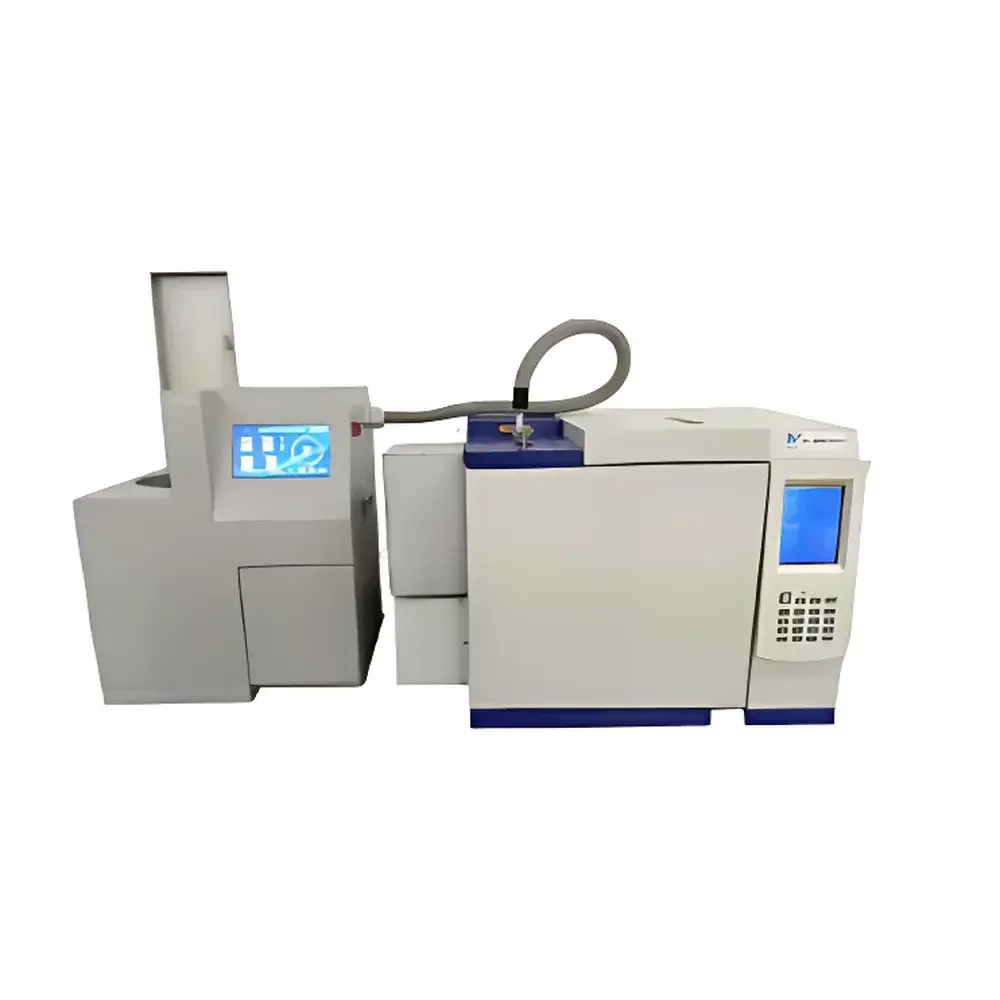
Beifen Sanpu GC-9860IV Laboratory Gas Chromatograph with FID and AHS-20A Automated Headspace Sampler for Methanol Analysis in Perfumes
| [Brand | Beifen Sanpu |
|---|---|
| Origin | Beijing, China |
| Manufacturer Type | Direct Manufacturer |
| Instrument Type | Benchtop Laboratory Gas Chromatograph |
| Model | GC-9860IV |
| Temperature Control Range | Up to 350 °C |
| Maximum Oven Ramp Rate | 22 °C/min |
| Maximum Cooling Rate | 410 °C/min |
| Carrier Gas Flow Range & Control | 0–562 mL/min (EPC) |
| Carrier Gas Pressure Range & Control | 0–485 kPa (EPC) |
| Injector Max Temp | 350 °C |
| Injector Pressure Setting Range | 0–512 kPa |
| Injector Total Flow Setting Range | 0–846 mL/min |
| Detectors Supported | FID, TCD, ECD, FPD, NPD |
| Temperature Zones | 6 independently controlled |
| Programmed Temperature Ramping | 16 steps |
| EPC/EFC Modes | Constant Flow / Constant Pressure |
| Supported Carrier Gases | N₂, H₂, He, Ar, Air |
| Communication Interface | Ethernet (IEEE 802.3) |
| Compliance | Designed for GLP/GMP-aligned workflows |
Overview
The Beifen Sanpu GC-9860IV is a high-performance, network-enabled laboratory gas chromatograph engineered for precise, reproducible volatile organic compound (VOC) quantification—particularly methanol—in complex, matrix-rich consumer products such as perfumes, eau de toilettes, and aerosol-based personal care formulations. This system operates on the fundamental principle of gas–solid partition chromatography, where analytes are thermally volatilized from the sample headspace, separated on a porous polymer-packed column (e.g., GDX-201), and detected via flame ionization detection (FID). Its integrated electronic pressure and flow control (EPC/EFC) architecture ensures retention time stability and method transferability across laboratories. The instrument is purpose-configured for compliance with GB 7917.4–1987 (“Hygienic Chemical Test Methods for Cosmetics”) and aligns with broader international frameworks—including ISO 11357 (plastics thermal analysis), ASTM D3699 (fuel alcohol content), and USP (residual solvents)—when deployed with validated methods and calibrated standards.
Key Features
- 6-zone independent temperature control with ±0.1 °C accuracy and range from ambient +4 °C to 450 °C, enabling robust method development for high-boiling or thermally labile compounds.
- 16-step programmable temperature ramping (0.1–80 °C/min), supporting rapid method optimization and shortened analysis cycles without compromising resolution.
- Full EPC/EFC implementation across all gas lines—carrier, makeup, fuel, and oxidant—with dual-mode operation (constant flow/constant pressure) and real-time digital feedback at 10 ms intervals.
- Vacuum fluorescent display (VFD) interface with intuitive menu navigation, eliminating reliance on external PCs for basic instrument setup and diagnostics.
- Automatic fault protection suite: includes auto-shutdown upon loss of detector flame, carrier gas interruption, or oven overtemperature events—critical for unattended overnight runs.
- Ethernet (IEEE 802.3) connectivity enables remote monitoring, centralized method deployment, and seamless integration into LIMS or CDS platforms compliant with 21 CFR Part 11 audit-trail requirements.
Sample Compatibility & Compliance
The GC-9860IV—paired with the AHS-20A 20-position automated headspace sampler—is optimized for aqueous and semi-volatile matrices where direct injection would risk column contamination or detector saturation. Perfume samples are equilibrated at 50 °C for 15 min in sealed vials prior to pressurized loop injection, minimizing solvent interference and maximizing methanol recovery. The GDX-201 packed column provides excellent peak symmetry and selectivity for low-molecular-weight alcohols against ethanol, acetone, and terpenes commonly found in fragrance bases. All hardware components—including inlet liners, septa, and ferrules—are selected for inertness and low bleed. System suitability testing per ICH Q2(R2) guidelines is supported through built-in retention time locking and peak area RSD validation tools. The platform meets essential design criteria for GLP-compliant laboratories and supports full traceability when operated under documented SOPs.
Software & Data Management
While the GC-9860IV operates autonomously via its embedded VFD controller, it is fully compatible with third-party chromatography data systems (CDS) such as Chromeleon, OpenLab CDS, or Empower. Raw acquisition files (.dat or .cdf) retain complete metadata—including EPC setpoints, actual flow/pressure logs, temperature profiles, and event timestamps—enabling retrospective method verification. Audit trail functionality, electronic signatures, and user-access-level permissions can be enforced at the CDS layer. The instrument’s Ethernet interface allows secure VLAN segmentation and TLS-encrypted data transmission, satisfying IT security policies in regulated environments. Method export/import in AIA format ensures cross-platform compatibility and facilitates regulatory submission packages.
Applications
- Quantitative determination of methanol in alcoholic fragrances per GB 7917.4–1987 (limit: ≤0.2% v/v).
- Residual solvent screening in cosmetic raw materials (e.g., propylene glycol, isopropyl alcohol, ethyl acetate).
- Stability-indicating assays for perfume formulations exposed to elevated temperature/humidity.
- Batch release testing of alcohol-based sanitizers and antiseptic sprays.
- Method transfer studies between QC labs using identical column chemistries and EPC parameters.
FAQ
Is the GC-9860IV compatible with USP residual solvent testing?
Yes—when configured with appropriate columns (e.g., GDX-201 or DB-624), FID detection, and validated headspace parameters, it satisfies identification and quantitation requirements for Class 2 solvents including methanol.
Can the AHS-20A be used with other GC brands?
The AHS-20A features universal pneumatic and electrical interfaces (TTL/RS-232) and is vendor-neutral; however, full method synchronization requires matching trigger protocols and pressure calibration.
Does the system support 21 CFR Part 11 compliance out-of-the-box?
The hardware provides necessary data integrity features (audit trails, electronic signatures, user authentication); formal compliance requires validated CDS software and documented procedural controls.
What maintenance intervals are recommended for routine FID operation?
FID jet cleaning every 2 weeks, ceramic igniter inspection monthly, and column trimming every 50 injections—especially with high-glycerin or waxy perfume extracts.
How does EPC improve reproducibility versus mechanical flow controllers?
EPC dynamically compensates for column aging, ambient pressure shifts, and gas purity fluctuations—reducing retention time drift to <0.02 min over 100 injections under identical conditions.





