
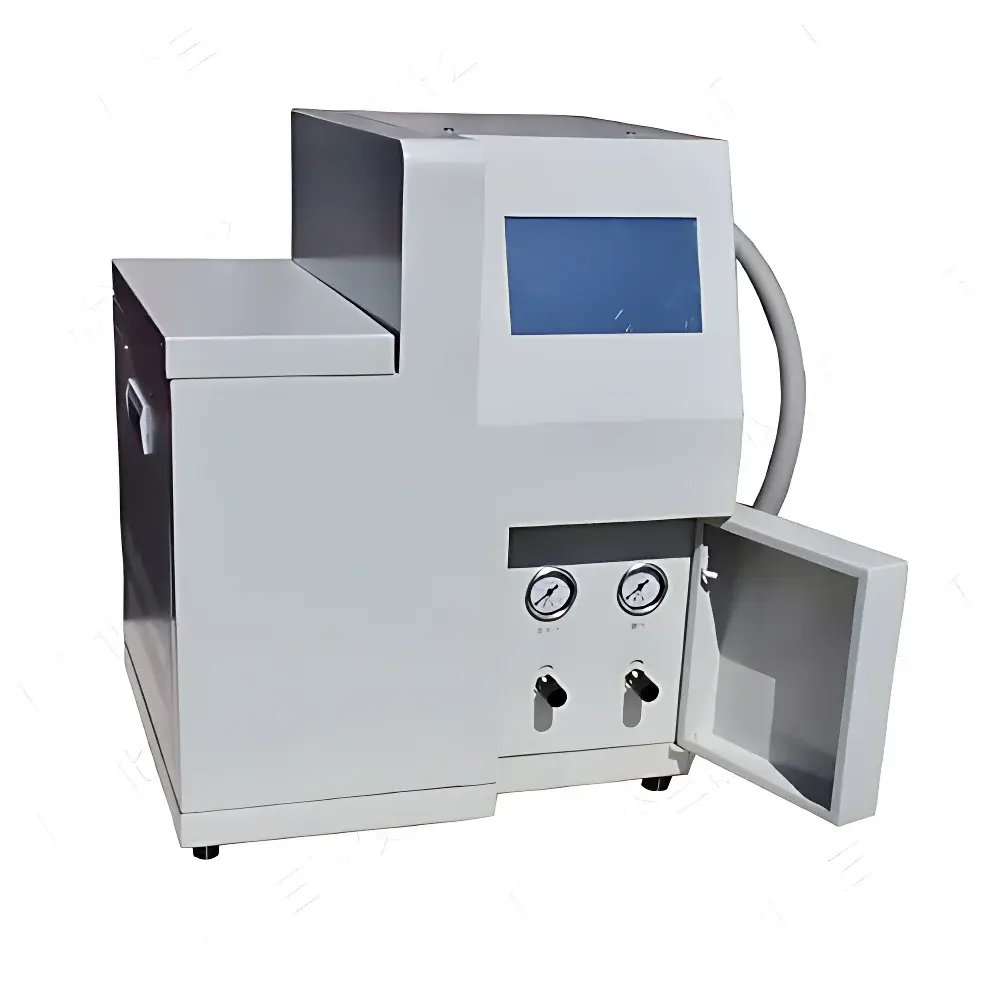
Beifen Sanpu SHA-20A Fully Automated Static Headspace Sampler for Benzene Homologues Analysis in Wood Coatings
| Brand | Beifen Sanpu |
|---|---|
| Origin | Beijing, China |
| Manufacturer Type | Direct Manufacturer |
| Product Category | Domestic |
| Model | SHA-20A |
| Instrument Type | Static Headspace Sampler |
| Automation Level | Fully Automatic |
| Sample Vial Heating Range | Ambient to 200 °C (1 °C increment) |
| Valve Temperature Control Range | 40–220 °C (±1 °C accuracy) |
| Loop Volume | 1 mL |
| Sample Position Capacity | 20 positions |
| Vial Size Compatibility | 10 mL or 20 mL |
Overview
The Beifen Sanpu SHA-20A is a fully automated static headspace sampler engineered for precise, reproducible extraction and introduction of volatile organic compounds (VOCs) — particularly benzene, toluene, ethylbenzene, and xylenes (BTEX) — from complex, high-boiling matrices such as solvent-based wood coatings. It operates on the principle of phase equilibrium partitioning: solid or liquid samples are sealed in inert vials and heated to a controlled temperature, allowing VOCs to volatilize and establish equilibrium between the sample matrix and the headspace gas phase. A precisely metered volume of this equilibrated vapor is then transferred via a thermostatted six-port valve and heated transfer line directly into the injection port of a gas chromatograph (GC). This approach eliminates solvent extraction, derivatization, or filtration steps — significantly reducing analytical error, carryover risk, and matrix-induced suppression effects common in direct liquid injection. The SHA-20A is specifically validated for compliance with GB 18581–2001 (“Limits of harmful substances in solventborne wood coatings”) and supports method development aligned with ASTM D6197, ISO 11890-2, and EPA Method 502.2 for VOC quantification in heterogeneous coatings.
Key Features
- Fully automated 20-position carousel with intelligent vial detection: automatically skips empty or misaligned positions to prevent mechanical collision and ensure unattended operation over extended sequences.
- Independent, high-stability temperature control zones: sample oven (ambient–200 °C), valve block (40–2220 °C), and transfer line (40–220 °C), all with ±0.5 °C thermal stability and 0.5% absolute accuracy — critical for quantitative BTEX recovery across diverse coating viscosities and resin loadings.
- Inert, deactivation-treated flow path: fused-silica-lined quantitative loop (1 mL standard), six-port valve, and heated transfer tubing minimize adsorption, degradation, or memory effects — essential for trace-level aromatic hydrocarbon analysis where carryover below 0.1% RSD is required.
- Positive-pressure sampling architecture: delivers consistent, pulse-free vapor introduction without carrier gas dilution; maintains baseline stability during GC analysis and enables accurate calibration using external standard or standard addition protocols.
- 7-inch graphical LCD interface with animated workflow guidance: supports intuitive parameter entry, real-time status monitoring (temperature, pressure, timing), and full audit trail logging — compliant with GLP documentation requirements.
- USB-host communication and hardware synchronization: enables seamless triggering of GC oven start, detector activation, and chromatography data system (CDS) acquisition — supporting 21 CFR Part 11–compliant electronic records when paired with validated CDS software.
Sample Compatibility & Compliance
The SHA-20A accommodates standard 10 mL and 20 mL crimp-top headspace vials (with optional customization for 50 mL or 100 mL formats), compatible with common septa types (PTFE/silicone, pre-slit). It accepts both liquid coatings (e.g., nitrocellulose lacquers, polyurethane varnishes) and semi-solid pastes after homogenization in N,N-dimethylformamide (DMF). Its design meets ISO/IEC 17025 general requirements for competence of testing and calibration laboratories. When operated per validated SOPs, the system demonstrates <1.0% RSD for 100 ppm ethanol in water — a benchmark for precision in VOC headspace analysis. Data integrity features include automatic timestamping, parameter versioning, and fault-event logging — facilitating internal QA audits and regulatory submissions under CNAS, FDA, or EU GMP frameworks.
Software & Data Management
All operational parameters — including vial incubation time (0.1–30 min), pressurization duration (0–999 s), loop fill time (0–999 s), and purge cycles (0–30 min) — are programmable either locally via the front-panel interface or remotely via USB-connected PC software. Time resolution is 1 ms, enabling fine-tuned optimization for challenging matrices like high-solids acrylic enamels. The system logs complete run metadata (date/time, vial ID, setpoints, actual temperatures, error flags) to non-volatile memory. Exportable CSV reports support integration with LIMS platforms. Optional EPC (Electronic Pressure Control) module provides closed-loop regulation of pressurization gas flow (0–100 mL/min), enhancing inter-day reproducibility for multi-laboratory method transfer.
Applications
- Quantitative determination of benzene, toluene, ethylbenzene, and xylene isomers (o-, m-, p-) in solvent-borne wood finishes per GB 18581–2001 and GB/T 23986–2009.
- VOC screening in architectural paints, automotive refinish coatings, and industrial primers prior to release.
- Stability testing of coating formulations under accelerated aging conditions (e.g., elevated temperature headspace profiling).
- Residual solvent analysis in cured film extracts for occupational exposure assessment.
- Method development for emerging regulations targeting alkylbenzenes and chlorinated solvents in eco-label certification schemes (e.g., Blue Angel, Greenguard).
FAQ
What sample preparation is required prior to headspace analysis of wood coatings?
Minimal preparation is needed: weigh ~0.2–0.5 g of homogeneous coating into a 20 mL headspace vial, add 1–2 mL DMF (HPLC grade), seal immediately, and equilibrate per method-defined time/temperature.
Can the SHA-20A be integrated with third-party GC systems?
Yes — it features universal TTL-level trigger outputs and accepts external start signals; fully compatible with Agilent, Thermo Fisher, Shimadzu, and PerkinElmer GC platforms.
Is validation documentation available for regulatory submissions?
Factory-installed IQ/OQ protocols and a comprehensive user manual (including performance verification procedures per USP ) are provided; PQ must be performed in-house per site-specific SOPs.
What maintenance intervals are recommended for long-term reliability?
Valve rotor seal replacement every 10,000 injections; quantitative loop cleaning with methanol weekly; annual calibration verification of all temperature zones using NIST-traceable probes.
Does the system support multi-level calibration curves?
Yes — up to 20 user-defined calibration levels can be stored and recalled; peak area/height ratios are calculated internally or exported for external regression analysis.
Related Products




