
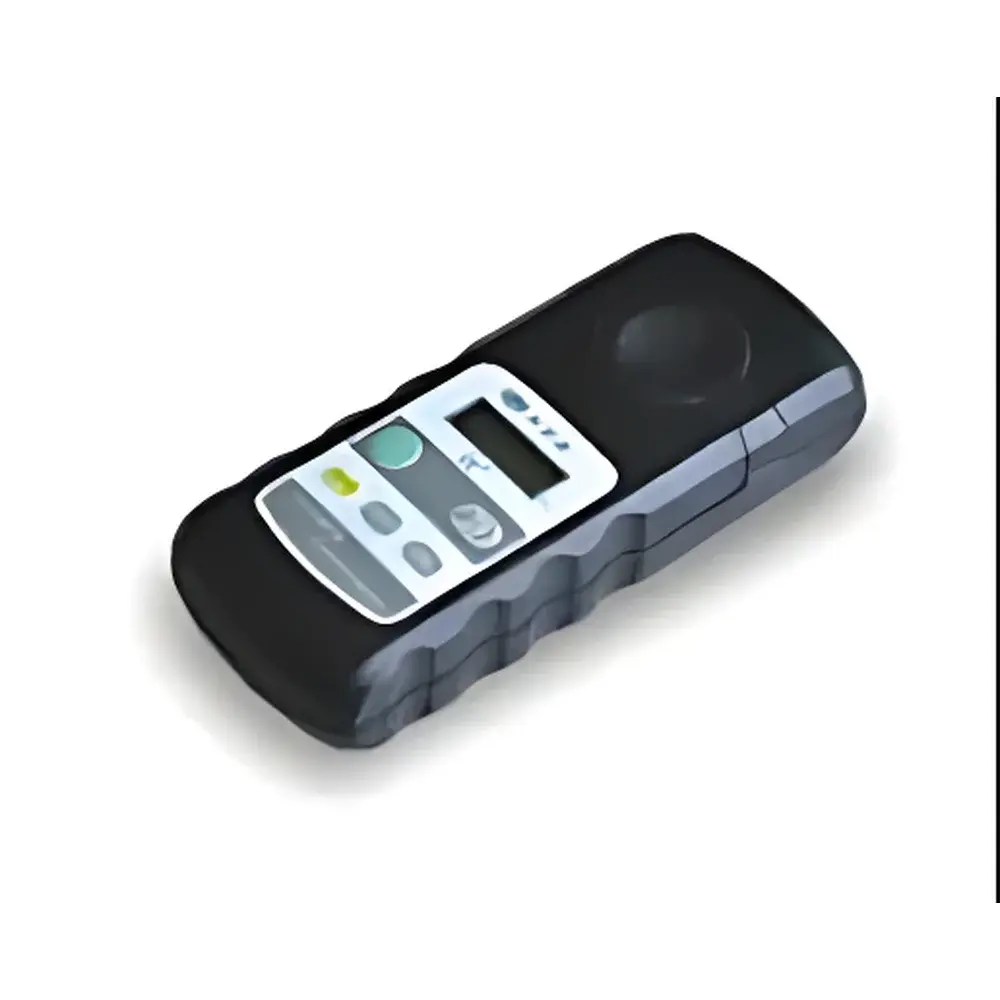
Beifen Sanpu Q-CL501B Portable Free Chlorine & Total Chlorine Photometer
| Brand | Beifen Sanpu |
|---|---|
| Origin | Beijing, China |
| Manufacturer Type | Direct Manufacturer |
| Instrument Type | Portable |
| Detection Principle | DPD-based Spectrophotometry |
| Measurable Parameters | Free Chlorine, Total Chlorine, Combined Chlorine |
| Measurement Time | ≤30 min |
| Accuracy | ±3% ±0.01 mg/L |
| Resolution | 0.01 mg/L |
| Default Range | 0.01–5.00 mg/L |
| Extended Range | 0.01–10.00 mg/L |
| Dimensions | 160 × 62 × 30 mm |
| Weight | 0.15 kg |
| Power Supply | 2 × AA alkaline batteries |
Overview
The Beifen Sanpu Q-CL501B Portable Free Chlorine & Total Chlorine Photometer is a field-deployable analytical instrument engineered for rapid, on-site quantification of chlorine species in water matrices using the standardized N,N-diethyl-p-phenylenediamine (DPD) spectrophotometric method. It operates on the principle of colorimetric reaction kinetics: free chlorine oxidizes DPD to form a stable pink-colored quinoneimine dye, while total chlorine—comprising both free and combined (chloramine) forms—is measured after addition of potassium iodide under acidic conditions to liberate iodine, which then reacts with DPD to produce an equivalent chromophore. Absorbance is measured at 515 nm using a precision LED-optical system with integrated wavelength stabilization, enabling trace-level detection in accordance with ISO 7393-2:2018, APHA Standard Methods 4500-Cl G, and GB/T 5750.11–2006 for drinking water quality analysis.
Key Features
- Triple-parameter capability: simultaneous or sequential measurement of free chlorine, total chlorine, and combined chlorine via programmable assay protocols
- Integrated optical path design with temperature-compensated photodiode detector and high-stability 515 nm LED source ensures minimal drift across ambient operating temperatures (0–40 °C)
- Ruggedized housing with IP65-rated sealing against dust and water ingress, validated for operation in high-humidity or splash-prone environments including wastewater treatment plants and aquaculture facilities
- Embedded microcontroller architecture featuring low-power ARM Cortex-M4 core, enabling >2000 measurements per battery set without recalibration
- User-configurable calibration curves supporting up to 10-point non-linear regression (linear, quadratic, or logarithmic), compliant with EPA Method 334.0 requirements for calibration verification
- Auto-zero function with dark-current compensation eliminates baseline drift during extended field deployment
Sample Compatibility & Compliance
The Q-CL501B is validated for use with raw water, potable water, swimming pool water, cooling tower effluent, hospital disinfection rinse solutions, and aquaculture recirculating systems. Sample turbidity up to 5 NTU does not interfere with measurement integrity when pre-filtration (0.45 µm membrane) is applied. All assay protocols align with national and international regulatory frameworks: GB/T 5750.11–2006 (China National Standard for Drinking Water), ISO 7393-2:2018 (Determination of residual chlorine), and US EPA Method 334.0 (Colorimetric Determination of Chlorine Residual). The instrument’s measurement uncertainty budget conforms to ISO/IEC 17025:2017 requirements for accredited environmental testing laboratories.
Software & Data Management
Data logging supports time-stamped storage of up to 500 test records, each containing sample ID, operator code, measurement date/time, parameter type, concentration value, and calibration status flag. USB-C interface enables direct export of CSV-formatted datasets to LIMS or QA/QC audit platforms. Firmware supports over-the-air updates via PC utility software compliant with FDA 21 CFR Part 11 for electronic record integrity—including user authentication, audit trail generation, and immutable data archiving. Calibration history is retained with full traceability to NIST-traceable DPD standards (SRM 2814).
Applications
- Real-time monitoring of chlorine residuals in municipal water distribution networks during emergency response or routine maintenance
- Verification of disinfection efficacy in healthcare facility sterilization cycles (e.g., endoscope reprocessing, dialysis water systems)
- Process control in wastewater tertiary treatment plants to ensure regulatory compliance with discharge limits (e.g., EPA NPDES permits)
- Quality assurance in food processing environments where chlorine-based sanitizers are used on contact surfaces and rinse water
- Field validation of chlorination dosing systems in aquaculture hatcheries to prevent gill damage in sensitive fish species
- Supporting GLP-compliant environmental monitoring programs requiring documented chain-of-custody and measurement traceability
FAQ
What is the difference between free chlorine, combined chlorine, and total chlorine?
Free chlorine refers to hypochlorous acid (HOCl) and hypochlorite ion (OCl⁻); combined chlorine denotes chloramines formed from reaction of chlorine with nitrogenous compounds; total chlorine is the sum of both fractions.
Does the instrument require external power or charging infrastructure?
No—operates exclusively on two standard AA alkaline batteries with no recharge circuitry, ensuring uninterrupted operation in remote or off-grid locations.
Can the Q-CL501B be used for regulatory reporting under ISO or EPA guidelines?
Yes—its DPD methodology, calibration traceability, and data audit features meet minimum technical requirements for inclusion in certified environmental test reports under ISO/IEC 17025 and EPA-approved methods.
How often must the optical system be cleaned or serviced?
The sealed cuvette chamber requires cleaning only after visible residue accumulation; recommended maintenance interval is every 200 measurements or quarterly—whichever occurs first.
Is third-party verification available for instrument performance validation?
Beifen Sanpu provides optional factory-issued Certificate of Conformance (CoC) with as-tested accuracy data against certified reference materials, valid for 12 months from date of issue.
Related Products







