
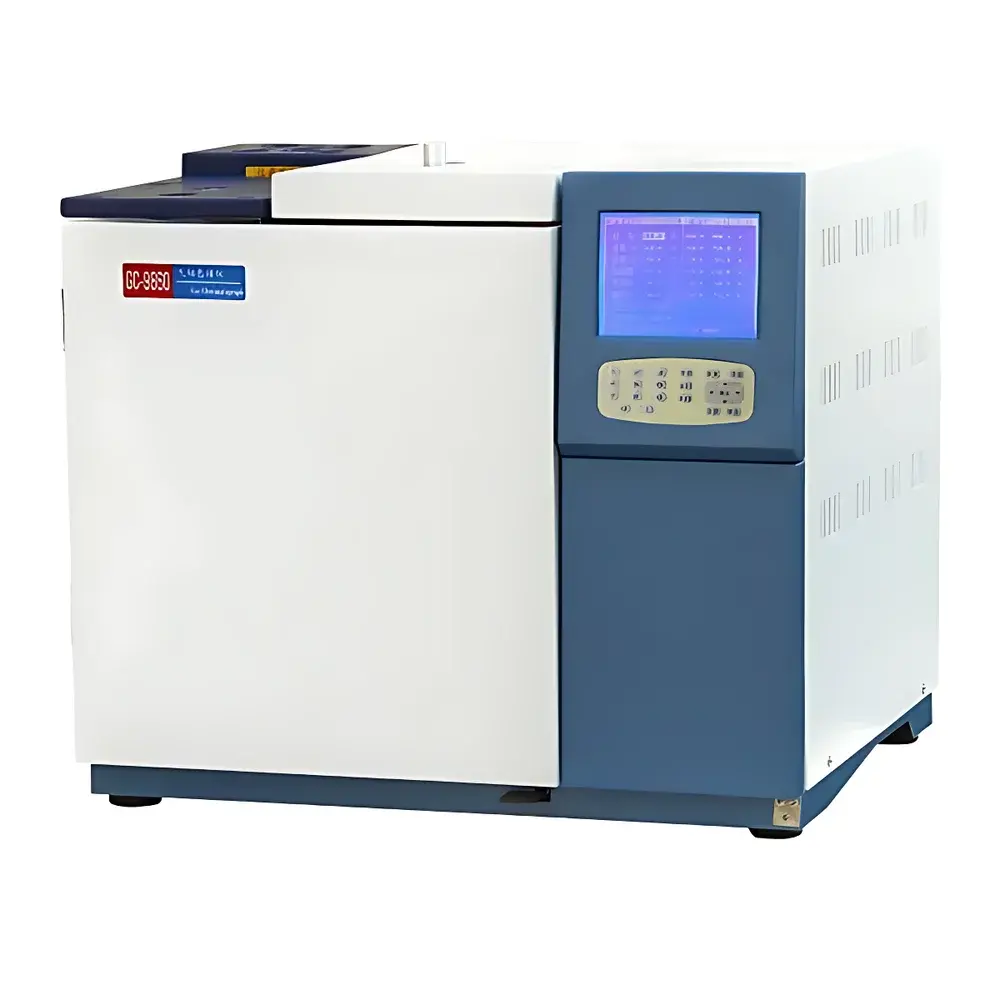
Beifen Sanpu GC-9860 Advanced Portable Gas Chromatograph
| Brand | Beifen Sanpu |
|---|---|
| Origin | Beijing, China |
| Manufacturer Type | Direct Manufacturer |
| Instrument Type | Portable Gas Chromatograph |
| Application Focus | Environmental Monitoring |
| Oven Temperature Range | 100–350 °C |
| Ramp Rate | 0.1–40 °C/min |
| Cool-down Time | ~6 min (from 350 °C to 100 °C) |
| Carrier Gas Flow Control Range | 0–1200 mL/min |
| Carrier Gas Pressure Control Range | 0–970 kPa |
| Injector Maximum Operating Temperature | 100–350 °C |
| Injector Pressure Setting Range | 0–970 kPa |
| Injector Total Flow Setting Range | 0–1000 mL/min |
Overview
The Beifen Sanpu GC-9860 is a purpose-engineered portable gas chromatograph designed for field-deployable and laboratory-based environmental monitoring applications. Built on proven packed and capillary column separation principles, it employs temperature-programmed elution and flame ionization detection (FID) or thermal conductivity detection (TCD) configurations—compatible with standard analytical columns (e.g., DB-5, HP-PLOT, or equivalent 1/4″ or 1/8″ OD tubing). Its compact chassis integrates a thermally stabilized oven, precision pressure/flow controllers, and a low-power consumption electronics architecture optimized for battery-assisted operation or AC mains use. Unlike benchtop systems, the GC-9860 prioritizes rapid thermal equilibration and robust mechanical packaging—enabling reliable operation in mobile labs, ambient air sampling stations, soil gas screening sites, and emergency response vehicles. The instrument conforms to fundamental chromatographic performance criteria defined in ASTM D3612 (analysis of dissolved gases in insulating oil), EPA Method TO-17 (VOCs in air), and ISO 10156 (gas cylinder safety verification), supporting method transfer and regulatory alignment where applicable.
Key Features
- Modular oven system with dual-zone thermal control: main column compartment (100–350 °C) and independent injector zone (100–350 °C), both calibrated to ±0.5 °C accuracy over full range
- Programmable temperature ramping from 0.1 to 40 °C/min, with up to 10-step multi-ramp sequences and hold-time flexibility
- Digital carrier gas pressure and flow regulation via integrated electronic pneumatic control (EPC), supporting helium, hydrogen, nitrogen, and argon
- Injector configuration options include split/splitless, on-column, and cold-on-column modes; compatible with standard 4-mm glass or stainless-steel liners
- Low thermal mass design enables full cool-down from 350 °C to 100 °C in approximately 6 minutes—critical for high-throughput field analysis
- Ruggedized aluminum chassis with shock-absorbing mounting, IP54-rated enclosure, and optional internal rechargeable Li-ion battery pack (8-hour runtime)
Sample Compatibility & Compliance
The GC-9860 accommodates gaseous, volatile liquid, and headspace-derived samples across environmental matrices—including ambient air, stack emissions, landfill gas, water purge-and-trap extracts, and soil vapor. It supports direct injection of unfiltered air (with optional particulate guard) and interfaces seamlessly with Beifen Sanpu’s HS-20A headspace sampler or TD-20 thermal desorber. All firmware and hardware configurations comply with GLP documentation requirements, including audit-trail enabled method storage, user-access logging, and electronic signature support (aligned with FDA 21 CFR Part 11 readiness when paired with validated software). Calibration verification follows ISO/IEC 17025 traceability protocols using NIST-traceable gas standards (e.g., EPA TO-14/TO-15 blends).
Software & Data Management
Instrument control and data acquisition are managed via GC-Studio v3.2—a Windows-based platform supporting real-time chromatogram visualization, peak integration (tangent skim, valley-to-valley, exponential baseline correction), retention time locking, and customizable report templates (PDF/CSV/XLSX export). Raw data files adhere to ASTM E1947-compliant .CDF format for long-term archival and third-party reprocessing. Remote diagnostics and firmware updates are supported over Ethernet or USB-C; optional cloud synchronization enables centralized lab management across distributed field units. Audit trail logs record all method changes, calibration events, and user logins with timestamp and operator ID—facilitating internal QA reviews and external accreditation audits.
Applications
- VOC screening in ambient air and indoor environments per EPA Compendium Method TO-15
- BTEX (benzene, toluene, ethylbenzene, xylenes) quantification in groundwater and soil gas at ppb-level sensitivity
- Landfill gas composition analysis (CH₄, CO₂, H₂S, NMHC) for emission reporting under GHG Protocol guidelines
- Industrial hygiene monitoring for workplace exposure limits (OSHA PELs, ACGIH TLVs)
- Emergency response triage for chemical spills or clandestine lab detection
- Educational chromatography training in university analytical chemistry laboratories
FAQ
Is the GC-9860 compliant with EPA Method TO-15 for ambient air VOC analysis?
Yes—when configured with a cryo-focused trap, appropriate capillary column (e.g., 60 m × 0.32 mm ID × 1.0 µm film), and FID/TCD detector, the system meets retention time stability, sensitivity, and calibration linearity requirements outlined in TO-15.
Can the instrument operate without mains power?
It supports dual-mode operation: AC 100–240 V input or DC 24 V input from an external battery pack; optional integrated Li-ion module provides ≥8 hours of continuous analysis at 220 °C oven setpoint.
What column dimensions and phase chemistries are recommended?
Standard compatibility includes 1/4″ or 1/8″ OD packed columns and fused-silica capillaries up to 60 m length; common stationary phases include polydimethylsiloxane (DB-1), phenyl-methyl-silicone (DB-5), and porous-layer open-tubular (PLOT) alumina/KCl for permanent gases.
Does the system support remote calibration verification?
Yes—via built-in electronic pressure/flow self-test routines and automated zero/span checks using certified calibration gases; results are logged with metadata and exported for QA review.
Is method validation support available?
Beifen Sanpu provides IQ/OQ documentation templates, system suitability test protocols, and application notes aligned with ISO 17025 and USP chromatographic system suitability criteria.




