
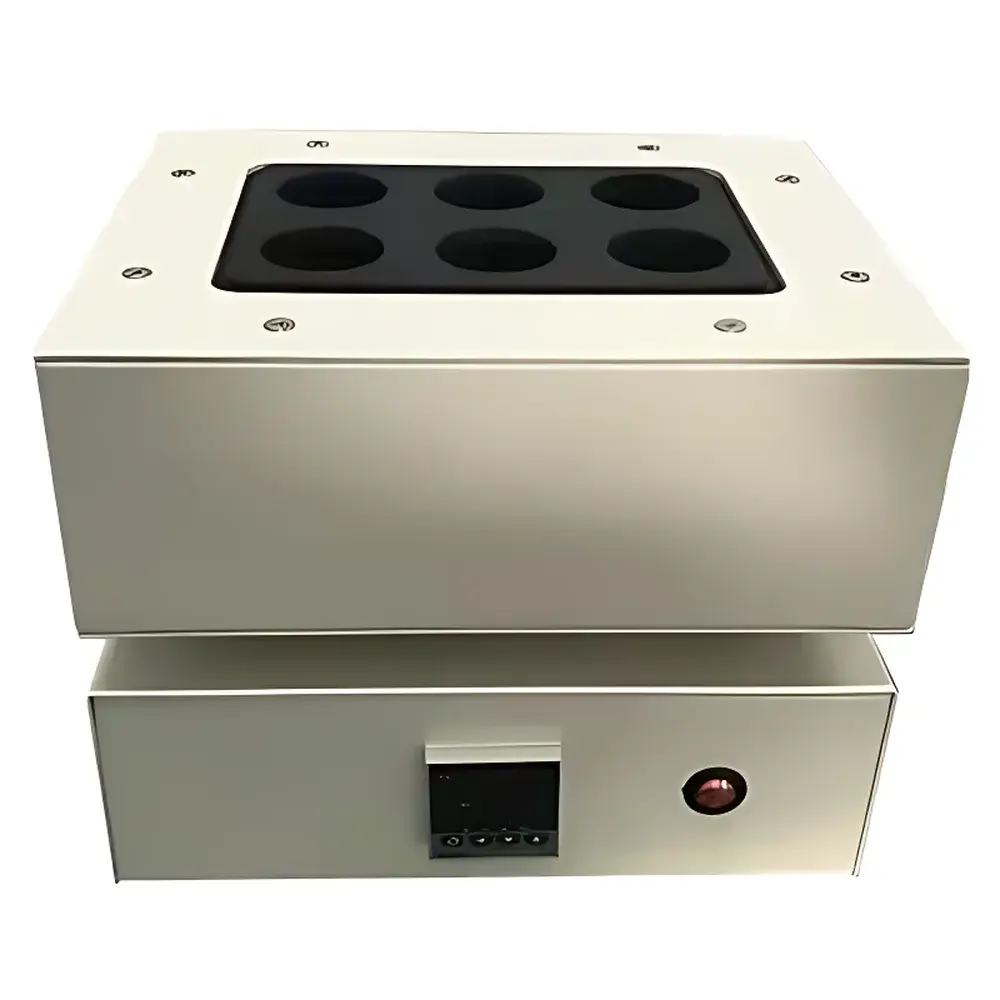
Beifen Sanpu CA-M Graphite Block Digestion System
| Brand | Beifen Sanpu |
|---|---|
| Model | CA-M |
| Origin | Beijing, China |
| Manufacturer | Beifen Sanpu Instrument Co., Ltd. |
| Heating Block Material | High-Purity Graphite |
| Temperature Range | Ambient to 350 °C (CA-M24/40/60) |
| Temperature Uniformity | ±0.1 °C |
| Heating Capacity | 24–60 sample positions (standard) |
| Block Hole Diameter | 32 mm (standard), 42 mm (glass-tube variants) |
| Hole Depth | 45–90 mm |
| Control System | PID-controlled microprocessor with digital timer and real-time overtemperature monitoring |
| Power Supply | AC 220 V / 50 Hz |
| Safety Protections | Overtemperature, overcurrent, and overvoltage cutoffs |
| Construction | Stainless steel chassis with corrosion-resistant internal components |
| Compatible Vessels | PTFE digestion tubes, borosilicate glass tubes, borosilicate quartz tubes (optional) |
Overview
The Beifen Sanpu CA-M Graphite Block Digestion System is an engineered solution for open-vessel wet digestion of solid and semi-solid samples prior to elemental analysis by techniques such as ICP-OES, ICP-MS, AAS, and IC. Unlike conventional hot plates or water baths—whose thermal heterogeneity compromises reproducibility—the CA-M employs a monolithic high-purity graphite heating block. Graphite’s exceptional thermal conductivity (≈120 W/m·K), low specific heat capacity, chemical inertness, and uniform volumetric heating enable rapid, spatially consistent temperature distribution across all digestion positions. This architecture eliminates cold spots and edge effects common in metal-sheathed heaters, directly improving digestion completeness, method robustness, and inter-batch repeatability. Designed for compliance-driven laboratories, the CA-M supports standardized digestion protocols including EPA Method 3050B, ISO 11466, ASTM D5762, and GB/T 5009 series, making it suitable for routine QA/QC workflows in environmental, food safety, agricultural, pharmaceutical, and geological testing labs.
Key Features
- High-purity graphite block with ≥99.9% carbon content, ensuring minimal trace metal background and long-term thermal stability under aggressive acid conditions (HNO₃, HCl, HF, H₂O₂, aqua regia)
- PID-controlled microprocessor with 0.1 °C setpoint resolution and real-time feedback loop; maintains temperature stability within ±0.1 °C across the entire block surface
- Multi-tier safety architecture: independent overtemperature cutoff (activated at 5 °C above setpoint), current-limiting circuitry, and voltage surge protection
- Corrosion-resistant construction: brushed 304 stainless steel housing, PTFE-coated internal cavity walls, and ceramic-insulated heating elements
- Dual-mode operation: programmable ramp-hold profiles (up to 9 segments) and fixed-temperature digestion modes
- Optimized hole geometry: standardized 32 mm bore (CA-M24/40/60) and enlarged 42 mm bore (CA-MG series) accommodate diverse vessel types while minimizing heat loss via convection
- Digital timer with audible and visual end-of-digestion alerts; auto-shutdown function preserves sample integrity during unattended operation
Sample Compatibility & Compliance
The CA-M accommodates a broad range of sample matrices—including soils, sediments, plant tissues, animal feed, food composites, pharmaceutical excipients, and geological digests—without requiring matrix-specific hardware modifications. Its design conforms to GLP and GMP documentation requirements: all temperature logs are timestamped, non-editable, and exportable in CSV format. The system supports audit-ready operation under FDA 21 CFR Part 11 when paired with validated LIMS integration (via RS-232 or optional USB-to-serial interface). All variants meet CE electromagnetic compatibility (EMC) Directive 2014/30/EU and Low Voltage Directive 2014/35/EU. Optional calibration certificates traceable to NIM (National Institute of Metrology, China) are available upon request.
Software & Data Management
While the CA-M operates as a standalone instrument, its embedded controller stores up to 100 user-defined methods with full parameter logging (set temperature, ramp rate, hold time, actual block temperature every 10 seconds). Data export is performed via USB flash drive or direct serial connection. For centralized lab management, optional Beifen Sanpu LabLink™ software (v3.2+) enables remote monitoring, batch report generation, electronic signature capture, and deviation flagging per USP and ISO/IEC 17025:2017 clause 7.7. All data files include cryptographic hash verification to ensure immutability during regulatory review.
Applications
- Environmental testing: heavy metal quantification (Pb, Cd, As, Cr, Ni, Zn) in contaminated soils per EPA SW-846 Method 3050B and ISO 11466
- Food and feed analysis: total arsenic, mercury, and cadmium determination in cereals, seafood, and dairy products per AOAC 999.10 and GB 5009.11–2023
- Agricultural research: nutrient element profiling (K, Ca, Mg, Fe, Mn, Cu, Zn) in plant tissue and fertilizer samples using USDA ARS protocol 127
- Pharmaceutical QC: residual catalyst metal screening (Pd, Pt, Rh) in active pharmaceutical ingredients (APIs) per ICH Q2(R2) guidelines
- Geochemical exploration: rare earth element (REE) and base metal recovery from rock powders and drill cores prior to ICP-MS analysis
FAQ
What vessel materials are compatible with the CA-M series?
PTFE (polytetrafluoroethylene), high-borosilicate glass (e.g., Schott Duran®), and fused quartz digestion tubes are supported. The CA-MG variants feature widened bores (42 mm) optimized for larger-diameter glassware.
Can the CA-M be used for hydrofluoric acid (HF) digestion?
Yes—provided PTFE or quartz vessels are used. The graphite block itself is resistant to HF, but stainless steel components are protected by PTFE coating; prolonged exposure to concentrated HF vapor requires optional quartz shielding kit.
Is temperature calibration traceable to national standards?
Factory calibration uses NIST-traceable RTD probes. Optional on-site calibration services include uncertainty budgets compliant with ISO/IEC 17025 and documentation aligned with ILAC-G8:2021.
How does the CA-M ensure uniform heating across all positions?
Through finite-element-optimized graphite block geometry, dual-zone power zoning, and real-time multi-point thermal mapping during manufacturing—verified by infrared thermography at 12 representative locations under load.
What maintenance is required for long-term reliability?
Annual inspection of thermal insulation integrity, verification of PID control loop response time (<2 s), and cleaning of vent channels with compressed air. No consumable parts require scheduled replacement within first 5 years of normal use.





