
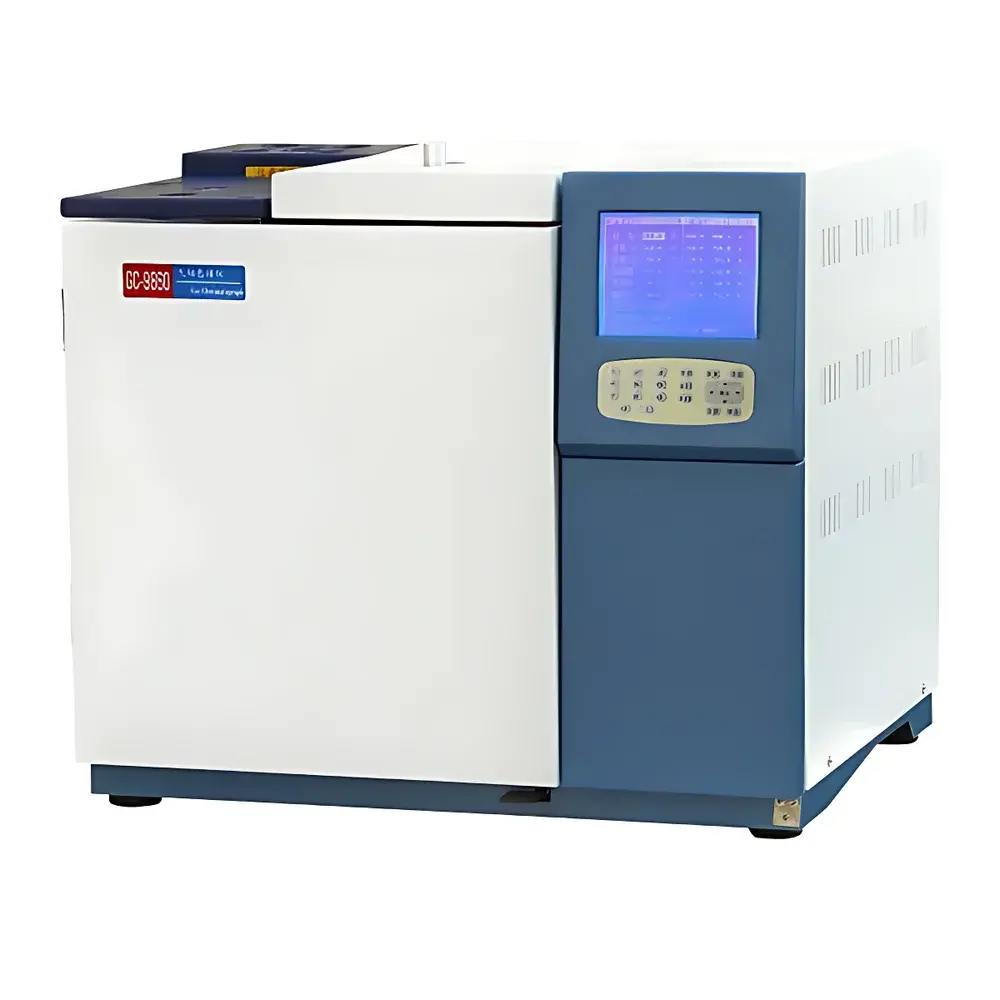
Beifen Sanpu GC-9860 Dedicated Gas Chromatograph for Fatty Acid and Residual Solvent Analysis
| [Brand | Beifen Sanpu |
|---|---|
| Origin | Beijing, China |
| Manufacturer Type | Direct Manufacturer |
| Instrument Type | Portable Gas Chromatograph |
| Model | GC-9860 |
| Temperature Control Range | 100–350 °C |
| Oven Ramp Rate | 0.1–40 °C/min |
| Cool-down Time (350→100 °C) | ~6 min |
| Carrier Gas Flow Range & Control | 0–1200 mL/min |
| Carrier Gas Pressure Range & Control | 0–970 kPa |
| Injector Maximum Operating Temperature | 100–350 °C |
| Injector Pressure Setting Range | 0–970 kPa |
| Injector Total Flow Setting Range | 0–1000 mL/min] |
Overview
The Beifen Sanpu GC-9860 Dedicated Gas Chromatograph is a purpose-engineered analytical platform optimized for the quantitative determination of fatty acid profiles—expressed as fatty acid methyl esters (FAMEs)—and residual solvents in edible oils and lipid-based matrices. It operates on the fundamental principle of capillary gas chromatography with flame ionization detection (GC-FID), enabling high-resolution separation and reproducible quantification of volatile and semi-volatile compounds across complex lipid samples. Unlike general-purpose GC systems, the GC-9860 integrates thermally stable injector architecture, precision oven temperature programming, and robust carrier gas control specifically calibrated for derivatized fatty acid analysis. Its design accommodates standardized sample preparation protocols per ISO 5508, AOAC 996.06, and GB/T 17376–2008, ensuring compatibility with routine laboratory workflows in food quality control, edible oil authentication, and nutritional labeling compliance.
Key Features
- Thermally stable split/splitless injector with programmable pressure and flow control (0–970 kPa; 0–1000 mL/min), supporting precise injection of derivatized FAME solutions.
- High-precision column oven with extended operating range (100–350 °C) and rapid ramp capability (0.1–40 °C/min), enabling efficient resolution of C8–C24 methyl ester homologues within a single run.
- Optimized cool-down performance: achieves 350 °C → 100 °C in approximately 6 minutes, minimizing turnaround time between sequential analyses.
- Integrated carrier gas management system with digital mass flow controllers for nitrogen, hydrogen, and air—ensuring consistent retention time stability and method transferability.
- Modular hardware architecture compatible with optional FID, TCD, or ECD detectors; factory-configured for FID-based fatty acid quantification.
- Compact, benchtop-portable form factor (W × D × H: 540 × 480 × 500 mm) designed for space-constrained QC labs and mobile testing units.
Sample Compatibility & Compliance
The GC-9860 supports analysis of all major edible oils—including bovine tallow, soybean oil, sunflower oil, olive oil, walnut oil, and almond oil—following standardized transesterification to FAMEs using alkaline-catalyzed methanolysis (e.g., KOH/MeOH or NaOH/MeOH). It complies with internationally recognized methodologies: ISO 5508 (animal and vegetable fats and oils — preparation of methyl esters of fatty acids), ISO 5509 (handling of test samples), and AOAC Official Method 996.06 (fatty acid composition by capillary GC). The system meets essential requirements for GLP-compliant environments, including stable baseline performance, retention time repeatability (<0.02 min RSD), and detector linearity over three orders of magnitude (0.1–100 µg/µL FAME standard). All hardware components are CE-marked and conform to IEC 61010-1 safety standards for laboratory electrical equipment.
Software & Data Management
The instrument is operated via N2000 Chromatographic Workstation software—a validated, Windows-based acquisition and processing platform supporting multi-channel signal handling, peak integration with customizable baselines, calibration curve generation (linear, quadratic, or polynomial), and automated report export in PDF, CSV, and XML formats. The software includes audit trail functionality compliant with FDA 21 CFR Part 11 requirements when deployed on secured networked workstations with user role management (administrator, analyst, reviewer). Raw data files (.DAT) are stored with embedded method parameters, instrument conditions, and operator metadata, facilitating traceability during regulatory inspections or internal QA audits. Integration with LIMS is supported via ODBC drivers and ASCII file exchange protocols.
Applications
- Quantitative profiling of saturated (palmitic, stearic), monounsaturated (oleic), and polyunsaturated (linoleic, α-linolenic) fatty acids in refined and virgin oils.
- Detection and quantification of residual solvents (e.g., hexane, petroleum ether, ethanol) from extraction or refining processes per EU Regulation (EC) No 152/2009.
- Authentication of oil blends and detection of adulteration through fatty acid ratio fingerprinting (e.g., oleic/linoleic, palmitic/stearic).
- Support for nutritional labeling compliance under FDA 21 CFR §101.9 and EU Regulation (EU) No 1169/2011.
- Routine QC in edible oil refineries, third-party testing laboratories, and national food safety agencies.
FAQ
What derivatization protocol is recommended for solid fat samples such as beef tallow?
For solid animal fats, a sulfuric acid-catalyzed methylation protocol is advised: dissolve ~0.1 g sample in anhydrous methanol, add concentrated H₂SO₄ (5–8 drops), heat at 70 °C for 10 min, then extract with hexane after aqueous quenching.
Is the GC-9860 compatible with ASTM D6584 or EN 14103 methods?
Yes—the system’s temperature programming accuracy, FID sensitivity, and column specifications (e.g., 30 m × 0.32 mm i.d. wax-phase capillary) meet the instrumental requirements defined in both ASTM D6584 (biodiesel FAME content) and EN 14103 (fatty acid methyl ester determination in biodiesel).
Can the instrument be used without external gas cylinders?
Yes—when paired with the BF-300E hydrogen generator and BF-2L zero-air generator (included in standard configuration), the system operates fully cylinder-free with <0.1 ppm hydrocarbon impurity specification.
What is the typical analysis time for a full FAME profile using the supplied column?
Under standard temperature programming (170 °C hold 1 min, 2 °C/min to 220 °C, hold 15 min), total run time is approximately 45–50 minutes, including post-run oven cooldown.
Does the N2000 software support electronic signature and 21 CFR Part 11 compliance?
Yes—when installed on a domain-controlled Windows environment with password-protected user accounts and enabled audit logging, N2000 satisfies core technical controls for electronic records and signatures as outlined in 21 CFR Part 11 Subpart B.




