
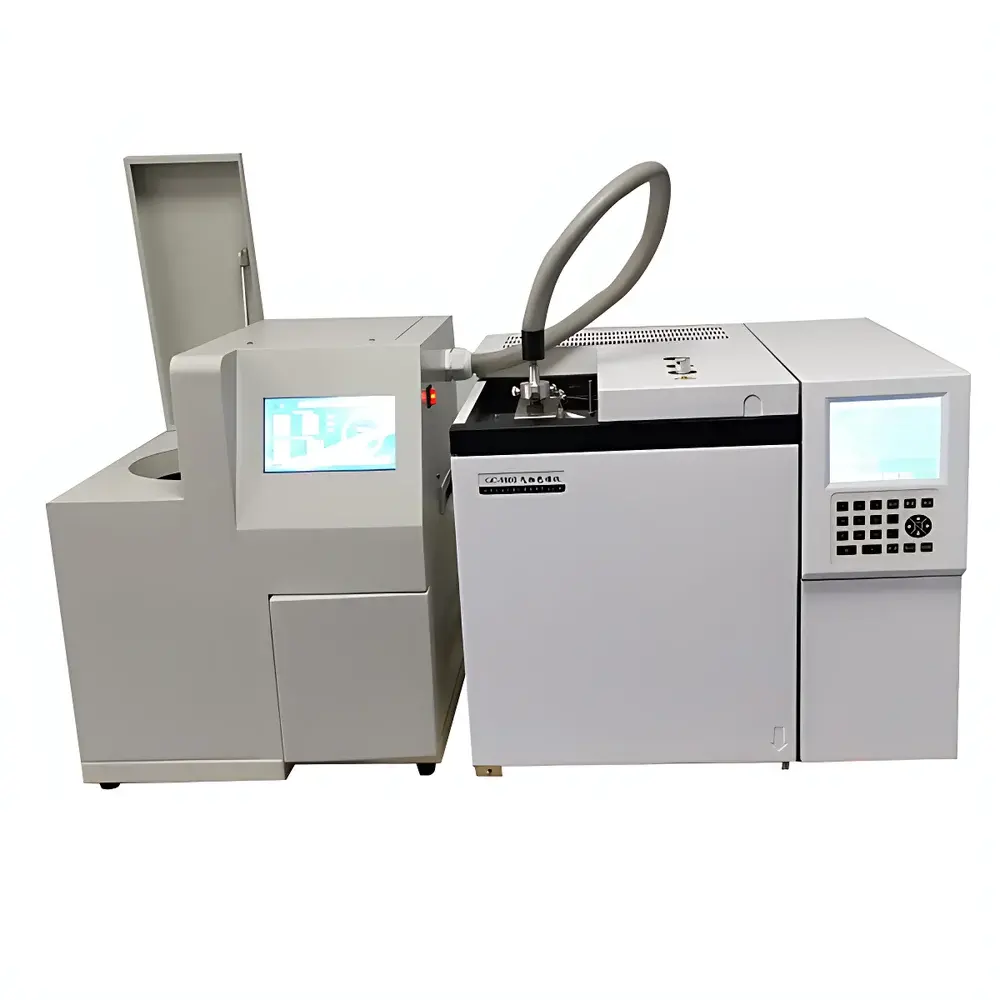
Beifen Sanpu AH9S-20A Plus Fully Automated Static Headspace Sampler
| Brand | Beifen Sanpu |
|---|---|
| Origin | Beijing, China |
| Manufacturer Type | Manufacturer |
| Region of Origin | Domestic (China) |
| Model | AH9S-20A Plus |
| Instrument Type | Static Headspace Sampler |
| Automation Level | Fully Automatic |
| Vial Heating Range | Ambient to 200 °C (1 °C increments) |
| Valve Temperature Control Range | 40–220 °C (±1 °C accuracy) |
| Sample Loop Volume | 1 mL |
| Sample Capacity | 20 positions |
| Vial Compatibility | 10 mL or 20 mL headspace vials |
Overview
The Beifen Sanpu AH9S-20A Plus is a fully automated static headspace sampler engineered for precise, reproducible quantification of residual ethylene oxide (EO) in sterilized medical devices and pharmaceutical packaging. It operates on the principle of equilibrium headspace gas-phase extraction: solid or liquid samples are sealed in heated vials, allowing volatile EO to partition into the headspace above the matrix; a precisely metered volume of this equilibrated vapor is then transferred via a thermostated sampling valve and loop into a gas chromatograph (GC) for separation and detection. This method complies with the fundamental thermodynamic requirements of ISO 10993-7:2008 and GB/T 16886.7–2015, which mandate static headspace–GC as the reference analytical procedure for EO residue testing in biological evaluation of medical devices. The system’s robust architecture ensures minimal carryover, high thermal stability across all critical zones (vial oven, transfer line, and valve), and consistent phase-equilibrium conditions—essential for achieving the sub-µg/g sensitivity required by regulatory thresholds (e.g., ≤10 µg/g for most Class III devices per ISO 10993-7).
Key Features
- Fully automated 20-position sample carousel with programmable sequence control and barcode reader compatibility for audit-ready sample tracking
- Independent dual-zone temperature control: vial oven (ambient to 200 °C, ±0.5 °C uniformity) and sampling valve/loop (40–220 °C, ±1 °C precision), minimizing condensation and adsorption losses
- 1 mL fixed-volume quantitative loop with inert SilcoNert®-treated stainless-steel construction to prevent EO degradation or surface binding
- Integrated pressure-balanced vial pressurization using carrier gas (N₂ or He) to ensure accurate, pulse-free sample transfer
- Self-diagnostic firmware with real-time monitoring of vial seal integrity, oven temperature ramp profiles, and valve actuation cycles
- Compliance-ready design supporting 21 CFR Part 11–compliant electronic signatures, audit trails, and user-access level management when paired with validated GC data systems
Sample Compatibility & Compliance
The AH9S-20A Plus accommodates standard 10 mL and 20 mL crimp-top headspace vials, compatible with aqueous extraction protocols specified in GB/T 16886.7–2015 and USP . It supports direct analysis of polymer-based medical device components—including polyethylene, polypropylene, PVC, and silicone elastomers—as well as lyophilized drug product stoppers and Tyvek® packaging. Method validation parameters—including linearity (R² ≥ 0.999 over 0.5–50 µg/mL EO), LOD (≤0.05 µg/g), LOQ (≤0.15 µg/g), and inter-day precision (RSD < 3.5%)—meet ICH Q2(R2) guidelines. The system is routinely deployed in GLP-compliant laboratories conducting biocompatibility studies under ISO 10993-1 and FDA Premarket Notification (510(k)) submissions. Its operational envelope satisfies the thermal stability requirements for EO hydrolysis kinetics modeling during post-sterilization aging studies.
Software & Data Management
Controlled via Beifen Sanpu’s HS-Link™ software (Windows 10/11 compatible), the AH9S-20A Plus enables method-driven workflow automation—from vial heating ramping and equilibration timing to loop fill/flush cycles and GC trigger synchronization. All acquisition parameters, calibration logs, and run metadata are timestamped and stored in encrypted SQLite databases. Audit trail functionality records operator ID, parameter changes, and instrument status events with immutable timestamps, fulfilling ALCOA+ (Attributable, Legible, Contemporaneous, Original, Accurate, Complete, Consistent, Enduring, Available) data integrity principles. Export options include CSV, PDF analytical reports, and direct integration with Agilent OpenLab CDS, Thermo Chromeleon, or Shimadzu GC Solutions via ASCII command protocol.
Applications
- Quantitative determination of EO residuals in single-use surgical gowns, face masks, catheters, and syringe components following ISO 10993-7 and GB/T 14233.1–2008
- Stability-indicating analysis of EO degradation products (e.g., ethylene glycol, diethylene glycol) during accelerated aging per ISO 11607-1
- Verification of EO desorption kinetics in porous packaging materials under controlled humidity and temperature gradients
- Supporting GMP manufacturing release testing for Class II and III medical devices subject to MDR 2017/745 Annex I, Chapter II, Section 10.2
- Method transfer between QC labs and contract testing organizations (CTOs) due to standardized hardware configuration and firmware version control
FAQ
What is the minimum detectable EO concentration achievable with this system when coupled to a standard FID-GC?
Typical method-level LODs range from 0.03–0.07 µg/g in solid matrices, depending on sample mass, extraction volume, and GC column efficiency. Validation must be performed per ISO/IEC 17025:2017 Clause 7.2.2.
Can the AH9S-20A Plus be used for dynamic headspace (purge-and-trap) applications?
No—it is designed exclusively for static headspace analysis. Dynamic headspace requires separate instrumentation with gas flow control, trapping cryo-cooling, and thermal desorption units.
Does the system support custom vial sizes beyond 10 mL and 20 mL?
Only standard 10 mL and 20 mL crimp-top vials with 18 mm or 20 mm closures are mechanically supported. Adapters for non-standard formats are not available.
How is carryover mitigated during high-concentration EO analysis?
The system employs a three-stage cleaning protocol: high-temperature valve bake-out (220 °C), inert gas purge of the loop and transfer line, and blank vial conditioning prior to each sequence—validated per USP system suitability criteria.
Is firmware update capability included, and how is cybersecurity managed?
Firmware updates are delivered via secure USB media with SHA-256 checksum verification. Network connectivity is disabled by default; optional Ethernet port requires segregated lab network deployment per ISO/IEC 27001 controls.




