
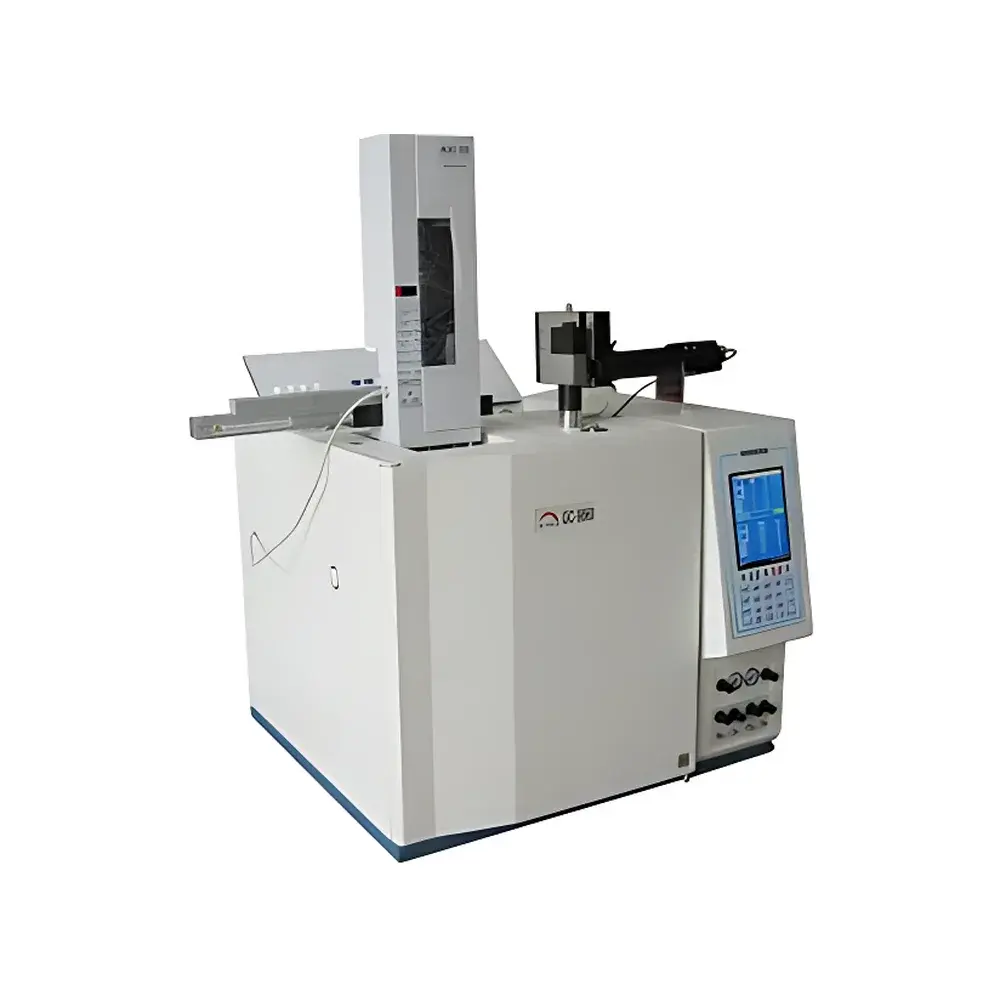
Beifen Sanpu HPGC-9860 Transformer Oil Dissolved Gas Analysis (DGA) Gas Chromatograph
| Brand | Beifen Sanpu |
|---|---|
| Model | HPGC-9860 |
| Type | Laboratory Gas Chromatograph |
| Origin | Hebei, China |
| Manufacturer | Beifen Sanpu Instrument Co., Ltd. |
| Compliance | GB/T 17623–1993, GB/T 7252–2001, DL/T 722–2000 |
| Detection Limits (per 1 mL oil sample) | H₂: 2 µL/L, CO: 2 µL/L, CO₂: 20 µL/L, CH₄: 0.2 µL/L, C₂H₂: 0.1 µL/L, C₂H₄: 0.1 µL/L, C₂H₆: 0.1 µL/L |
| Repeatability | Qualitative ≤1%, Quantitative ≤3% |
| Configuration | Dual-column, triple-detector (TCD/FID) flow path |
| Control | Fully networked workstation with remote bidirectional control (temperature, ignition, bridge current, carrier gas flow) |
| Optional | Electronic Flow Controller (EFC), Electronic Pressure Controller (EPC) |
Overview
The Beifen Sanpu HPGC-9860 is a purpose-built laboratory gas chromatograph engineered for dissolved gas analysis (DGA) in transformer insulating oil—critical for predictive maintenance and condition-based monitoring of power transformers. It implements the internationally recognized dual-column, triple-detector configuration (typically TCD for H₂/CO/CO₂ and FID for hydrocarbons), enabling simultaneous, fully automated quantification of seven key fault gases—H₂, CO, CO₂, CH₄, C₂H₂, C₂H₄, and C₂H₆—in a single 1 mL oil injection. This architecture ensures compliance with IEC 60567 guidance principles and aligns with the analytical rigor required by utility asset management frameworks. The system operates on the fundamental principle of partition equilibrium: dissolved gases are extracted from oil via headspace equilibration or vacuum extraction, then separated in capillary or packed columns based on volatility and polarity, and detected with high sensitivity and selectivity. Its design prioritizes long-term stability under unattended operation, making it suitable for integration into substation-level monitoring networks or centralized lab environments.
Key Features
- Dual-column, triple-detector flow path optimized for DGA specificity and resolution—eliminates manual re-injection and reduces analysis cycle time to <15 minutes per sample.
- Integrated 7-inch full-color TFT touchscreen with bilingual (English/Chinese) firmware and hot-swappable keyboard interface—supports operator flexibility without firmware reflash.
- Self-diagnostic firmware with real-time hardware status logging, automatic parameter retention after power interruption, and non-volatile memory for method files and calibration curves.
- Network-enabled architecture supporting TCP/IP, CAN bus, Modbus RTU/TCP, and optional GPRS/3G modules—enables secure, encrypted data transmission to SCADA, ERP, or cloud-based asset health platforms.
- Remote bidirectional control capability: users can adjust oven/isothermal zone temperatures, initiate FID ignition sequences, modulate bridge current (TCD), and regulate carrier gas flow (via optional EFC/EPC modules) from offsite workstations.
- Modular detector and column compartment design facilitates field upgrades and minimizes downtime during preventive maintenance or detector replacement.
Sample Compatibility & Compliance
The HPGC-9860 is validated for use with mineral oil, silicone-based insulating fluids, and ester-based biodegradable oils per ASTM D3612 Class B (headspace extraction) and ISO 10478 Annex A protocols. Sample introduction supports both manual syringe injection and automated liquid-phase sampling via optional autosampler (e.g., CTC PAL or equivalent). All quantitative results adhere to traceability requirements defined in ISO/IEC 17025:2017 for testing laboratories. The instrument satisfies mandatory regulatory benchmarks for electric utility applications—including GB/T 17623–1993 (Chinese national standard for DGA methodology), GB/T 7252–2001 (interpretation guidelines for fault diagnosis), and DL/T 722–2000 (power industry technical specification). Data integrity is maintained through audit-trail-enabled software compliant with FDA 21 CFR Part 11 (electronic records/signatures) when configured with user-access controls and electronic signature modules.
Software & Data Management
The bundled “Networked Transformer Oil Gas Analysis Workstation” is a Windows-based application built on .NET Framework 4.8, supporting concurrent control of up to 16 HPGC-9860 units on a single LAN segment. It provides method development tools with customizable integration parameters (peak width, baseline drift correction, retention time locking), automated calibration curve generation (linear, quadratic, or multi-point weighted regression), and Roessler/Duval triangle & Rogers ratio diagnostics integrated directly into report templates. Raw data (.CDF) and processed reports (PDF, Excel, XML) are stored in a relational SQL Server database with configurable retention policies. Export options include SFTP, HTTPS REST API endpoints, OPC UA server integration, and direct MODBUS TCP mapping for PLC interoperability. Audit logs record all user actions—including method edits, calibration events, and remote control commands—with timestamps and operator IDs.
Applications
- Early detection of thermal faults (e.g., >700°C overheating indicated by C₂H₂ presence) and partial discharge activity (elevated H₂ and CH₄).
- Trending dissolved gas concentrations over time to assess insulation degradation kinetics and estimate remaining useful life (RUL) of transformer assets.
- Verification of oil reclamation effectiveness post-filtration or vacuum dehydration processes.
- Commissioning acceptance testing for new or refurbished transformers per IEEE C57.104–2019 standards.
- Supporting forensic failure analysis in conjunction with dissolved metal analysis (ICP-OES) and furanic compound profiling (HPLC).
- Integration into digital twin models for grid asset performance simulation and risk-based maintenance scheduling.
FAQ
Does the HPGC-9860 support ASTM D3612-compliant headspace extraction?
Yes—the system is validated for Class B headspace analysis using standard 10 mL or 20 mL vials with crimp-seal septa; compatible with commercial headspace samplers (e.g., PerkinElmer TurboMatrix, Thermo TriPlus).
Can the instrument be operated without local personnel present?
Yes—fully enabled for unattended 24/7 operation with scheduled auto-calibration, email/SMS alerts on fault conditions, and remote recovery via secure VPN or cellular gateway.
Is EPC/EFC hardware required for GLP/GMP compliance?
While not mandatory, electronic pressure/flow control is strongly recommended for audit readiness—it provides digitally logged, tamper-evident gas parameter records essential for 21 CFR Part 11 and ISO 17025 accreditation.
What data security protocols are implemented in the networked workstation?
TLS 1.2+ encryption for all client-server communications, role-based access control (RBAC) with LDAP/Active Directory integration, and optional FIPS 140-2 validated cryptographic modules.
How frequently must the system be calibrated for routine DGA monitoring?
Initial calibration requires 6-point multi-gas standard; subsequent verification is performed daily using a single-point check standard—full recalibration recommended every 30 days or after column change/maintenance.







