
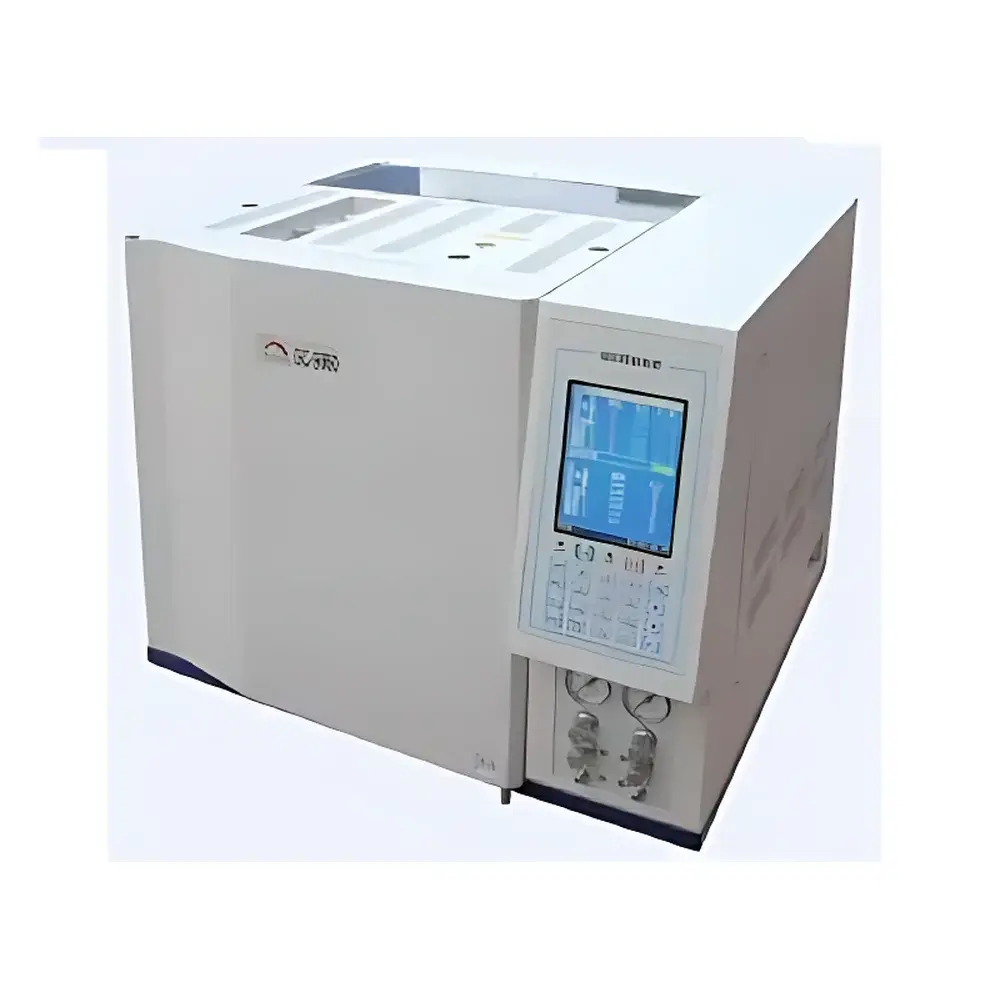
Beifen Sanpu GC-9860Ⅲ Network-Enabled Gas Chromatograph
| Brand | Beifen Sanpu |
|---|---|
| Origin | Beijing, China |
| Manufacturer Type | Direct Manufacturer |
| Model | GC-9860Ⅲ |
| Temperature Control Range | 8 °C above ambient to 450 °C |
| Oven Ramp Rate | 0.1–80 °C/min |
| Cool-down Time | ~7 min (450 °C → 50 °C) |
| Carrier Gas Flow Range & Control | 0–500 mL/min |
| Carrier Gas Pressure Control | 8 pressure steps |
| Injector Max Operating Temperature | 450 °C |
| Injector Pressure Setting Range | 0–970 kPa |
| Injector Total Flow Setting Range | 0–100 mL/min |
| Temperature Zones | 6 independent zones |
| Programmable Temperature Ramps | 16 stages |
| EPC/EFC Modes | Constant Flow, Constant Pressure, Split Flow |
| Supported Gases | N₂, H₂, Air, He, Ar |
| EPC/EFC Ramp Stages | 4 |
| Detector Options | FID, TCD, ECD (⁶³Ni), FPD, NPD |
| FID Detection Limit | ≤3×10⁻¹² g/s (n-hexadecane) |
| TCD Sensitivity | ≥4000 mV·mL/mg (n-hexadecane) |
| ECD Detection Limit | ≤1×10⁻¹⁴ g/s |
| Communication Interface | IEEE 802.3 Ethernet |
Overview
The Beifen Sanpu GC-9860Ⅲ Network-Enabled Gas Chromatograph is a benchtop analytical instrument engineered for precision separation, identification, and quantification of volatile and semi-volatile organic compounds in complex matrices. Based on the fundamental principle of differential partitioning between a mobile phase (inert carrier gas) and a stationary phase (capillary or packed column), the GC-9860Ⅲ delivers high-resolution chromatographic performance across diverse application domains—from environmental monitoring and petrochemical QA/QC to food safety and pharmaceutical residual solvent analysis. Its modular architecture supports up to three independently configurable detectors (FID, TCD, ECD, FPD, or NPD), enabling simultaneous multi-analyte detection with orthogonal selectivity. The system integrates embedded Ethernet connectivity (IEEE 802.3 compliant), allowing remote instrument control, real-time status monitoring, method deployment, and data acquisition from centralized laboratory information management systems (LIMS) or enterprise networks—fully supporting unattended operation in distributed lab environments.
Key Features
- 6-zone independent temperature control with ±0.1 °C stability and 1 °C increment resolution, covering 8 °C above ambient to 450 °C
- High-speed programmable oven ramping (0.1–80 °C/min) with 16-stage temperature programming and 4-stage EPC/EFC ramp capability
- Advanced Electronic Pressure and Flow Control (EPC/EFC) supporting constant-flow, constant-pressure, and split-flow modes across five carrier gases (N₂, H₂, He, Ar, air)
- 5.7-inch color LCD interface with optional touch functionality; intuitive method setup, real-time chromatogram display, and event logging
- Four auxiliary digital I/O channels for external device synchronization (e.g., autosamplers, purge-and-trap units, or thermal desorption systems)
- Modular detector bay accommodating up to three concurrently operational detectors—including FID (detection limit ≤3×10⁻¹² g/s), TCD (≥4000 mV·mL/mg), ECD (⁶³Ni source, ≤1×10⁻¹⁴ g/s), FPD, and NPD
- Comprehensive injection flexibility: split/splitless capillary, packed-column, gas sampling via 6-port valve, and compatibility with automated headspace and thermal desorption modules
Sample Compatibility & Compliance
The GC-9860Ⅲ is validated for routine analysis of regulated analytes per widely adopted international standards, including ASTM D3606 (benzene/toluene in gasoline), EPA Method 8021B (halogenated hydrocarbons), USP (residual solvents), and ISO 11843-3 (detection capability assessment). Its hardware design meets IEC 61010-1 safety requirements for laboratory electrical equipment. All detector signal outputs are digitized at ≥24-bit resolution with linear dynamic ranges exceeding 10⁶ (FID), 10⁴ (ECD), and 10⁵ (FPD-P), ensuring trace-level quantitation integrity. The system supports audit-trail-enabled method storage and execution—aligning with GLP and GMP documentation practices where electronic records must satisfy FDA 21 CFR Part 11 criteria for authenticity, confidentiality, and retrievability.
Software & Data Management
Control and data processing are managed via Beifen Sanpu’s GC Navigator™ software suite, compatible with Windows 10/11 (64-bit). The software provides full bidirectional communication over standard TCP/IP, enabling remote configuration of temperature gradients, detector parameters, EPC setpoints, and valve timing sequences. Raw data files adhere to ANDI/NetCDF format for cross-platform compatibility with third-party processing tools (e.g., OpenLab CDS, Chromeleon, Simplicity). Integrated peak integration algorithms support baseline correction, retention time locking, and internal standard normalization. All user actions—including method edits, sequence starts, and calibration updates—are timestamped and logged with operator ID, fulfilling ALCOA+ (Attributable, Legible, Contemporaneous, Original, Accurate, Complete, Consistent, Enduring, Available) data integrity principles.
Applications
- Environmental: Analysis of BTEX, PAHs, chlorinated pesticides, and VOCs in soil, water, and ambient air samples
- Petrochemical: Hydrocarbon type analysis (PIONA), simulated distillation (ASTM D2887), and refinery gas composition profiling
- Pharmaceutical: Residual solvent testing (ICH Q3C), extractables/leachables screening, and stability-indicating assays
- Food & Flavor: Fatty acid methyl ester (FAME) profiling, aroma compound fingerprinting, and adulteration detection
- Forensics & Toxicology: Volatile substance identification in blood, urine, or post-mortem specimens per SWGTOX guidelines
FAQ
Does the GC-9860Ⅲ support 21 CFR Part 11-compliant electronic signatures and audit trails?
Yes—the GC Navigator™ software implements role-based access control, electronic signature capture, and immutable audit logs for all critical operations, meeting core technical requirements of FDA 21 CFR Part 11.
Can the instrument be integrated into an existing LIMS environment?
Absolutely. Native Ethernet connectivity enables seamless integration via standard protocols (e.g., HL7, ASTM E1384, or custom API endpoints) for automated result transfer and sample tracking.
What is the maximum operating temperature for the TCD cell?
The TCD operates stably up to 400 °C, with filament current regulation optimized for long-term baseline stability and low noise performance.
Is helium-free operation supported?
Yes—EPC/EFC firmware fully supports hydrogen and nitrogen as alternative carrier gases, including optimized linear velocity calculations and retention time prediction algorithms.
How many methods can be stored onboard the instrument?
The embedded controller retains up to 100 user-defined methods with full parameter sets, including temperature programs, detector configurations, and valve event tables.
Related Products





