
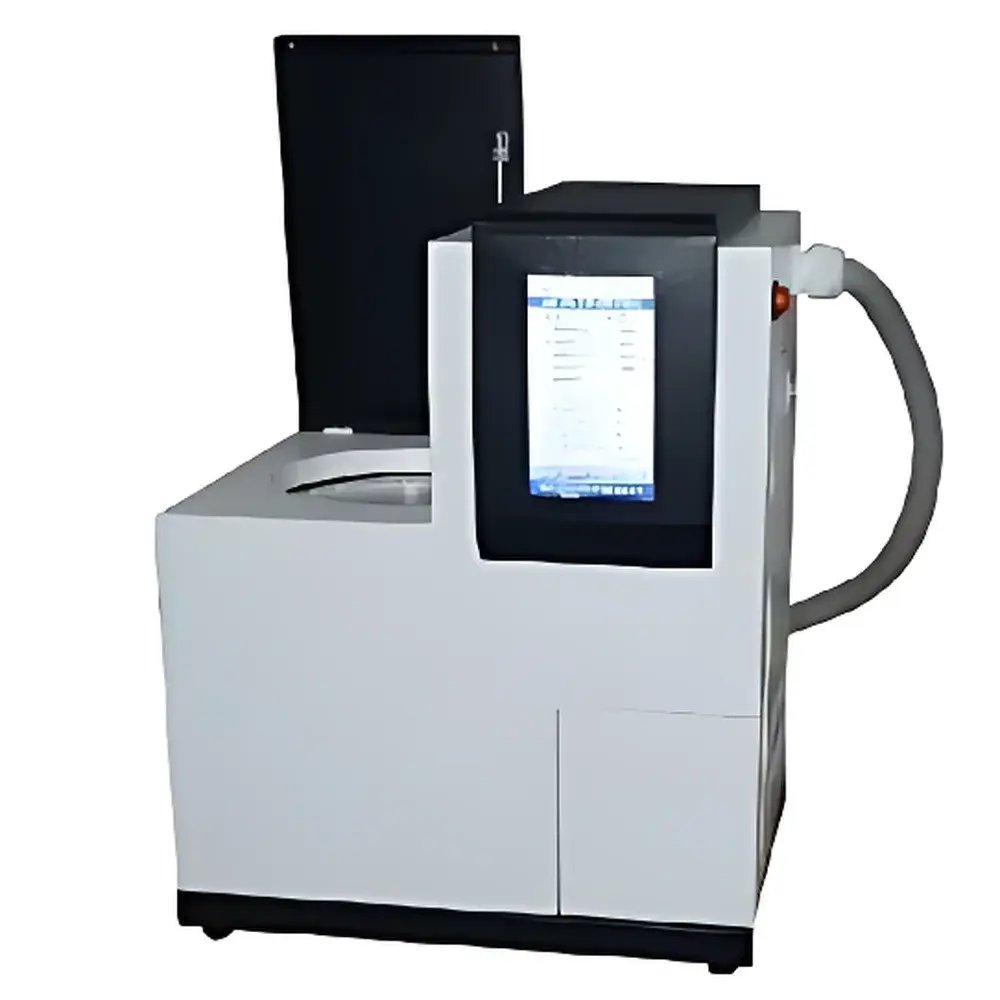
Beifen Sanpu ATDS-20A Dual-Stage Automated Thermal Desorber with Cryogenic Trap
| [Brand | Beifen Sanpu |
|---|---|
| Origin | Beijing, China |
| Manufacturer Type | OEM Manufacturer |
| Instrument Type | Dual-Stage Thermal Desorber |
| Sample Capacity | 20 positions |
| Primary Heating Zone Temp Range | Ambient to 450 °C (1 °C increments) |
| Secondary Desorption Zone Temp Range | Ambient to 450 °C (1 °C increments) |
| Cryogenic Trap Temp Range | −35 °C to ambient (electronic cooling) |
| Temperature Accuracy | ±0.5 °C |
| Desorption Recovery Rate | >99% (compound-dependent) |
| Relative Standard Deviation (RSD) | ≤2.5% (benzene at 0.05 μg) |
| Transfer Line & Valve Temp Control | Ambient to 300 °C |
| Re-focusing Time | 0–60 min |
| Injection Time | 0–60 min |
| Purge/Backflush Flow | 0–100 mL/min (adjustable) |
| Simulated Sampling Flow | 0–160 mL/min |
| Sample Tube Format | 1/4″ OD × 3.5″ (ASTM D6196-compliant) |
| Interface | Motor-driven 6-port valve |
| Dimensions (L×W×H) | 350 × 450 × 510 mm |
| Weight | ~40 kg] |
Overview
The Beifen Sanpu ATDS-20A Dual-Stage Automated Thermal Desorber with Cryogenic Trap is a laboratory-grade, fully automated sample introduction system engineered for trace-level volatile organic compound (VOC) and semi-volatile organic compound (SVOC) analysis via thermal desorption–gas chromatography (TD–GC) or thermal desorption–gas chromatography–mass spectrometry (TD–GC–MS). It implements a two-stage desorption process: primary thermal desorption releases analytes from sorbent tubes under controlled inert gas flow; analytes are then refocused onto a cryogenically cooled trap (−35 °C minimum) prior to rapid secondary desorption into the GC inlet. This dual-stage architecture—combined with precise temperature ramping (>3000 °C/min), low-thermal-mass transfer lines, and electronic refrigeration—ensures high analyte recovery, narrow band focusing, and reproducible peak shape essential for regulatory compliance in environmental, indoor air, and industrial hygiene testing.
Key Features
- Fully automated 20-position sample carousel with unattended operation and integrated self-diagnostic startup sequence
- Four independently programmable temperature zones: primary desorption oven, secondary desorption chamber, transfer line, and six-port valve—all controllable in 1 °C increments (ambient to 450 °C for ovens; ambient to 300 °C for valve and line)
- Cryogenic cold trap with electronic cooling (−35 °C to ambient), eliminating reliance on liquid nitrogen or mechanical compressors
- Motor-driven 6-port switching valve enabling precise timing of desorption, backflush, and injection events
- Programmable re-focusing time (0–60 min), injection duration (0–60 min), and adjustable purge/backflush flow (0–100 mL/min)
- Integrated simulated sampling mode with flow control (0–160 mL/min) for calibration curve generation directly on the instrument
- Automated tube activation protocol to thermally condition used sorbent tubes post-analysis
- Low-voltage (24 V DC) heating for transfer line, enhancing electrical safety and thermal stability
- Modular configuration support: field-upgradable to ambient-temperature or cryogenic secondary desorption modes
- GC synchronization capability—supports hardware trigger output and external software initiation (e.g., via Chromeleon, OpenLab, or Empower)
Sample Compatibility & Compliance
The ATDS-20A accepts standard 1/4″ OD × 3.5″ stainless steel or quartz sorbent tubes compliant with ASTM D6196, ISO 16017-1, and US EPA TO-17 specifications. Its design supports multi-bed sorbents (e.g., Tenax TA, Carbopack B/C, Carboxen 1000) and accommodates reactive analytes via optional fused-silica transfer tubing. The system meets performance criteria defined in key regulatory methods including HJ 644–2013 (ambient air VOCs), HJ 583–2010 (benzene series), HJ 734–2014 (stationary source emissions), GB/T 18883–2002 (indoor air quality), and GB 50325–2020 (civil construction pollution control). Temperature accuracy (±0.5 °C), RSD ≤2.5% (benzene), and >99% desorption recovery satisfy GLP and ISO/IEC 17025 method validation requirements. Data integrity is supported through audit-trail-capable method logging and time-stamped event records.
Software & Data Management
Operation is managed via an embedded 7-inch capacitive touchscreen interface running a real-time Linux-based controller. Method parameters—including temperature ramps, timing sequences, valve actuation points, and flow profiles—are configured using a graphical workflow editor with drag-and-drop logic blocks. All methods and run logs are stored internally with timestamped metadata (operator ID, instrument serial number, calibration status). Raw event data (e.g., heater power, valve position, temperature setpoints vs. actuals) are exportable in CSV format for external QA/QC review. The system supports 21 CFR Part 11–compliant user access levels (administrator, analyst, viewer) when integrated with validated LIMS or chromatography data systems. Firmware updates are performed via USB or Ethernet without requiring factory service.
Applications
- Regulatory monitoring of ambient and indoor air VOCs (e.g., benzene, toluene, xylenes, formaldehyde precursors) per HJ 644–2013 and GB/T 18883–2002
- VOC emission profiling from building materials, automotive interiors, and consumer products (HJ/T 400–2007)
- Fixed-source stack testing for aromatic and chlorinated hydrocarbons (HJ 734–2014)
- Occupational hygiene assessment in manufacturing and pharmaceutical cleanrooms
- Method development and validation for trace-level SVOC analysis (e.g., PAHs, phthalates) requiring cryofocusing
- Reference material certification and interlaboratory comparison studies requiring high inter-run reproducibility
FAQ
What distinguishes dual-stage thermal desorption from single-stage systems?
Double-stage desorption incorporates a cryogenic trap to refocus volatilized analytes before final injection, yielding sharper peaks, lower detection limits, and improved resolution of early-eluting compounds—particularly critical for complex environmental matrices.
Is the ATDS-20A compatible with Agilent, Thermo, and Shimadzu GC/MS platforms?
Yes. It features universal hardware triggering (TTL), analog signal outputs, and configurable GC start delays. Dedicated mechanical adapters are available for all major inlet types (split/splitless, PTV, direct capillary).
Can the cold trap operate continuously across multiple runs without maintenance?
The solid-state Peltier cooler enables uninterrupted operation for ≥20 consecutive samples. No consumables, coolant refills, or vacuum pumps are required—only routine sorbent tube replacement and annual temperature sensor verification.
How is method traceability ensured during audits?
All method files include digital signatures, version history, and immutable timestamps. System logs record every temperature deviation, valve actuation, and error event—exportable for inclusion in FDA 21 CFR Part 11 or ISO 17025 technical records.
Does the instrument support EPA TO-17 compliance?
Yes. With appropriate sorbent tube selection (e.g., Carbopack B/C + Carbosieve SIII), validated temperature programs, and documented recovery studies, the ATDS-20A fulfills TO-17 performance criteria for precision, sensitivity, and artifact control.




