
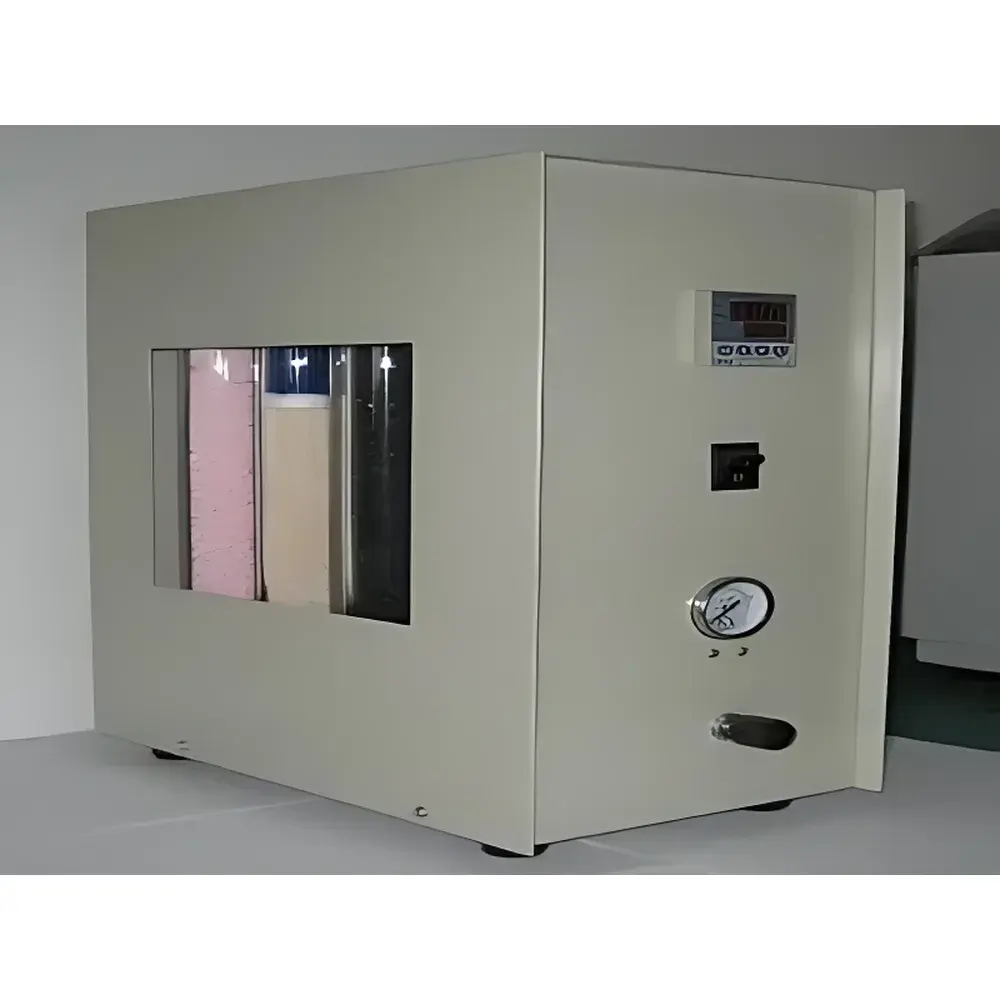
Brookfield BF-4 Hydrocarbon Scrubber for Zero-Air Generation
| Brand | Beifen Sanpu |
|---|---|
| Origin | Hebei, China |
| Manufacturer Type | OEM Manufacturer |
| Origin Category | Domestic (China) |
| Model | BF-4 |
| Pricing | Upon Request |
| Input Hydrocarbon Concentration (e.g., CH₄) | <100 ppm |
| Output Hydrocarbon Concentration (e.g., CH₄) | <0.1 ppm |
| Inlet Gas Pressure Range | 0–0.6 MPa |
| Inlet Gas Flow Rate | 0–1000 mL/min |
| Catalytic Furnace Temperature Control Range | 0–600 °C |
| Warm-up Time to Stable Operation | <1 h |
| Ambient Operating Temperature | 0–40 °C |
| Ambient Relative Humidity | <85% RH |
| Power Supply | 220 V AC / 50 Hz |
Overview
The Brookfield BF-4 Hydrocarbon Scrubber is a laboratory-grade zero-air generator engineered for trace-level hydrocarbon removal from compressed air or cylinder-sourced gas streams. It operates on catalytic oxidation principle: ambient air—supplied via oil-free compressors or high-pressure cylinders—is passed through a precisely temperature-controlled furnace containing a proprietary high-activity noble-metal catalyst. At optimized thermal conditions (typically 350 °C), gaseous hydrocarbons—including methane, ethane, propane, and other volatile organic compounds (VOCs)—are quantitatively oxidized to CO₂ and H₂O, yielding ultra-low-hydrocarbon output air essential for analytical blank integrity.
This instrument meets the stringent purity requirements specified in Chinese national standard GB/T 15263–1994 and environmental monitoring method standard HJ/T 38–1999 for non-methane total hydrocarbon (NMHC) analysis. Its design prioritizes operational safety, energy efficiency, and long-term catalytic stability—achieving sub-0.1 ppm residual methane concentration while maintaining furnace operation at significantly lower temperatures than conventional scrubbers (≤350 °C vs. typical 450–600 °C), thereby reducing thermal stress and extending catalyst service life.
Key Features
- High-efficiency catalytic oxidation core with low-temperature activation (350 °C nominal operating point)
- Stable hydrocarbon removal performance across variable inlet flow rates (0–1000 mL/min) and pressure ranges (0–0.6 MPa)
- Integrated digital temperature controller with ±1 °C accuracy and ramp/soak programming capability
- Robust stainless-steel gas path construction compliant with ISO 8573-1 Class 1 particulate and oil-free air specifications
- Front-panel LED display showing real-time furnace temperature and status indicators
- Passive cooling design eliminating need for forced-air blowers or external chillers
- Modular architecture enabling field-replaceable catalyst cartridges without system disassembly
Sample Compatibility & Compliance
The BF-4 is compatible with all common air sources used in analytical laboratories: oil-free diaphragm compressors, membrane compressors, and standard industrial-grade compressed air cylinders. It delivers zero-air meeting the purity criteria required for gas chromatography (GC), flame ionization detection (FID), Fourier-transform infrared (FTIR) spectroscopy, and chemiluminescence NOx analyzers. Its validated hydrocarbon removal efficiency (<0.1 ppm CH₄ residual) satisfies the “zero-air” definition per EPA Method TO-14A, ASTM D6348–22 Annex A1, and ISO 8573-1:2010 Class 0 for hydrocarbons. While not certified to UL/CE as a standalone appliance, its electrical subsystem complies with IEC 61010-1 safety requirements for laboratory equipment. Documentation supports GLP-compliant validation protocols including IQ/OQ/PQ execution.
Software & Data Management
The BF-4 operates as a stand-alone hardware unit with no embedded firmware or network connectivity. All operational parameters are controlled manually via front-panel interface; no software installation or driver dependency is required. For integration into automated laboratory environments, optional analog (0–5 V or 4–20 mA) temperature output signals are available upon request to interface with SCADA or LIMS systems. Audit trails for maintenance events (e.g., catalyst replacement dates, calibration logs) must be maintained externally in accordance with ISO/IEC 17025 clause 7.9 and FDA 21 CFR Part 11 if used in regulated QC/QA workflows.
Applications
- Providing hydrocarbon-free carrier, fuel, and makeup gases for GC-FID systems in environmental NMHC testing
- Generating zero-air blanks for ambient air quality monitoring stations (e.g., continuous NMHC analyzers)
- Supporting calibration gas preparation where background hydrocarbon interference must be eliminated
- Enabling low-detection-limit analysis in stack emission testing per HJ 38–2017 methodology
- Serving as a critical component in multi-instrument air supply networks requiring centralized zero-air distribution
FAQ
What is the expected service life of the catalyst cartridge under normal operating conditions?
Typical catalyst lifetime exceeds 12 months when operated continuously at ≤350 °C with inlet hydrocarbon concentrations below 100 ppm and particulate-free air input.
Can the BF-4 be used with nitrogen or synthetic air as input gas?
Yes—while optimized for ambient air, it accepts any inert or oxidizing gas stream containing combustible hydrocarbons, provided inlet dew point remains below –40 °C to prevent catalyst poisoning.
Is routine calibration required?
No scheduled calibration is mandated; however, users should verify outlet hydrocarbon concentration annually using certified methane standard gas (e.g., 1 ppm CH₄ in air) and a calibrated FID or photoionization detector.
Does the unit include pressure regulation and filtration stages?
The BF-4 incorporates integrated coalescing and activated carbon pre-filters upstream of the catalyst bed but does not include adjustable pressure regulators—these must be installed externally if source pressure exceeds 0.6 MPa.
How is catalyst deactivation diagnosed?
A sustained increase in outlet methane concentration above 0.1 ppm during steady-state operation—verified against reference gas—indicates catalyst exhaustion and necessitates replacement.



