
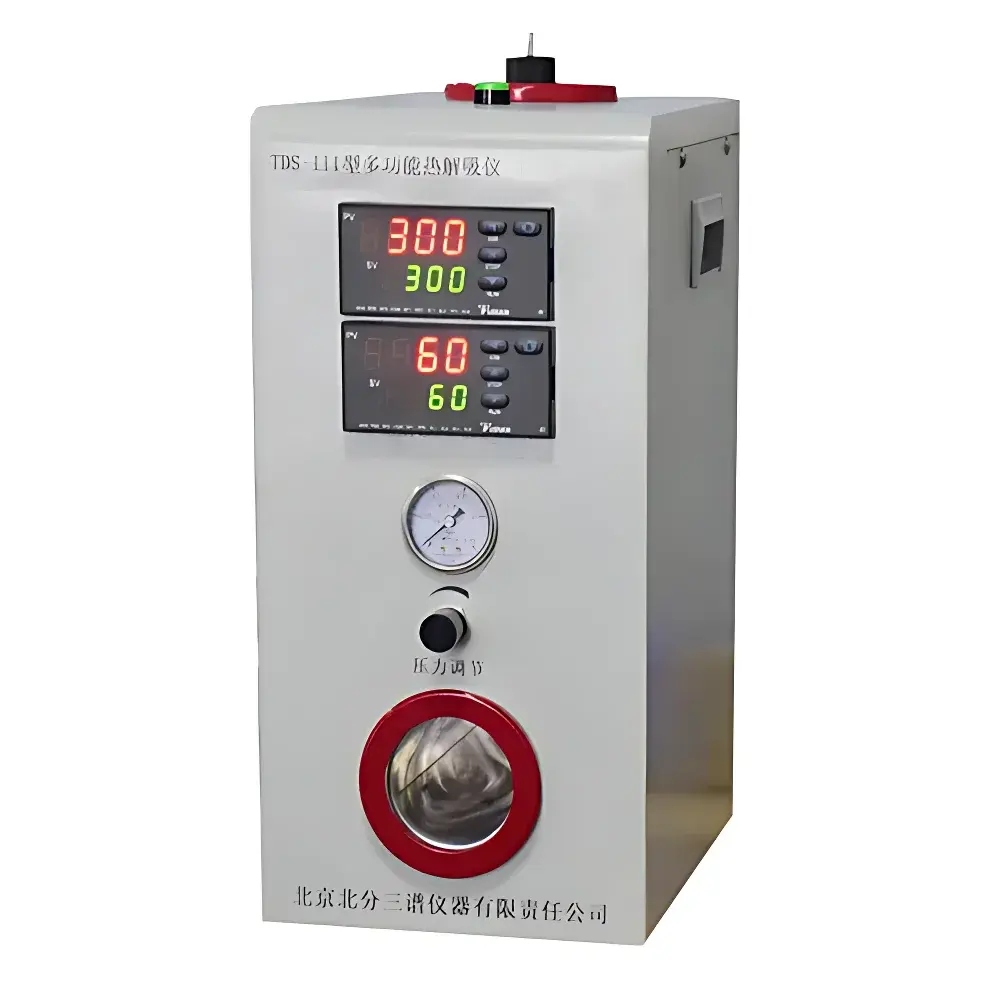
Beifen Sanpu HPTDS-III Multi-Function Thermal Desorber for Allyl Chloride and 1,3-Dichloropropene Analysis
| Brand | Beifen Sanpu |
|---|---|
| Origin | Beijing, China |
| Manufacturer Type | OEM Manufacturer |
| Product Category | Domestic (China-Made) |
| Model | HPTDS-III |
| Pricing | Upon Request |
Overview
The Beifen Sanpu HPTDS-III Multi-Function Thermal Desorber is a laboratory-grade sample pre-concentration and introduction system engineered for quantitative determination of volatile organic compounds (VOCs), specifically allyl chloride and 1,3-dichloropropene, in ambient and workplace air matrices. It operates on the principle of thermal desorption — a controlled, temperature-programmed release of analytes adsorbed onto solid sorbent tubes (e.g., activated carbon), followed by transfer of the desorbed vapor into a gas chromatograph (GC) for separation and detection. This method conforms to standardized analytical protocols including GBZ/T 300.62–2017 (Occupational Health Standards for Determination of Allyl Chloride and 1,3-Dichloropropene in Workplace Air) and GB 50325–2006 (Indoor Air Quality Control for Civil Construction Projects). The instrument is designed for manual syringe-based injection into GC systems equipped with flame ionization detectors (FID), ensuring compatibility with widely deployed benchtop GC platforms such as the GC-2010 series. Its dual-zone thermal architecture enables simultaneous conditioning of sorbent tubes and precise heating of large-volume gas-tight syringes (up to 100 mL), supporting reproducible quantitation across regulatory concentration ranges (0.0–0.10 mg/mL).
Key Features
- Dual independent temperature zones: desorption furnace (RT–400 °C, ±0.5 °C stability) and syringe heater (RT–100 °C, ±0.5 °C stability), both programmable in 1 °C increments
- Optimized desorption geometry: zero-dead-volume connection between desorption tube (6 mm OD or 1/4″) and 100 mL gas-tight syringe, minimizing analyte loss and carryover
- High recovery performance: >85% average desorption efficiency for chlorinated propenes under standardized conditions (240 °C, 50 mL/min N₂ carrier flow)
- Integrated flow control: adjustable carrier gas flow (10–200 mL/min) with <0.1% long-term stability, critical for method reproducibility
- Modular mechanical design: compact footprint (390 × 170 × 360 mm), low power consumption (~500 W), and lightweight construction (~9 kg) for benchtop deployment in QC labs and occupational hygiene testing facilities
- User-centric operation: intuitive manual workflow suitable for laboratories with varying levels of GC expertise; no software dependency or automation overhead
Sample Compatibility & Compliance
The HPTDS-III supports standard 6 mm OD activated carbon sorbent tubes (100 mg packing) compliant with Chinese national standards for workplace air sampling. It is validated for use in conjunction with BS-H2 personal air samplers (0–500 mL/min flow range) and FID-equipped GC systems. Method validation data meet requirements of GBZ/T 300.62–2017 for linearity (r ≥ 0.999 over 0.0–0.10 mg/mL), precision (RSD < 5% for replicate desorptions), and detection sensitivity appropriate for occupational exposure limit (OEL) assessment. While not certified to ISO/IEC 17025 or FDA 21 CFR Part 11 out-of-the-box, the instrument’s deterministic thermal profile, traceable temperature calibration, and manual audit trail (via lab notebook documentation) support GLP-aligned workflows in third-party occupational health laboratories conducting accredited testing per CNAS-CL01.
Software & Data Management
The HPTDS-III is a hardware-only thermal desorption unit with no embedded firmware or proprietary software. Temperature setpoints, dwell times, and gas flow rates are configured manually via front-panel digital controllers. All operational parameters are recorded externally by the user during method execution, enabling full traceability in accordance with Good Laboratory Practice (GLP) documentation requirements. When paired with chromatographic data systems (e.g., Shimadzu GCsolution, Thermo Chromeleon), raw peak area or height data from FID output are imported directly for calibration curve generation and concentration calculation. No driver installation or vendor-specific interface is required — the system functions as a passive, analog-compatible sample introduction module.
Applications
- Quantitative analysis of allyl chloride and 1,3-dichloropropene in workplace air per GBZ/T 300.62–2017
- Indoor air quality assessment of benzene and TVOC per GB 50325–2006 using activated carbon tube sampling
- VOC monitoring in chemical manufacturing, pesticide formulation, and polymer synthesis environments
- Method development and validation for thermal desorption–GC/FID analysis of halogenated alkenes
- Training and method transfer applications where operator familiarity with manual syringe injection is prioritized over full automation
FAQ
What is the primary difference between thermal desorption and headspace analysis?
Thermal desorption recovers analytes adsorbed onto solid sorbents (e.g., activated carbon), enabling pre-concentration of trace VOCs from large air volumes; headspace analysis measures analytes partitioned into the vapor phase above liquid or solid samples without pre-concentration.
Can the HPTDS-III be used for other VOCs beyond allyl chloride and dichloropropene?
Yes — it is compatible with any thermally stable VOC recoverable from carbon-based sorbents, including benzene, toluene, xylene (BTX), and other C3–C12 aliphatic/aromatic compounds, provided desorption parameters are optimized per compound volatility and polarity.
Is the instrument compatible with autosamplers or fully automated GC systems?
No — the HPTDS-III delivers desorbed analytes into a 100 mL gas-tight syringe for manual injection; it does not integrate with robotic liquid handlers or GC autosamplers.
Does the unit include calibration certificates or NIST-traceable temperature verification?
Factory calibration is performed at key setpoints (e.g., 100 °C, 240 °C, 400 °C); users are advised to perform periodic verification using external calibrated thermocouples per internal QA procedures.
What maintenance is required for long-term reliability?
Routine cleaning of the desorption chamber and syringe heater well; periodic inspection of O-rings and gas fittings; replacement of activated carbon tubes per batch-use protocol — no consumables specific to the instrument itself.
Related Products







