
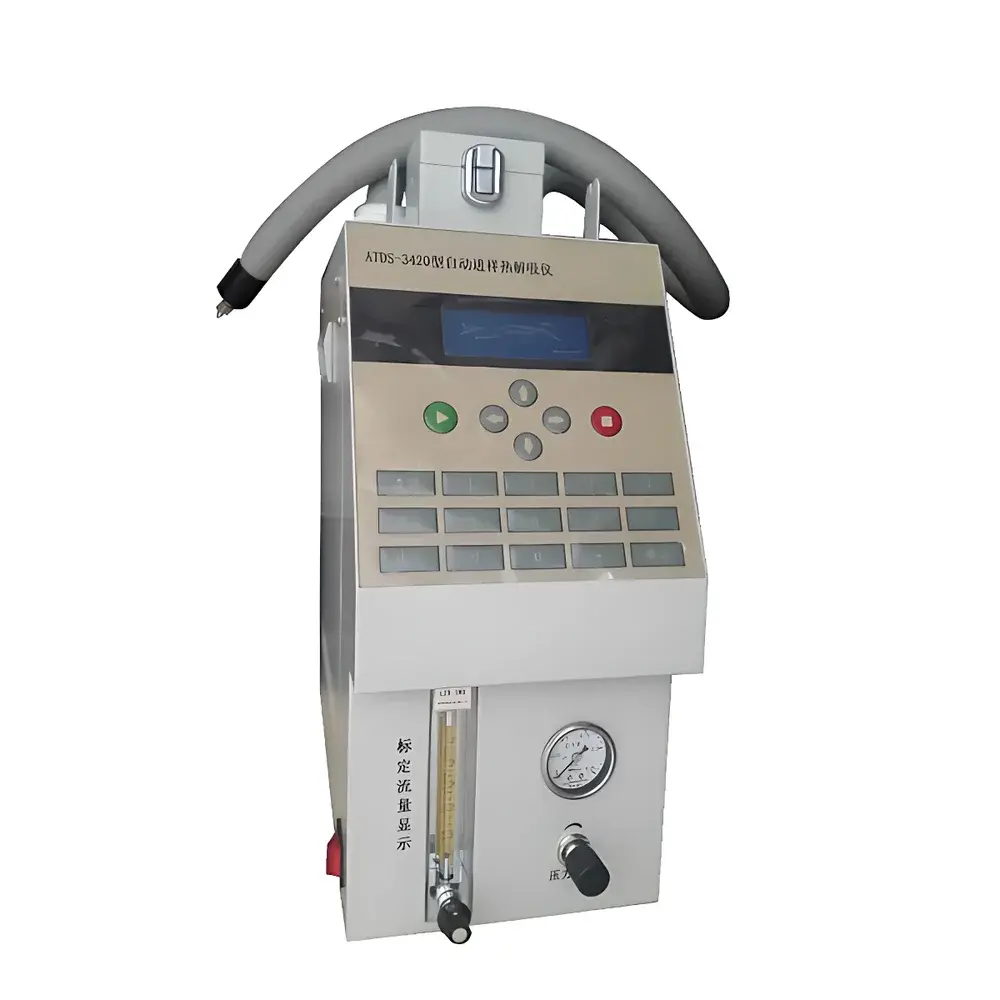
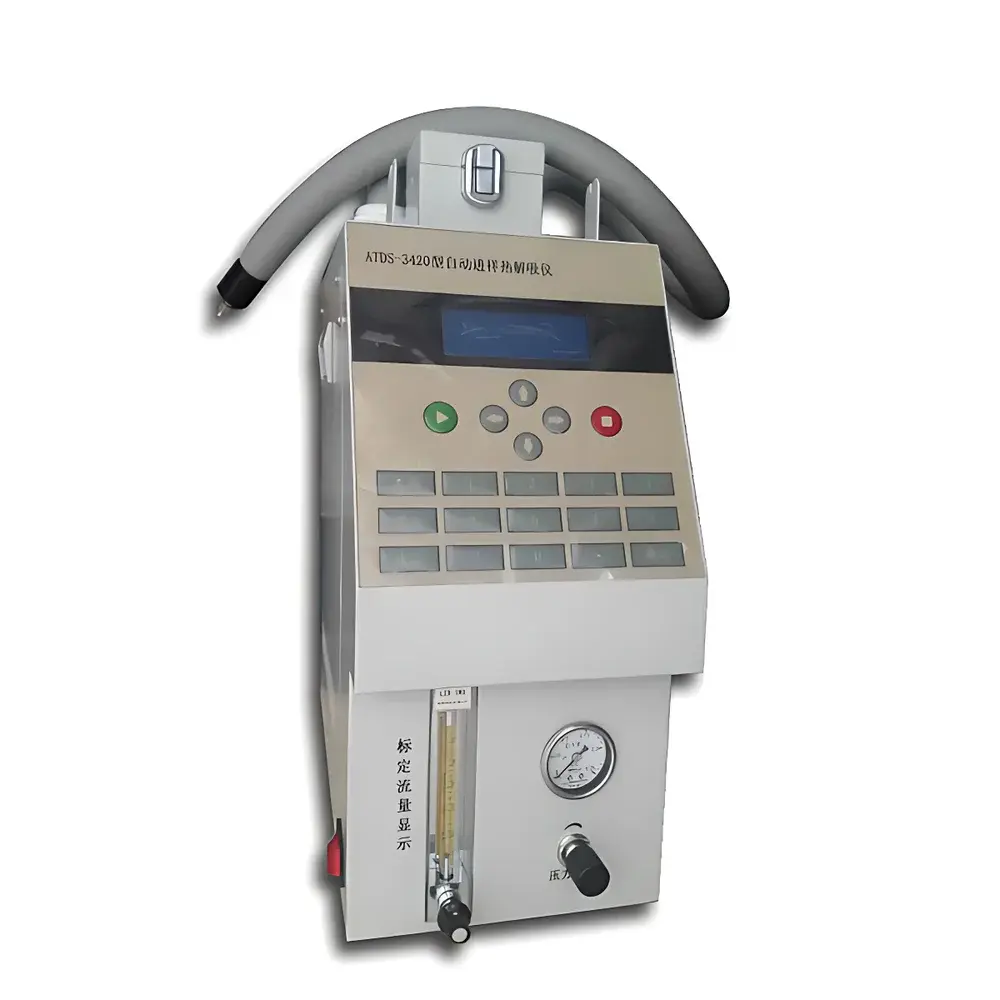
Beifen Sanpu ATDS-342 Automated Thermal Desorber
| Brand | Beifen Sanpu |
|---|---|
| Origin | Beijing, China |
| Manufacturer Type | Direct Manufacturer |
| Product Category | Domestic |
| Model | ATDS-342 |
| Instrument Type | Dual-Stage Thermal Desorber |
| Desorption Temperature Range | 30–400 °C |
| Cold Trap Temperature Range | −30 °C |
| Desorption Recovery Rate | >85% |
| Sample Capacity | 20 positions |
Overview
The Beifen Sanpu ATDS-342 Automated Thermal Desorber is a dual-stage, programmable sample introduction system engineered for trace-level volatile organic compound (VOC) analysis by gas chromatography (GC). It operates on the principle of thermal desorption—first releasing analytes from sorbent tubes under controlled heating and inert gas flow, then refocusing them in a cryogenically cooled trap before rapid transfer to the GC column. This two-step process ensures high sensitivity, minimal analyte loss, and superior reproducibility for quantitative analysis at sub-ppb concentration levels. Designed for seamless integration with both domestic and international GC systems—including Agilent, Thermo Fisher, Shimadzu, and PerkinElmer platforms—the ATDS-342 eliminates manual handling, reduces carryover risk, and supports unattended batch processing of up to 20 samples per run. Its architecture conforms to fundamental requirements for regulated VOC analysis workflows, particularly those aligned with ISO 16000-6, ASTM D6196, and EPA TO-17 methodologies.
Key Features
- Dual-stage thermal desorption with independent temperature control for desorption furnace (30–400 °C), valve manifold (up to 160 °C), and transfer line (up to 160 °C), all adjustable in 1 °C increments and stabilized within ±0.5 °C accuracy
- Integrated cryogenic cold trap capable of reaching −30 °C, enabling effective analyte focusing and enhanced detection sensitivity
- 20-position automated sample carousel with programmable sequence execution and full event-driven timing (up to 8 time segments per method)
- 9 user-editable, non-volatile method storage slots supporting rapid recall and method standardization across shifts or laboratories
- Simultaneous GC start synchronization via TTL trigger output or external event input; compatible with legacy GC instruments without hardware modification
- Automatic post-desorption tube purge (0–20 mL/min, continuously adjustable) to minimize cross-contamination between runs
- Optional 0.53 mm fused silica transfer line for improved transmission of thermally labile or polar compounds
- Industrial-grade pneumatic actuators sourced from internationally certified suppliers, ensuring long-term valve reliability and leak-tight operation
- Adjustable LCD backlight and silent keypad mode for low-noise laboratory environments
Sample Compatibility & Compliance
The ATDS-342 accepts standard 6 mm OD stainless steel or glass sorbent tubes (e.g., Tenax TA, Carbopack B/C, Carboxen 1000) used in accordance with EPA Method TO-17 and ISO 16017-1. It supports both single- and multi-bed tube configurations and accommodates internal standard addition via calibrated syringe ports prior to desorption. All thermal zones are electrically isolated and powered via low-voltage circuits for enhanced operator safety. The system meets essential electrical safety standards (IEC 61010-1) and is suitable for use in GLP-compliant laboratories where audit-ready operation is required. While not pre-certified for FDA 21 CFR Part 11, its method logging, time-stamped run records, and parameter lockout functionality support implementation of electronic record controls when paired with validated LIMS or chromatography data systems.
Software & Data Management
The ATDS-342 features an embedded microcontroller-based interface with Chinese-character LCD display and membrane keypad navigation. All method parameters—including temperature ramps, hold times, carrier gas flow profiles, and event triggers—are configured locally and stored in non-volatile memory. Time-stamped logs capture date/time, method ID, sample position, and final status (success/failure) for each run. No proprietary PC software is required; however, the unit provides RS-232 serial output for optional integration with third-party lab informatics platforms. For laboratories requiring full electronic signature and audit trail capabilities, the device can be operated as a peripheral instrument under validated chromatography data systems that manage method deployment, result review, and electronic archiving per ALCOA+ principles.
Applications
- Indoor air quality assessment per GB 50325-2006 (benzene and TVOC determination in residential and commercial buildings)
- OCCUPATIONAL EXPOSURE monitoring in manufacturing, petrochemical, and pharmaceutical facilities
- Rapid identification of unknown airborne contaminants during emergency response or hazmat incidents
- Residual solvent analysis in active pharmaceutical ingredients (APIs) and packaging materials per ICH Q3C guidelines
- Exhaled breath metabolite profiling for clinical research applications
- Quality control of fragrance compounds and flavor volatiles in consumer products
- Environmental forensics and chemical weapons convention (CWC) verification sampling
- Leachate and off-gas testing in polymer and composite material development
FAQ
Is the ATDS-342 compatible with GC-MS systems?
Yes—it delivers sharp, narrow-band analyte pulses ideal for mass spectrometric detection and supports electron ionization (EI) and chemical ionization (CI) source compatibility through precise transfer timing and inert flow path design.
Can it perform single-stage desorption?
Yes—users may bypass cold trap focusing and configure direct desorption-to-GC transfer for specific applications requiring faster cycle times or higher-boiling analytes.
What maintenance intervals are recommended?
Valve seals and O-rings should be inspected every 500 runs; cold trap coolant (liquid nitrogen or mechanical cooler) requires replenishment or servicing based on usage frequency and ambient conditions.
Does it support internal standard calibration?
Yes—dedicated injection ports allow precise spiking of deuterated or isotopically labeled surrogates directly onto sorbent tubes prior to sampling or analysis.
Is remote operation possible?
While no native Ethernet or Wi-Fi interface is included, RS-232 communication enables remote command execution and status polling via host PC scripts or SCADA-compatible middleware.




