
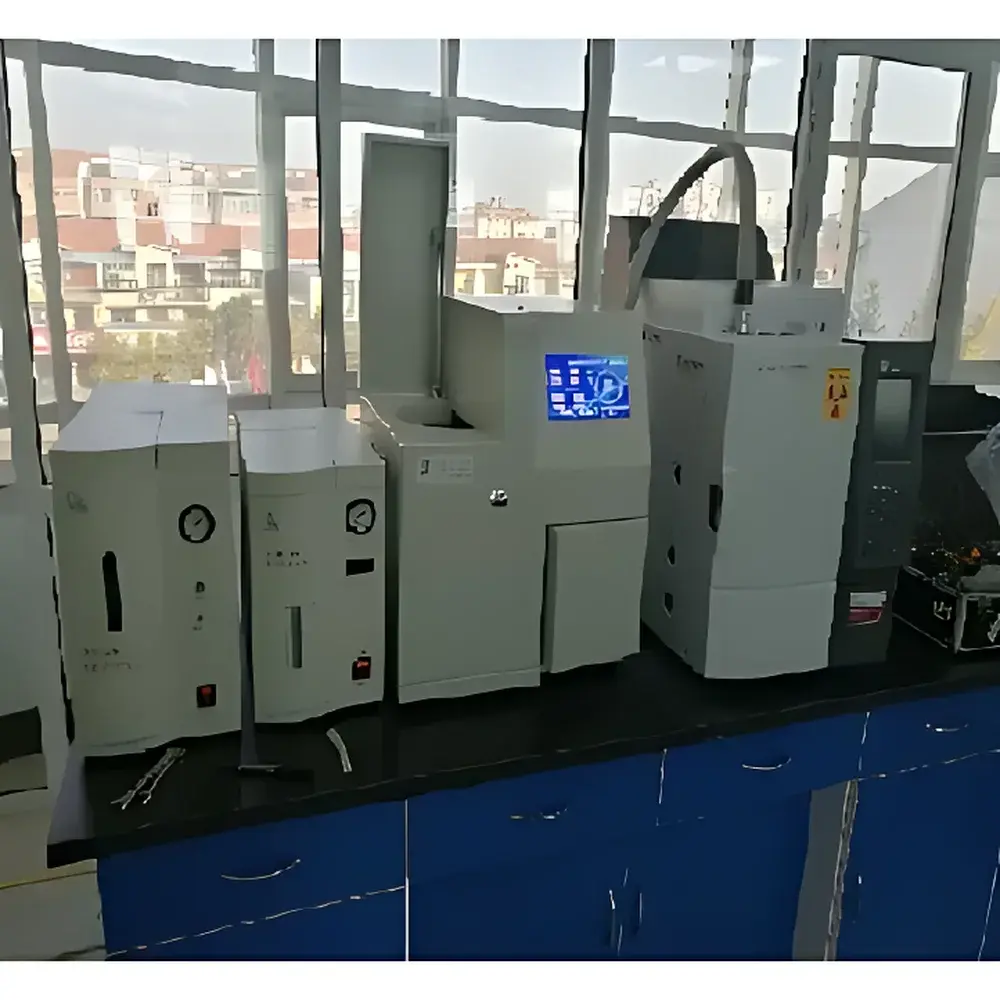
Beifen Sanpu G3C-9860 Fully Automated Static Headspace Sampler with Integrated GC System
| Brand | Beifen Sanpu |
|---|---|
| Origin | Beijing, China |
| Manufacturer Type | OEM Manufacturer |
| Instrument Type | Static Headspace Sampler |
| Automation Level | Fully Automatic |
| Vial Heating Range | Ambient to 200 °C (1 °C increments) |
| Valve & Transfer Line Temperature Control Range | 40–220 °C (±1 °C accuracy) |
| Sample Loop Volume | 1 mL |
| Vial Capacity | 20 positions |
| Compatible Vial Sizes | 10 mL and 20 mL |
Overview
The Beifen Sanpu G3C-9860 is a fully integrated, laboratory-grade static headspace sampling system designed for seamless coupling with gas chromatographs (GC) in regulated and research environments. It operates on the principle of phase equilibrium partitioning: volatile and semi-volatile analytes in solid or liquid matrices (e.g., feedstuffs, pharmaceuticals, polymers, food packaging) are thermally equilibrated in sealed vials; the resulting headspace vapor is then transferred quantitatively via a precisely temperature-controlled valve and heated transfer line into the GC injection port. This method eliminates matrix interference, reduces column contamination, and enhances reproducibility—making it ideal for residual solvent analysis, environmental volatiles screening, and quality control testing where sample integrity and method robustness are critical.
Key Features
- Fully automated 20-position carousel with programmable vial sequencing and priority queue support for unattended overnight operation
- Independent dual-zone thermal control: vial oven (ambient to 200 °C, ±1 °C stability) and high-fidelity valve/loop assembly (40–220 °C, ±1 °C precision), minimizing condensation and carryover
- 1 mL fixed-volume pressurized loop with inert flow path (electropolished stainless steel), ensuring quantitative transfer and low memory effect
- Compatible with standard 10 mL and 20 mL crimp-top or screw-cap headspace vials per ASTM D7217 and ISO 11843-2 guidelines
- Integrated pressure monitoring and leak-check routines prior to each injection cycle, supporting GLP-compliant audit trails
- Modular architecture enabling direct integration with third-party GC systems (including Agilent, Shimadzu, Thermo Fisher, and PerkinElmer platforms) via standard TTL/RS-232 or Ethernet interfaces
Sample Compatibility & Compliance
The G3C-9860 supports a broad range of sample types—including viscous liquids (e.g., edible oils, syrups), heterogeneous solids (e.g., soybean meal, polymer pellets, dried herbs), and semi-solids (e.g., creams, pastes)—without derivatization or extraction. Its thermal design accommodates volatile organic compounds (VOCs) with boiling points from −40 °C (e.g., propane) to 220 °C (e.g., dibutyl phthalate). The system conforms to key regulatory frameworks: USP for residual solvents in pharmaceuticals, EPA Method 502.2 and 8260D for drinking water and soil analysis, and ISO 17025–accredited laboratories’ requirements for uncertainty estimation and traceability. All firmware and hardware components are CE-marked and RoHS-compliant.
Software & Data Management
Controlled via Beifen Sanpu’s HS-GC Workstation software (Windows 10/11 compatible), the G3C-9860 supports method development, sequence building, real-time status monitoring, and event logging. The software includes built-in calibration curve generation (linear, quadratic, weighted), peak integration validation tools, and electronic signature support aligned with FDA 21 CFR Part 11 requirements—including user access levels, audit trail activation, and data immutability settings. Raw data files are saved in vendor-neutral .csv and .txt formats, facilitating import into LIMS or third-party chemometric platforms such as OpenLab CDS or Chromeleon.
Applications
- Residual solvent quantification in soybean meal, rapeseed cake, and other protein-rich animal feed ingredients (e.g., hexane, ethanol, isopropanol per AOAC 996.12)
- Leachable VOC analysis in food contact materials (plastics, adhesives, coatings) per EU Regulation (EC) No 10/2011
- Residual monomer detection in medical device polymers (e.g., acrylonitrile, styrene) under ISO 10993-18
- Alcohol content verification in pharmaceutical excipients and herbal tinctures
- Volatile impurity profiling in battery electrolyte formulations and lithium-ion cathode precursors
FAQ
What sample preparation is required prior to headspace analysis?
Minimal preparation is needed: samples are weighed directly into certified headspace vials, sealed with PTFE/silicone septa, and equilibrated under defined time/temperature conditions. No solvent extraction or filtration is required.
Can the G3C-9860 be used with cryogenic GC inlet systems?
Yes—the system’s heated transfer line and valve module maintain consistent vapor-phase integrity up to 220 °C, enabling compatibility with both standard split/splitless inlets and cryo-focused inlets when paired with appropriate GC configuration.
Is method validation documentation provided?
Beifen Sanpu supplies a comprehensive IQ/OQ protocol package, including installation checklist, operational performance tests (precision, carryover, linearity), and a template for PQ execution aligned with ICH Q2(R2) guidelines.
Does the system support dynamic headspace (purge-and-trap) mode?
No—the G3C-9860 is engineered exclusively for static headspace sampling. For dynamic applications, Beifen Sanpu offers the AHS-20A Plus standalone purge-and-trap interface as a complementary solution.
What maintenance intervals are recommended for routine operation?
Vial carousel alignment and septum piercing mechanism inspection every 500 injections; valve loop cleaning and carrier gas filter replacement every 3 months; annual calibration verification using NIST-traceable reference standards.
Related Products





