
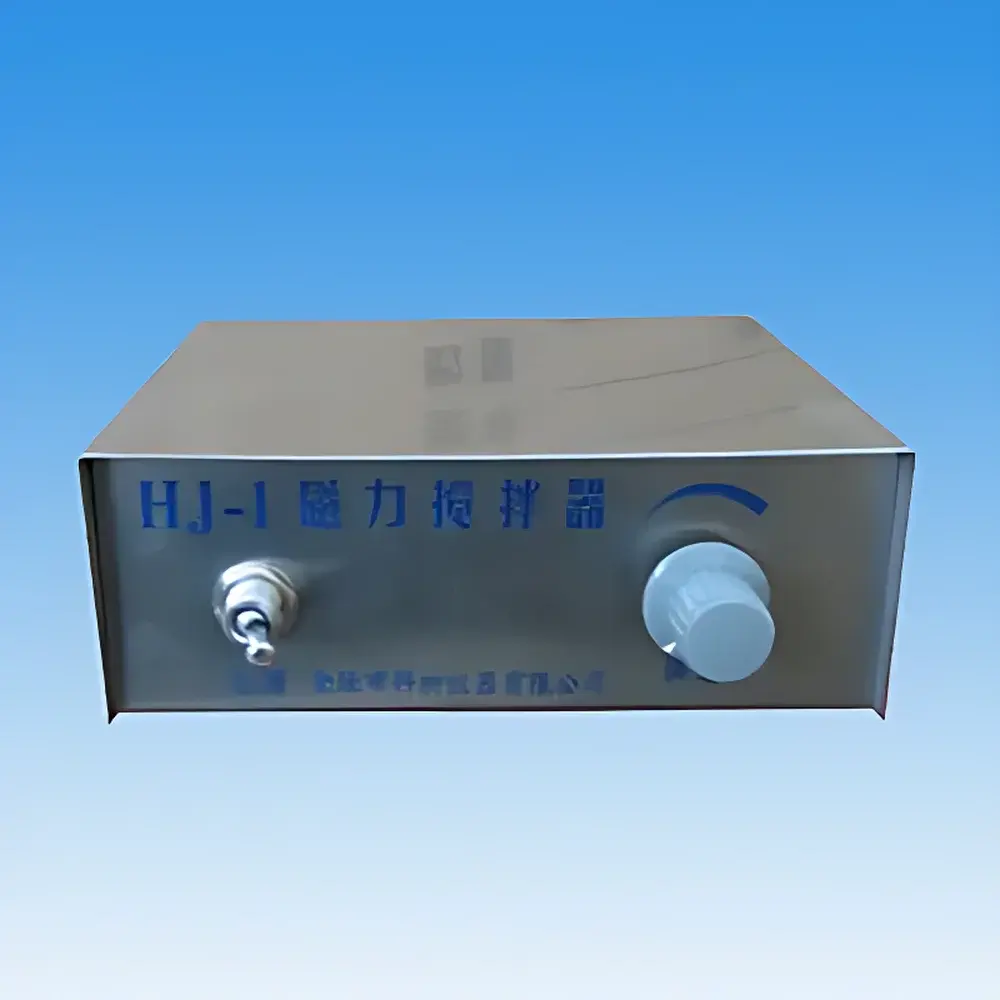
Beifen Sanpu HJ-1 Magnetic Stirrer
| Brand | Beifen Sanpu |
|---|---|
| Origin | Beijing, China |
| Manufacturer Type | Direct Manufacturer |
| Product Origin | Domestic (China) |
| Model | HJ-1 |
| Pricing | Available Upon Request |
Overview
The Beifen Sanpu HJ-1 Magnetic Stirrer is a compact, benchtop laboratory instrument engineered for reliable, low-noise mixing of liquid samples in beakers, flasks, and other standard glassware. Operating on the principle of magnetic coupling—where a rotating permanent magnet beneath the work surface induces synchronous rotation of a PTFE-coated stir bar immersed in the sample—the HJ-1 delivers consistent agitation without mechanical shaft penetration or seal wear. Unlike heated variants (e.g., HJ-2), the HJ-1 is a non-heating model optimized for ambient-temperature mixing applications requiring precise speed control and operational stability. Its design prioritizes durability, electromagnetic efficiency, and user safety, making it suitable for routine QC testing, reagent preparation, titration support, and sample homogenization in academic, environmental, pharmaceutical, and industrial laboratories.
Key Features
- Brushless permanent-magnet DC motor with ≥10,000-hour rated service life under no-load conditions
- Stepless speed regulation from startup to 2600 rpm, enabling fine-tuned control across viscosity ranges
- Low-vibration, silent operation due to balanced rotor assembly and rigid cold-rolled steel chassis
- Electrostatically applied high-temperature epoxy powder coating for enhanced corrosion resistance and chemical splash protection
- Integrated LED power indicator and intuitive rotary speed dial with tactile feedback
- Grounded three-prong IEC C13 input socket compliant with IEC 61000-3-2 harmonic emission standards
- Compact footprint (160 × 140 × 90 mm) compatible with fume hoods and confined benchtop spaces
Sample Compatibility & Compliance
The HJ-1 supports standard laboratory vessels up to 2 L capacity, including borosilicate glass beakers (≥50 mL), Erlenmeyer flasks, and cylindrical jars. It accommodates stir bars ranging from 15 mm to 40 mm in length (recommended: PTFE- or PTFE/glass-coated, 20–30 mm). The device operates within an ambient temperature range of 5–40 °C and relative humidity ≤80% RH (non-condensing). It conforms to GB/T 2829–2002 (Intermittent Sampling Inspection for Periodic Inspection of General Laboratory Instruments) and meets CE marking requirements for EMC (EN 61326-1) and Low Voltage Directive (2014/35/EU) when used with certified power supplies. While not intrinsically safe for flammable solvent environments, it may be deployed in Class 1, Division 2 areas when installed per NEC Article 500 guidelines and paired with explosion-proof stir bars.
Software & Data Management
The HJ-1 is a standalone analog instrument with no embedded microprocessor, firmware, or digital interface. Consequently, it does not generate electronic records, lack audit trails, and is exempt from FDA 21 CFR Part 11 compliance requirements. Its operational parameters—including speed setting and runtime—are manually controlled and not logged. For GLP/GMP environments requiring traceability, users are advised to document settings via lab notebook entries or LIMS-integrated procedural checklists. No driver installation, USB connectivity, or remote monitoring capability is provided or supported.
Applications
- Preparation of buffer solutions, standard dilutions, and calibration standards in analytical chemistry workflows
- Homogenization of suspension-based samples prior to filtration, centrifugation, or spectrophotometric analysis
- Supporting titration procedures where continuous, gentle agitation ensures endpoint reproducibility
- Mixing of aqueous reagents in environmental water testing (e.g., COD, BOD, heavy metal extraction)
- Cell culture media conditioning and pH adjustment in non-sterile pre-incubation steps
- Blending of polymer solutions and colloidal dispersions during materials science prototyping
FAQ
What is the maximum recommended vessel size for optimal stirring performance?
A 1 L beaker is the practical upper limit for consistent vortex formation and stir bar tracking at speeds above 1200 rpm. For volumes exceeding 1.5 L, use a longer stir bar (≥35 mm) and reduce speed to maintain coupling stability.
Can the HJ-1 be used with corrosive solvents such as concentrated acids or organic halides?
Yes—provided the stir bar is chemically inert (e.g., PTFE/glass encapsulated) and the vessel remains upright and centered. Avoid direct contact between spilled liquids and the coated housing surface; wipe immediately with isopropyl alcohol if contamination occurs.
Is the unit compatible with 110 V / 60 Hz power systems?
No—the HJ-1 is designed exclusively for 220 V ±10%, 50 Hz input. Use only with a properly rated step-down transformer meeting IEC 61558-2-6 isolation requirements if operating in North American or Japanese facilities.
Does the HJ-1 include a timer function?
No—timer functionality is exclusive to the HJ-2 variant. The HJ-1 requires manual operation and external timing devices for duration-controlled protocols.
What maintenance is required to ensure long-term reliability?
Periodic inspection of the stir bar for chipping or coating loss, cleaning of the ceramic plate surface with lint-free cloth, and verification of grounding continuity every six months per ISO/IEC 17025 Clause 6.4.3 recommendations.



