
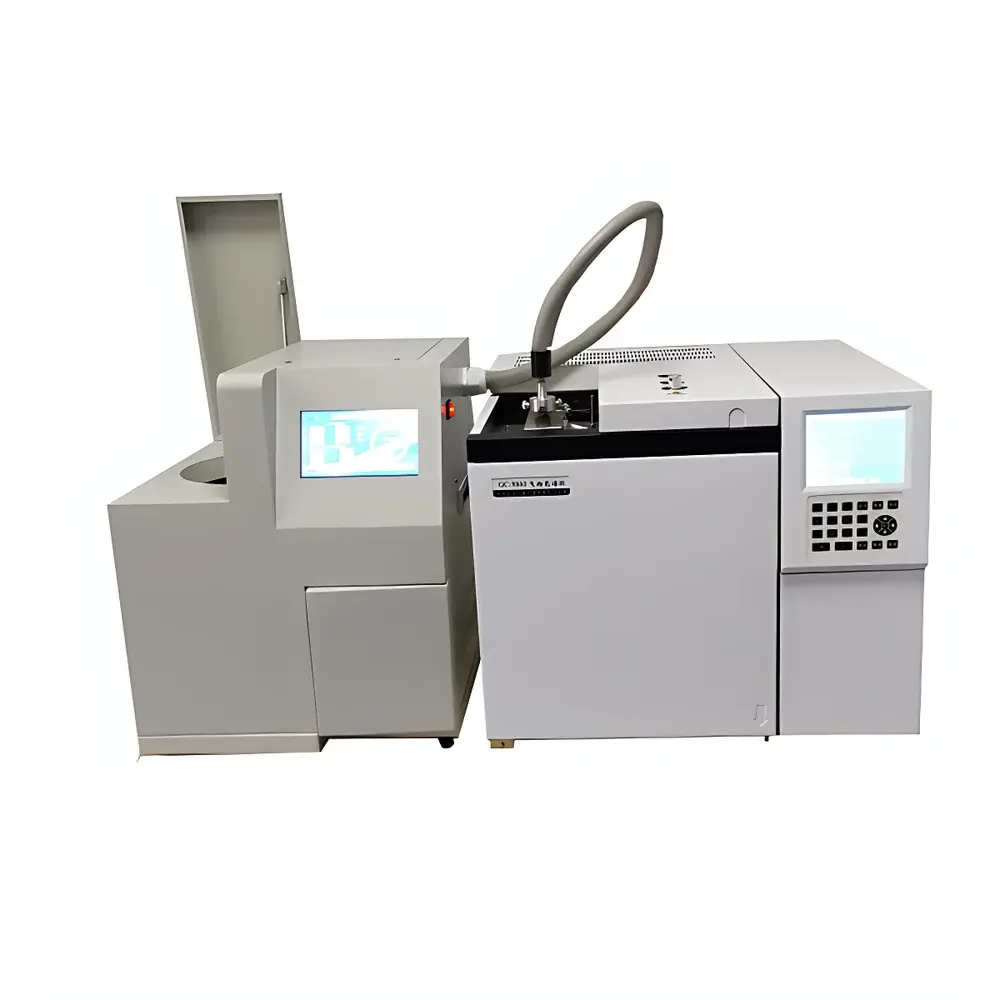
Beifen Sanpu AH.S-20A PLUS Automated Static Headspace Sampler for Water Quality Analysis of BTEX and Styrene
| Brand | Beifen Sanpu |
|---|---|
| Model | AH.S-20A PLUS |
| Instrument Type | Automated Static Headspace Sampler |
| Automation Level | Fully Automatic |
| Sample Capacity | 20-position vial carousel |
| Vial Compatibility | 10 mL or 20 mL crimp-top headspace vials |
| Oven Temperature Range | Ambient to 200 °C (1 °C increments) |
| Valve & Transfer Line Temperature Range | 40–220 °C (±1 °C accuracy) |
| Quantitative Loop Volume | 1 mL |
| Compliance | Designed for HJ 1067–2019 (China EPA Standard Method for BTEX and Styrene in Water) |
Overview
The Beifen Sanpu AH.S-20A PLUS is a fully automated static headspace sampler engineered for precise, reproducible quantification of volatile organic compounds (VOCs) — specifically benzene, toluene, ethylbenzene, xylenes (o-, m-, p-), isopropylbenzene (cumene), and styrene — in aqueous environmental matrices. It operates on the principle of equilibrium static headspace sampling: water samples are heated in sealed vials to volatilize target analytes into the headspace phase; after thermal equilibration, a fixed volume of headspace gas is withdrawn via a thermostatted sampling valve and transferred directly to a gas chromatograph (GC) equipped with a flame ionization detector (FID). This method eliminates liquid-phase injection complications, minimizes matrix interference, and delivers high sensitivity for trace-level VOC analysis at sub-μg/L concentrations — fully aligned with the technical requirements of HJ 1067–2019, the official Chinese Environmental Protection Standard for BTEX analysis in surface water, groundwater, wastewater, and drinking water sources.
Key Features
- Fully automated 20-position sample carousel with programmable sequence control, enabling unattended overnight operation and high-throughput batch processing.
- Independent temperature control for both sample oven (ambient to 200 °C, ±1 °C stability) and critical transfer components (valve & loop: 40–220 °C, ±1 °C), ensuring consistent vapor-phase equilibration and preventing condensation or carryover.
- 1 mL fixed-volume quantitative loop with inert, low-dead-volume internal pathway — optimized for minimal adsorption and maximal transfer efficiency of polar and non-polar aromatics.
- Robust pneumatic architecture with pressure-controlled vial pressurization and precise syringe-driven sampling, delivering high repeatability (RSD < 2.5% for replicate injections under standardized conditions).
- Integrated hardware interlock with GC start signal synchronization, supporting seamless method coupling and full instrument coordination via RS-232 or Ethernet interface.
Sample Compatibility & Compliance
The AH.S-20A PLUS accommodates standard 10 mL and 20 mL crimp-seal headspace vials, compatible with common septa materials (e.g., PTFE/silicone) and certified for use with aqueous samples containing salts, humic substances, and moderate suspended solids. Its operational parameters satisfy the instrumental prerequisites defined in HJ 1067–2019, including specified equilibration time (30–60 min), vial heating temperature (60–85 °C recommended), and loop injection volume (1 mL). While developed for China’s national monitoring framework, the system’s performance characteristics — such as method detection limits (MDLs) of 2–3 μg/L and quantitation limits (QLs) of 8–12 μg/L for the eight target analytes — are comparable to those achieved using EPA Method 502.2 and ISO 15680:2017 for aromatic hydrocarbons in water. The design supports GLP-compliant workflows through audit-trail-capable method storage and timestamped run logs.
Software & Data Management
Controlled via Beifen Sanpu’s dedicated HS-Link software (Windows-based), the AH.S-20A PLUS enables comprehensive method development: users define vial position mapping, equilibration time/temperature profiles, agitation settings (if optional shaker module installed), pressurization duration, loop fill/extraction timing, and GC trigger logic. All parameters are saved in encrypted .hsd files with versioning and user-access controls. Raw acquisition data include vial ID, temperature setpoints, actual oven/valve temperatures, injection timestamps, and cycle status flags — exportable in CSV or XML for LIMS integration. Software complies with basic 21 CFR Part 11 readiness: electronic signatures, password-protected method editing, and immutable audit trails for all critical parameter changes.
Applications
This headspace sampler is routinely deployed in municipal water quality laboratories, environmental monitoring stations, third-party testing facilities, and industrial effluent compliance labs. Primary applications include routine surveillance of drinking water source protection zones, verification of wastewater treatment plant discharge compliance, forensic investigation of accidental benzene spills, and long-term trend analysis of aromatic contamination in lake and river ecosystems. It is also validated for use in soil leachate analysis (per HJ 642–2013) and sediment pore water characterization when paired with appropriate extraction protocols. Its robustness and precision make it suitable for accreditation under CNAS-CL01 (equivalent to ISO/IEC 17025) for environmental testing.
FAQ
What is the maximum allowable salt content in water samples for reliable BTEX recovery?
Samples with up to 3% (w/v) NaCl show no significant suppression of headspace partitioning for benzene and toluene; higher salinities require matrix-matched calibration or standard addition.
Can the AH.S-20A PLUS be used with mass spectrometric detection (GC-MS)?
Yes — its inert flow path and stable transfer conditions support coupling with single-quadrupole and triple-quadrupole GC-MS systems; method optimization for dwell time and dwell order is required.
Is the 1 mL loop volume adjustable?
No — the loop is fixed at 1 mL to ensure metrological traceability and reproducibility per HJ 1067–2019; alternative volumes require hardware modification not supported under warranty.
Does the system support internal standard addition?
Internal standards must be added manually to vials prior to sealing; the sampler does not feature an integrated liquid autosampler for post-vial spiking.
What maintenance intervals are recommended for optimal performance?
Valve seals and septa should be replaced every 500 injections; oven airflow filters cleaned monthly; and system leak checks performed weekly using helium or nitrogen pressure decay test.





