
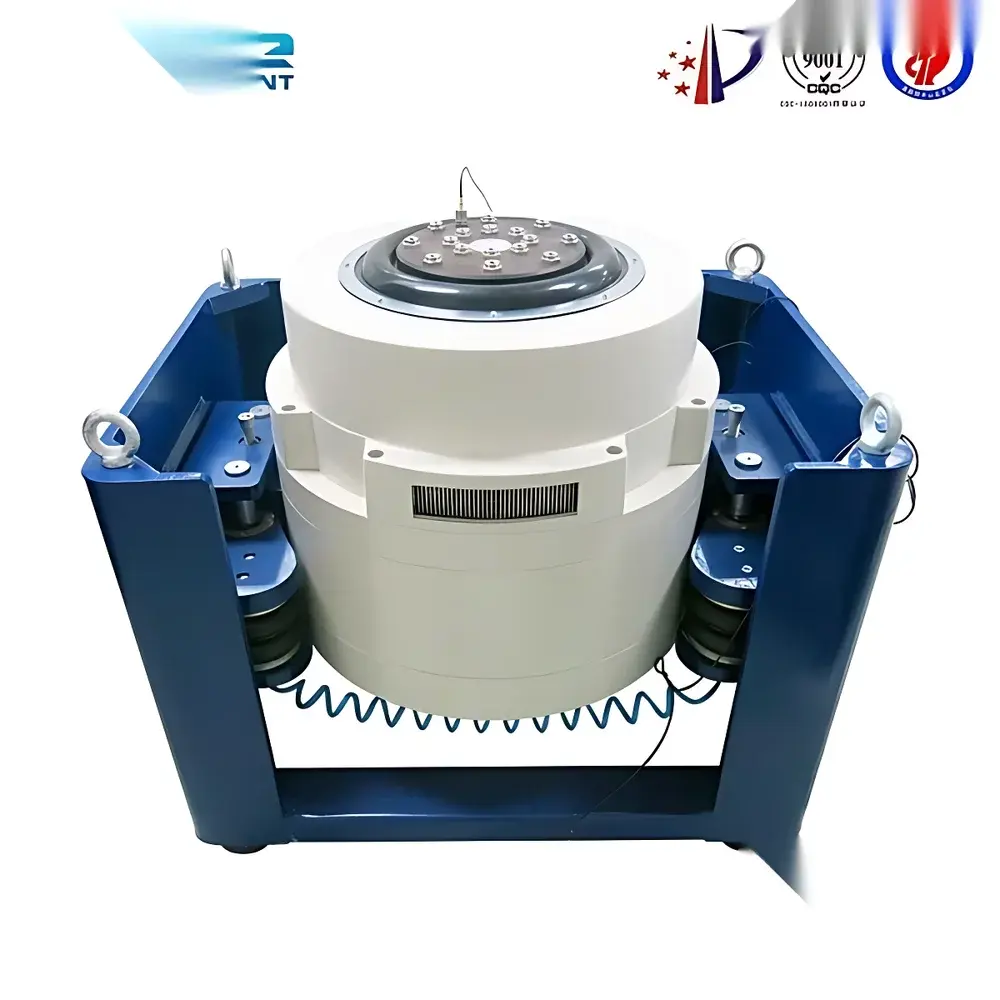
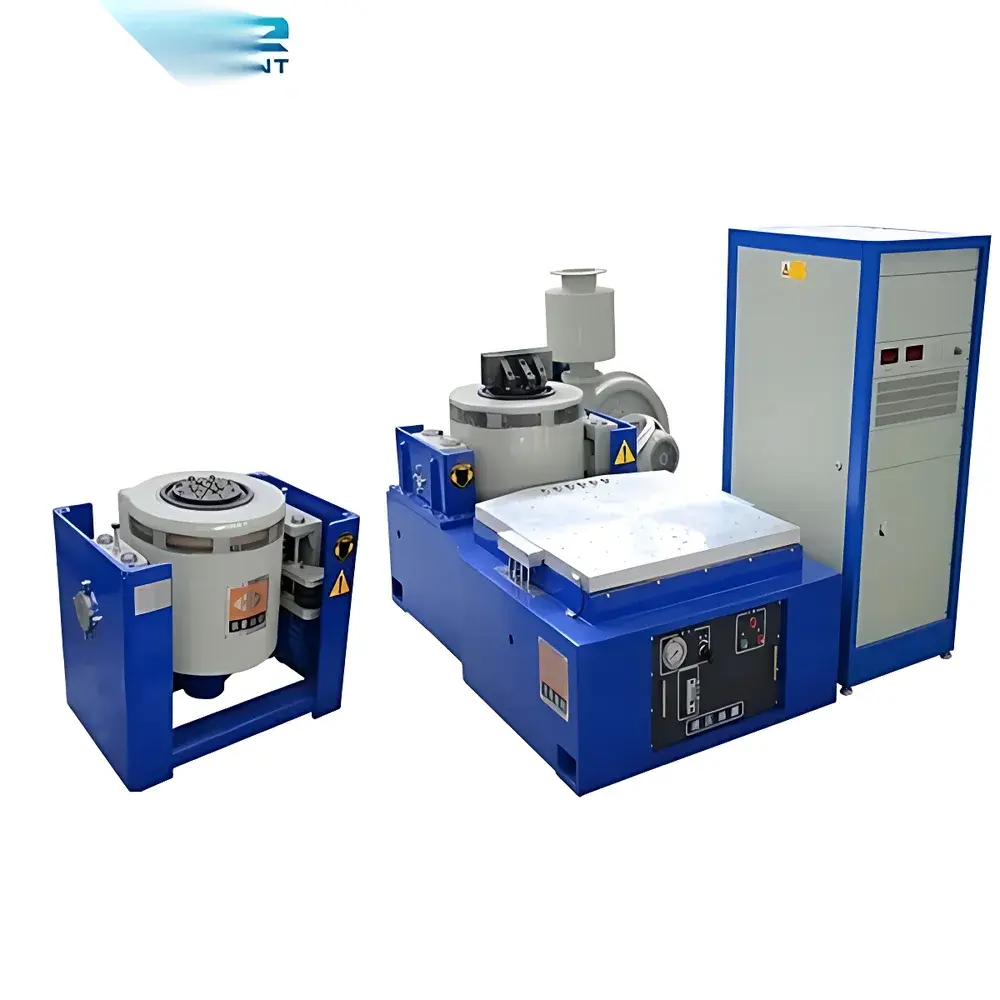
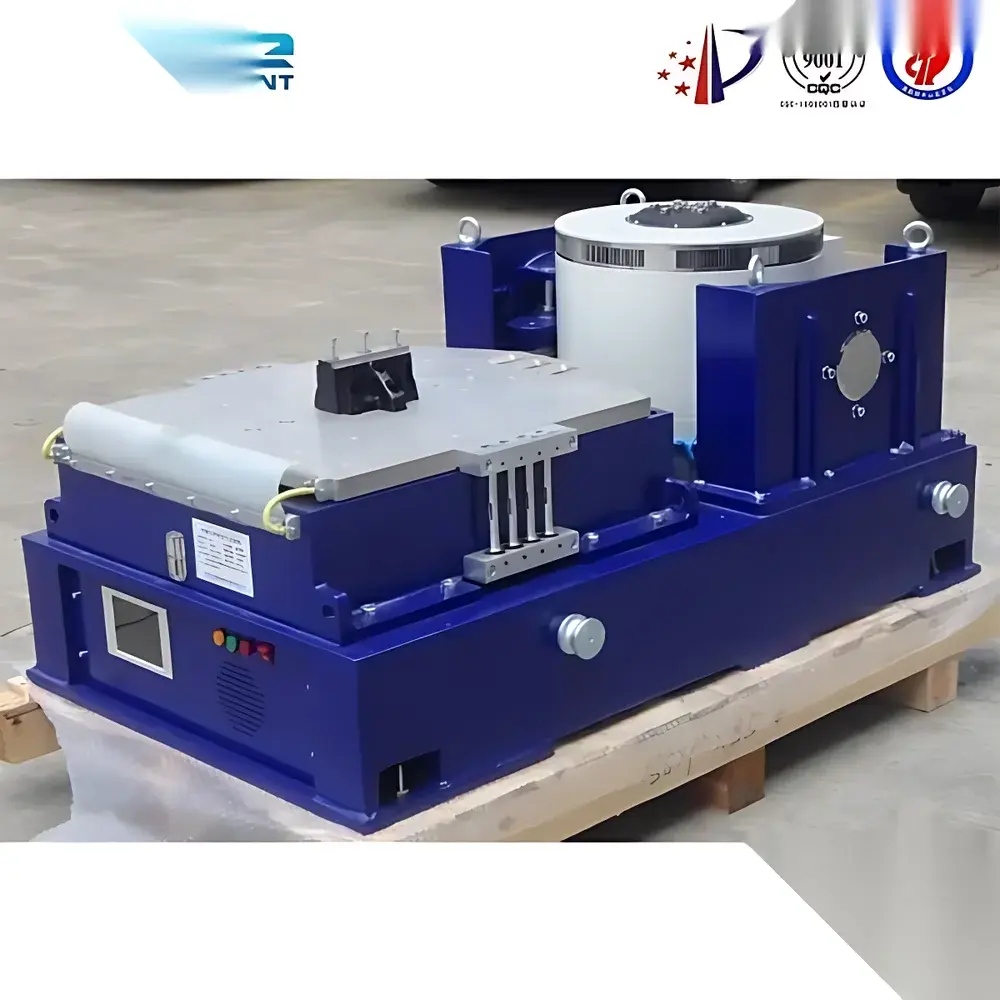
Generic 20g Random Vibration Shaker System
| Brand | OEM / Third-Party Manufacturer |
|---|---|
| Origin | Imported |
| Manufacturer Type | Authorized Distributor |
| Max Acceleration | 20 g (peak) |
| Max Displacement | 5 mm p-p |
| Frequency Range | 1–600 Hz (standard), up to 5000 Hz (customizable) |
| Load Capacity | 100 kg |
| Power Rating | 2.2 kW |
| Table Surface Options | 30×30 cm, 50×50 cm, 75×75 cm, or 100×100 cm |
| Vibration Axes | Vertical (Z-axis) and Horizontal (X/Y-axis) |
| Waveform | Sinusoidal |
| Control Modes | Sweep, Programmable (15-segment), Logarithmic, Octave (15-step), Frequency Tuning |
Overview
The Generic 20g Random Vibration Shaker System is an electrodynamic vibration testing platform engineered for precision mechanical stress evaluation under controlled sinusoidal excitation. While commonly referenced as a “random vibration” shaker in commercial nomenclature, this system operates primarily in deterministic sinusoidal mode—supporting sweep, programmable, logarithmic, and octave-based test profiles per ISO 5344, IEC 60068-2-6, and MIL-STD-810H methodologies. It is not a true broadband random shaker (which requires closed-loop PSD control and digital signal synthesis), but rather a high-fidelity sinusoidal shaker optimized for resonant frequency identification, fatigue life assessment, and structural integrity verification of components and subassemblies. Its 20 g peak acceleration capability, combined with 5 mm peak-to-peak displacement and a 100 kg payload capacity, enables rigorous qualification testing across aerospace hardware, automotive ECUs, medical device enclosures, and industrial electronics. The system’s modular table configurations (30×30 cm to 100×100 cm) and dual-axis (vertical/horizontal) mounting options support both single-point and multi-axis sequential testing protocols.
Key Features
- Electrodynamic actuator architecture with air-cooled voice coil motor, delivering stable 20 gpk acceleration across the full operational bandwidth.
- Programmable test sequencing: 15 independent segments per test profile, each configurable for target frequency, dwell time, sweep rate, and amplitude ramping—fully compliant with ASTM D999 and IPC-9701 requirements.
- True bidirectional sweep functionality: user-defined upper/lower frequency limits and dwell duration, supporting both linear and logarithmic sweep modes (1–600 Hz standard; extended to 5000 Hz upon factory calibration).
- Dual-axis mechanical design: interchangeable vertical (Z-axis) and horizontal (X/Y-axis) configurations, with rigid base plates and low-center-of-gravity structural framing to minimize rocking moments during high-g excitation.
- Adjustable displacement range: 0–5 mm p-p, digitally regulated via feedback-controlled amplifier to maintain waveform fidelity at resonance peaks.
- Integrated thermal protection and over-acceleration cutoff circuits ensure long-term reliability under continuous duty cycles.
- Standard 2.2 kW power supply with IEC 61000-3-2 harmonic compliance and CE/UKCA marking for global laboratory deployment.
Sample Compatibility & Compliance
The shaker accommodates test specimens up to 100 kg mass on any standard table size (30×30 cm minimum; 100×100 cm maximum), with optional slip-table extensions and fixture interface kits (M6/M8 threaded inserts, T-slots) for custom mounting. It supports passive and active transducer integration—including accelerometers (IEPE or charge output), laser Doppler vibrometers, and strain gauge arrays—for real-time response validation. The system meets essential regulatory benchmarks for environmental simulation: ISO 10816-1 (vibration severity assessment), IEC 60068-2-6 (sinusoidal vibration testing), and MIL-STD-810H Method 514.8 (vibration tailoring). Though not inherently compliant with FDA 21 CFR Part 11 out-of-the-box, its controller firmware supports audit-trail-enabled software upgrades for GxP-aligned validation workflows when deployed in pharmaceutical or Class II/III medical device QC labs.
Software & Data Management
The shaker operates with vendor-neutral SCPI-compatible command set (IEEE 488.2), enabling seamless integration into LabVIEW, MATLAB, or Python-based test automation frameworks. Optional Windows-based control software provides graphical waveform preview, real-time FFT spectrum display, and automated report generation (PDF/CSV) with timestamped metadata. All test logs include traceable parameters: applied frequency, acceleration setpoint, displacement limit, ambient temperature, and system status flags. For regulated environments, optional firmware modules enable electronic signatures, user role-based access control, and immutable data archiving—aligned with GLP and GMP documentation expectations.
Applications
- Resonance search and mode shape analysis of printed circuit board assemblies (PCBAs) and chassis structures.
- Vibration endurance screening of avionics enclosures, satellite subsystems, and UAV payloads per ECSS-Q-ST-70-08C.
- Qualification testing of automotive infotainment modules, ADAS sensors, and battery management systems under ISO 16750-3.
- Reliability validation of consumer electronics (smartphones, wearables) per IEC 60068-2-64 (though note: true random testing requires supplemental controller hardware).
- Educational and R&D use in mechanical engineering laboratories for modal analysis coursework and thesis-level dynamic characterization studies.
FAQ
Is this system capable of true random vibration testing?
No—it is a high-performance sinusoidal shaker. True random vibration requires a dedicated controller with real-time PSD synthesis, closed-loop error correction, and broadband amplifier bandwidth (>5 kHz). This unit supports only deterministic waveforms: sine, sweep, and programmable step sequences.
Can it perform multi-axis simultaneous vibration?
No. It supports vertical (Z-axis) or horizontal (X/Y-axis) operation individually. Multi-axis testing must be conducted sequentially using repositioning or auxiliary fixtures.
What is the maximum payload at 20 g across all frequencies?
The 100 kg load rating applies at frequencies ≤100 Hz. Above 100 Hz, payload must be derated per the shaker’s force-limited envelope (F = m·a); consult the mechanical compliance curve in the technical manual.
Does the system include calibration certification?
A factory-as-built calibration certificate (traceable to NIST or PTB standards) is included. Annual recalibration services are available through authorized service centers.
Is remote monitoring supported?
Yes—via Ethernet (TCP/IP) or RS-232 interface using SCPI commands. Real-time acceleration and displacement telemetry can be streamed to external DAQ systems.



