
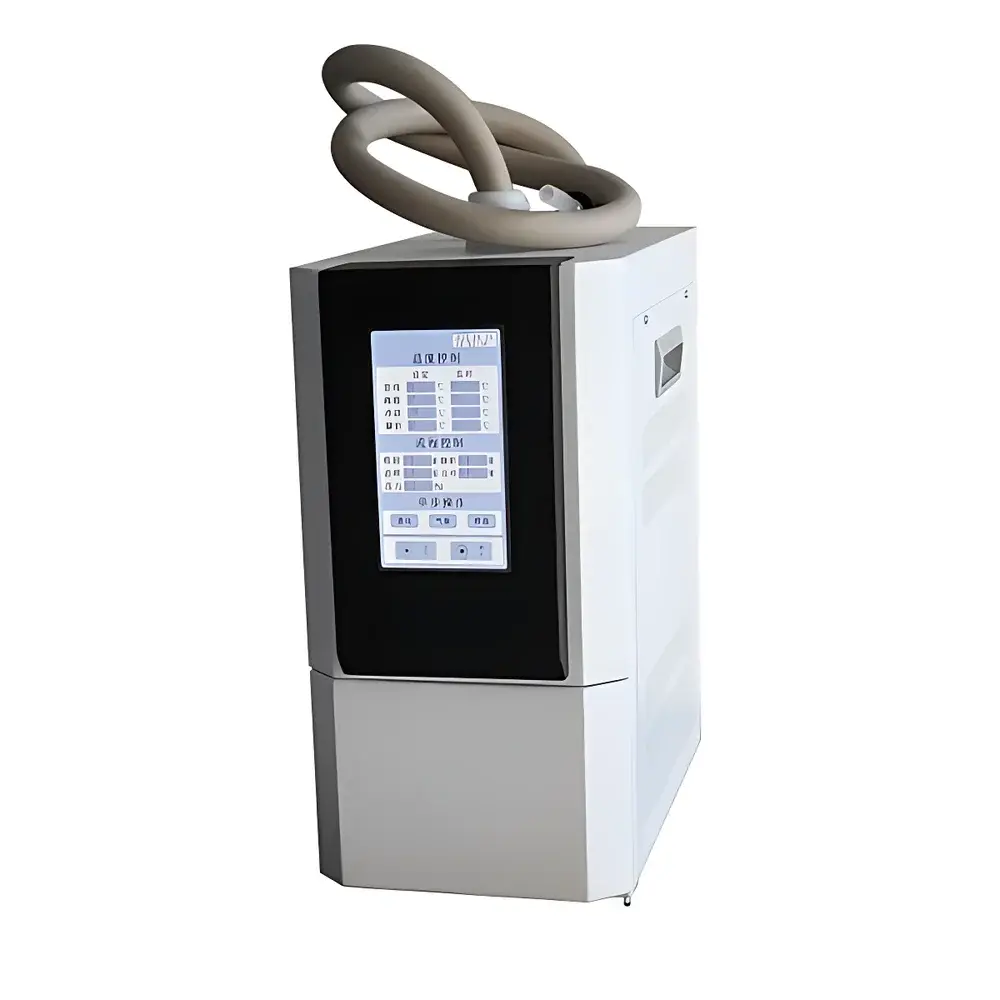
Beifen Sanpu HP-6900N Automated Cryo-Concentrating Thermal Desorber for Hydrogen Sulfide Analysis
| Brand | Beifen Sanpu |
|---|---|
| Origin | Beijing, China |
| Manufacturer Type | Direct Manufacturer |
| Instrument Type | Secondary Thermal Desorber |
| Model | HP-6900N |
| Desorption Zone Temp Range | Ambient to 350 °C (1 °C increments, ramp rate >2000 °C/min) |
| Valve & Transfer Line Temp Range | Ambient to 220 °C (1 °C increments) |
| Cold Trap Temp Range | −35 °C to ambient (1 °C increments) |
| Temperature Control Accuracy | < ±0.5 °C |
| Adsorption Flow Rate | 0–300 mL/min (adjustable) |
| Desorption/Injection/Backflush Time Range | 0.01–999 min |
| Backflush Flow Rate | 0–160 mL/min (adjustable) |
| Sample Capacity | 1 tube position |
| Desorption Recovery | >90% |
| Dimensions | 400 × 220 × 420 mm |
| Power Consumption | ~300 W |
| Weight | ~20 kg |
Overview
The Beifen Sanpu HP-6900N Automated Cryo-Concentrating Thermal Desorber is a dedicated sample introduction system engineered for trace-level quantification of hydrogen sulfide (H₂S) and other volatile sulfur compounds in ambient air matrices. Designed in strict compliance with GB/T 14678–1993 (“Air Quality — Determination of Hydrogen Sulfide, Methanethiol, Dimethyl Sulfide, and Dimethyl Disulfide”), the instrument integrates semiconductor-based cryogenic trapping with rapid thermal desorption to achieve high-fidelity preconcentration and transfer of analytes into gas chromatographic systems. Its core architecture employs four independently controlled temperature zones — adsorption cold trap, desorption furnace, multi-port valve manifold, and heated transfer line — enabling precise retention of low-boiling, reactive species such as H₂S (bp: −60 °C) prior to sharp, reproducible elution. Unlike conventional thermal desorbers optimized for semi-volatiles, the HP-6900N prioritizes sub-ambient trapping stability and minimal surface interaction, minimizing decomposition or wall adsorption that compromises accuracy in sulfur speciation analysis.
Key Features
- Seven-inch full-color touchscreen interface with intuitive Chinese-language UI (English firmware optional upon request), supporting one-touch method launch and real-time monitoring of temperature profiles, elapsed time, and system status.
- Four-zone independent temperature control: cryo-trap (−35 °C to ambient), desorption zone (ambient to 350 °C), valve oven (ambient to 220 °C), and transfer line (ambient to 220 °C), all adjustable in 1 °C increments with stability better than ±0.5 °C.
- Integrated mass flow sensor for dynamic volumetric sampling; automatically calculates and logs sampled air volume based on user-defined flow rate (0–300 mL/min) and duration.
- Automated sequence programming for synchronized adsorption, cryo-focusing, thermal desorption, GC injection, and post-run backflush — eliminating manual intervention and ensuring inter-run consistency.
- Dual-stage inertization: all internal gas pathways (including stainless-steel tubing, valve seats, and trap frits) undergo silanized or Sulfinert®-type deactivation to prevent H₂S adsorption, oxidation, or catalytic decomposition.
- Universal GC/GC-MS compatibility via configurable hardware interfaces (including Agilent, Thermo Fisher, Shimadzu, and PerkinElmer pinout mapping); supports TTL-triggered start of GC acquisition and data system logging.
- Onboard liquid standard calibration capability using syringe-driven vaporization, enabling direct generation of certified H₂S reference concentrations without external permeation tubes or gas cylinders.
Sample Compatibility & Compliance
The HP-6900N is validated for use with sorbent tubes containing Tenax TA, Carbopack B/C, or mixed-bed media (e.g., Carbograph 4 + Carboxen 1000) for ambient air sampling per ISO 16017-1 and EPA TO-17 protocols. Its −35 °C cold trap ensures quantitative retention of H₂S (vapor pressure ≈ 1.7 atm at 25 °C) even during extended sampling at elevated humidity. All temperature ramping, dwell, and hold parameters are fully programmable and logged with timestamps, satisfying GLP audit requirements for traceability. The system meets mechanical and electrical safety standards per GB 4793.1–2007 (equivalent to IEC 61010-1) and supports 21 CFR Part 11-compliant electronic records when paired with validated chromatography data systems (CDS).
Software & Data Management
Instrument operation and method configuration are managed either locally via the embedded touchscreen or remotely through a Windows-based PC application (included). The software enables creation of multi-step thermal programs, storage of up to 100 user-defined methods, and export of CSV-formatted run logs containing temperature setpoints, flow values, timing events, and system error flags. All parameters — including adsorption time, desorption ramp rate, trap re-equilibration delay, and backflush duration — are editable and version-controlled. Audit trail functionality records operator ID, timestamp, and parameter changes, supporting laboratory quality management systems aligned with ISO/IEC 17025 and FDA guidance on analytical instrument qualification.
Applications
Primary applications include regulatory monitoring of H₂S emissions from wastewater treatment plants, landfill gas collection systems, petroleum refineries, and pulp-and-paper facilities. The system also supports research-grade analysis of odorant sulfur compounds in indoor air, biogas composition profiling, and method development for ASTM D5504 (determination of sulfur compounds in natural gas) and EN 14791 (ambient air — determination of H₂S by GC-FPD). Its single-tube design and automated workflow make it suitable for routine QC labs requiring high throughput and minimal analyst training.
FAQ
Is the HP-6900N compatible with non-Chinese GC systems?
Yes — it includes hardware adapters and TTL/RS232 interfaces for seamless synchronization with major international GC and GC-MS platforms.
What sorbent tubes are recommended for H₂S analysis?
Tenax TA alone is insufficient due to breakthrough; we recommend Carbopack B or dual-bed tubes (Carbograph 4 + Carboxen 1000) validated per EPA TO-17 for sub-ppbv H₂S recovery.
Does the system support unattended overnight operation?
Yes — programmable sleep/wake cycles, automatic leak detection before each run, and thermal fault shutdown ensure safe extended operation.
Can the cold trap temperature be held below −30 °C for extended periods?
The semiconductor cooling module maintains stable −35 °C for ≥8 hours under typical lab conditions (25 °C ambient, 50% RH), verified per manufacturer thermal load testing.
How is calibration traceability maintained?
Liquid standard injections are traceable to NIST SRM 1643e (trace elements in water) or certified H₂S-in-nitrogen gas standards; full calibration reports are auto-generated and exportable.
Related Products






