
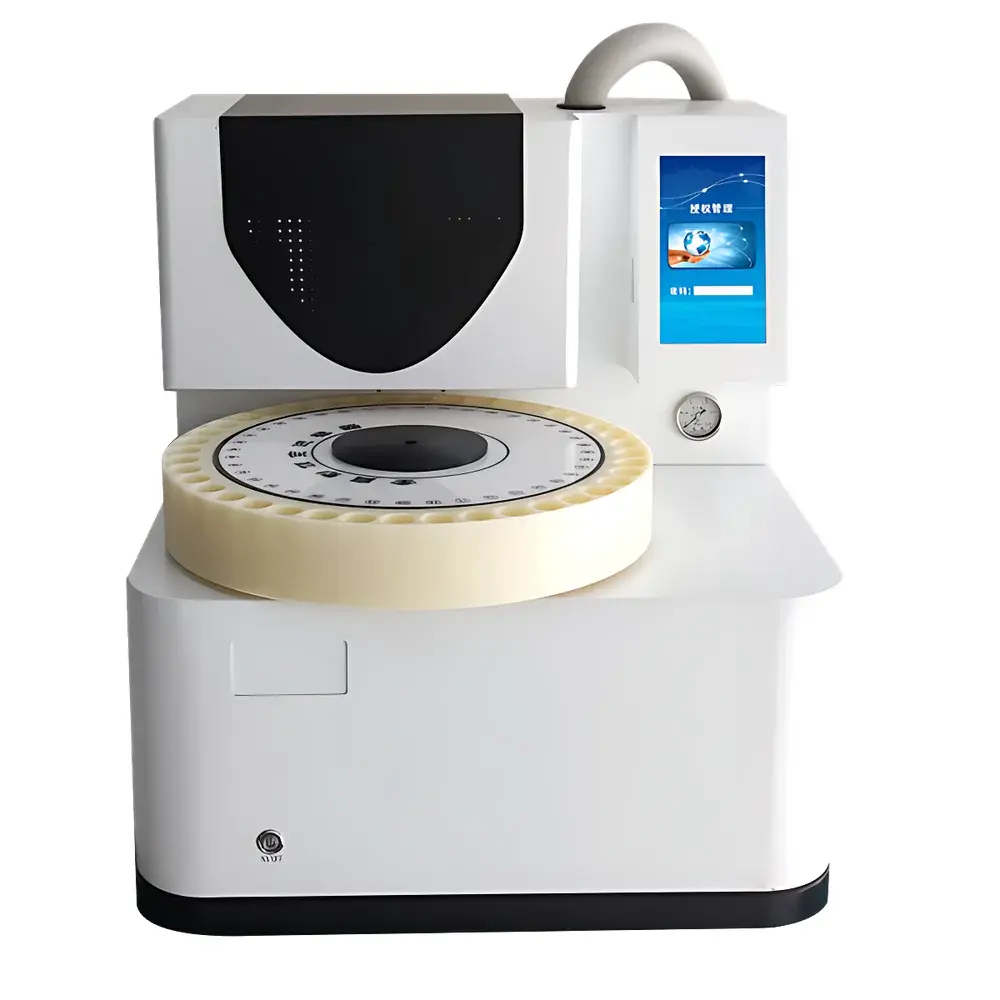
Beifen Sanpu AHS-40B Automated Static Headspace Sampler
| Brand | Beifen Sanpu |
|---|---|
| Origin | Beijing, China |
| Manufacturer Type | Direct Manufacturer |
| Instrument Type | Static Headspace Sampler |
| Automation Level | Fully Automated |
| Sample Vial Heating Range | 0–220 °C |
| Valve Heating Range | 40–220 °C |
| Loop Volume | 1 mL |
| Temperature Control Accuracy | ±0.5 °C (stability), 0.5% (accuracy) |
| Sample Capacity | 40 positions |
| Vial Size | 10 mL |
Overview
The Beifen Sanpu AHS-40B Automated Static Headspace Sampler is an engineered solution for high-throughput, reproducible sample introduction into gas chromatography (GC) and GC–MS systems. It operates on the principle of static headspace analysis: volatile analytes partition from liquid or solid matrices into the equilibrated vapor phase above the sample, which is then pressurized and transferred quantitatively via a heated six-port valve and inert transfer line to the GC inlet. Designed for regulatory-compliant laboratories, the AHS-40B delivers precise thermal control across all critical zones—sample vials, injection valve, and transfer tubing—to prevent condensation, adsorption, or degradation of thermally labile volatiles. Its architecture supports method robustness in environmental, clinical, food safety, and forensic applications where detection at sub-ppb levels and inter-laboratory reproducibility are essential.
Key Features
- Fully automated 40-position carousel with real-time vial presence detection—no manual position mapping required;
- Independent 15-position heated sample block enabling staggered equilibration and overlapping cycles for throughput optimization;
- Integrated vial agitation (orbital shaking) to accelerate phase equilibrium, improve sensitivity for low-volatility compounds, and enhance method repeatability (RSD < 1.0% demonstrated for 100 ppm ethanol in water);
- Heated valve oven (40–220 °C) and insulated transfer line—both maintained within a single thermal zone—to eliminate cold spots and ensure quantitative transfer of high-boiling-point analytes;
- Electronic pressure control (EPC) capable of precise, programmable pressurization (0–0.25 MPa) and adjustable pressurization time (0–999 s), sampling time (0–30 min), and loop fill duration;
- Motor-driven actuation system—no external carrier gas or pneumatic lines required—reducing infrastructure complexity and improving operational safety;
- 7-inch graphical LCD interface with animated workflow guidance; bilingual UI (English/Chinese) and built-in stopwatch, log history, and contextual help functions;
- USB communication interface supporting full remote configuration and monitoring via PC; compatible with third-party GC and data systems through TTL/relay-triggered synchronization.
Sample Compatibility & Compliance
The AHS-40B accommodates standard 10 mL crimp-top headspace vials (customizable for 5–100 mL formats) and accepts both liquid and solid samples—including aqueous solutions, soils, biological tissues, beverages, and polymers—without matrix-specific hardware modification. Its thermal stability (±0.5 °C) and inert flow path (siliconized stainless steel and deactivated fused silica tubing) minimize analyte loss, carryover, or artifact formation. The instrument complies with multiple national and method-specific standards, including HJ 679–2013, HJ 741–2015, HJ 1067–2019, and GB/T 5750.8–2006 for VOC analysis in water, soil, and drinking water. It supports GLP/GMP-aligned workflows through audit-trail-capable method storage (up to 10 protocols), parameter logging, and fault diagnostics with overtemperature protection and self-test on startup.
Software & Data Management
All operational parameters—including vial temperature, valve and transfer line setpoints, pressurization pressure, loop fill time, and purge duration—are fully programmable either locally via the front-panel interface or remotely via USB-connected software. The system supports synchronized start/stop triggers with GC instruments and chromatographic data systems (CDS), enabling seamless integration into automated batch sequences. While the AHS-40B does not embed FDA 21 CFR Part 11-compliant electronic signatures, its parameter logging, method versioning, and error-event timestamping provide foundational traceability for ISO/IEC 17025-accredited laboratories. Optional EPC upgrade enhances long-term flow consistency and reduces manual calibration dependency.
Applications
- Environmental testing: Quantification of BTEX, chlorinated solvents, and halogenated hydrocarbons in groundwater, soil extracts, and air-captured sorbents per EPA Method 502.2, 524.4, and equivalent Chinese HJ standards;
- Clinical toxicology: Ethanol, methanol, and acetone determination in whole blood and serum per GA/T 842–2019;
- Food and beverage quality control: Residual solvents (e.g., ethyl acetate, dichloromethane), off-flavor compounds (e.g., aldehydes, esters), and fermentation byproducts;
- Pharmaceutical QC: Residual solvent analysis in active pharmaceutical ingredients (APIs) and excipients per ICH Q3C guidelines;
- Polymer and packaging migration studies: Detection of volatile migrants (e.g., styrene, toluene) from plastic containers into food simulants.
FAQ
What sample vial sizes does the AHS-40B support?
Standard configuration supports 10 mL crimp-top vials; optional adapters accommodate 5 mL, 20 mL, 50 mL, and 100 mL formats upon request.
Can the instrument perform dynamic headspace (purge-and-trap) analysis?
No—the AHS-40B is a static headspace sampler only. Dynamic headspace capability requires dedicated purge-and-trap hardware not integrated into this platform.
Is the 1 mL sample loop volume fixed or customizable?
The default loop volume is 1 mL, but custom loops of 0.5 mL, 2 mL, or 5 mL are available as factory-configured options.
How does the system prevent cross-contamination between samples?
It employs programmable post-injection backflush (0–100 mL/min, inert gas) of the valve and loop, plus heated transfer line purging, to eliminate residual analytes prior to the next cycle.
Does the AHS-40B meet requirements for regulated environments such as clinical labs?
Yes—it provides thermal stability, method traceability, and hardware-level diagnostics suitable for ISO/IEC 17025 and CAP-accredited laboratories; however, full 21 CFR Part 11 compliance requires supplementary CDS-level validation.





