
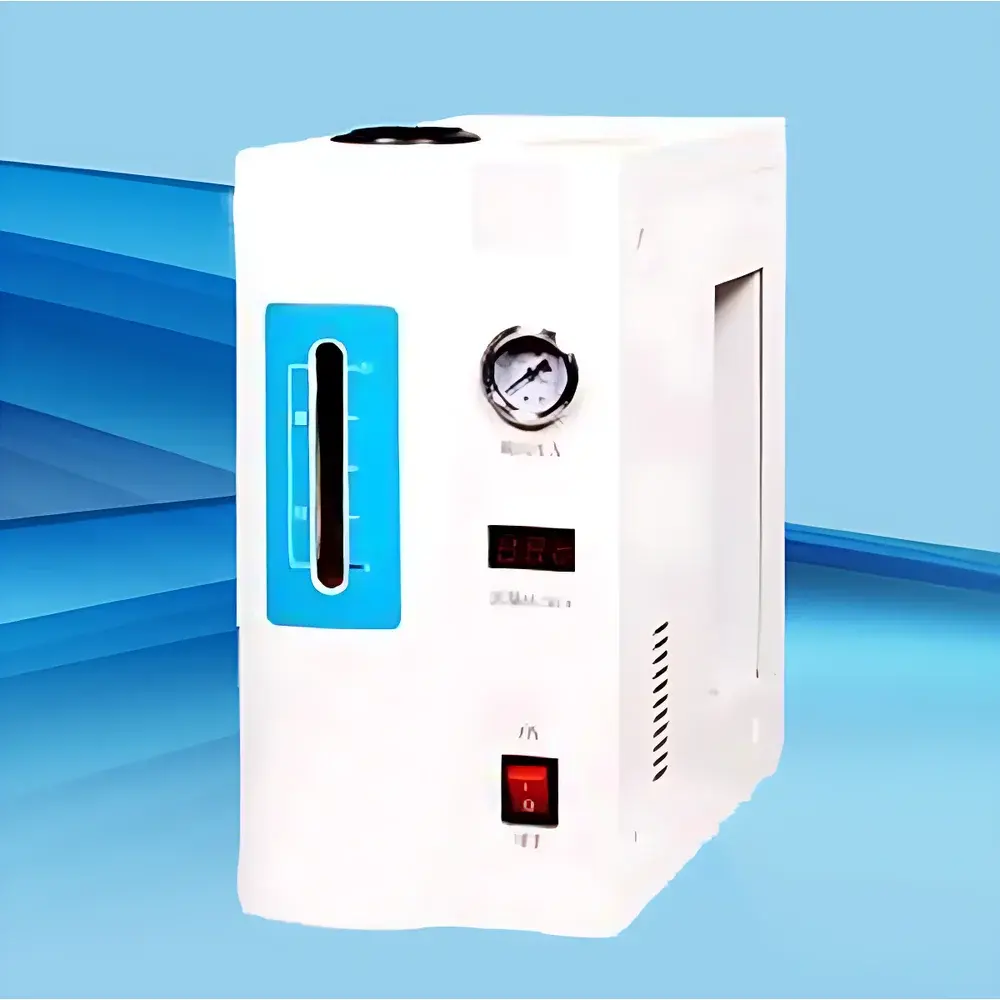
Beifen Sanpu BF-1000N High-Purity Nitrogen Generator
| Brand | Beifen Sanpu |
|---|---|
| Origin | Beijing, China |
| Manufacturer Type | Direct Manufacturer |
| Model | BF-1000N |
| Power Consumption | 200 W |
| Nitrogen Purity | 99.996% (v/v, O₂-equivalent) |
| Output Flow Rate | 0–1000 mL/min |
| Output Pressure | 0.4 MPa |
| Input Air Pressure | 0.5 MPa |
| Operating Temperature | 10–40 °C |
| Relative Humidity | <85% RH |
| Dimensions (L×W×H) | 520×280×400 mm |
| Weight | ~25 kg |
| Compliance | Designed for ISO/IEC 17025-compliant lab environments, compatible with GLP/GMP workflows requiring documented gas supply integrity |
Overview
The Beifen Sanpu BF-1000N High-Purity Nitrogen Generator is an on-demand, membrane-assisted pressure-swing electrolytic nitrogen generation system engineered for continuous, reliable operation in analytical laboratories. Unlike cryogenic or PSA-based nitrogen sources, the BF-1000N employs a proprietary multi-layer plate-type electrolytic separation cell architecture to selectively dissociate moisture and oxygen from compressed air feedstock via electrochemical decomposition of water vapor—yielding nitrogen gas with trace oxygen content ≤4 ppm (equivalent to 99.996% v/v purity). The core electrolyzer operates at thermally stabilized low temperature (<45 °C), minimizing electrode degradation and ensuring long-term stability of gas output specifications. Integrated automatic purge sequencing (10-minute initial venting cycle) eliminates residual ambient air from internal manifolds prior to delivery, enabling rapid attainment of specification-grade purity without manual conditioning. This design supports uninterrupted operation under variable demand profiles typical of GC carrier gas, LC-MS instrument purge lines, and inert atmosphere glove boxes.
Key Features
- Multi-layer plate-type electrolytic separation cell with enlarged active surface area—enhances current efficiency and extends operational lifetime beyond 15,000 hours under nominal load conditions.
- Integrated non-backflow liquid protection system—mechanically prevents electrolyte migration into gas pathways, eliminating risk of contamination to connected instrumentation.
- Intelligent power management with adaptive load regulation—maintains consistent flow-pressure characteristics across input voltage fluctuations (220 V ±10%, 50 Hz).
- Real-time digital flow indication and pressure stabilization circuitry—ensures steady-state delivery at 0.4 MPa (±0.02 MPa) within ±2% full-scale accuracy.
- Compact benchtop footprint (520 × 280 × 400 mm) with vibration-damped base—optimized for placement adjacent to GC ovens, mass spectrometers, or nitrogen-sensitive synthesis stations.
- Low thermal signature and passive cooling architecture—requires no external ventilation ducting or dedicated HVAC integration.
Sample Compatibility & Compliance
The BF-1000N is validated for use with all major gas-dependent analytical platforms requiring high-purity nitrogen, including but not limited to: gas chromatography (GC) carrier and detector gases (FID, NPD, ECD), liquid chromatography–mass spectrometry (LC-MS) nebulizer and drying gas supplies, Fourier-transform infrared (FTIR) purge lines, and inerting applications in pharmaceutical stability chambers. Its output meets ASTM D6349-20 requirements for nitrogen purity in instrumental analysis and aligns with ISO 8573-1:2010 Class 2:2:2 compressed air quality standards when supplied with appropriately filtered inlet air (recommended pre-filtration: coalescing + activated carbon + desiccant). While not certified to FDA 21 CFR Part 11, the unit’s stable, auditable output profile supports ALCOA+ data integrity principles when paired with external logging systems compliant with GxP documentation protocols.
Software & Data Management
The BF-1000N operates as a standalone hardware system with no embedded firmware, cloud connectivity, or proprietary software interface. All operational parameters—including power status, flow rate, and pressure—are conveyed via analog metering and tactile controls. This architecture ensures electromagnetic compatibility (EMC) with sensitive detection electronics and eliminates cybersecurity vulnerabilities associated with networked lab devices. For laboratories requiring traceable gas usage records, third-party analog-to-digital signal converters (e.g., National Instruments USB-6009) may be used to log flow and pressure outputs into LIMS or ELN platforms supporting IEEE 1451.2 transducer interface standards.
Applications
- Carrier gas supply for capillary GC systems requiring consistent 99.996% N₂ purity and sub-ppm oxygen tolerance.
- Drying and nebulizing gas for electrospray ionization (ESI) and atmospheric pressure chemical ionization (APCI) sources in LC-MS platforms.
- Purge gas for FTIR spectrometers, Raman analyzers, and UV-Vis spectrophotometers where hydrocarbon or moisture interference must be minimized.
- Inert blanket gas for solvent evaporation stations, Schlenk lines, and nitrogen gloveboxes operating below 10 ppm O₂.
- Reference gas source for calibration of oxygen analyzers and paramagnetic gas sensors in QA/QC laboratories.
FAQ
What compressed air quality is required for optimal BF-1000N performance?
Supply air must be oil-free, dried to ≤−40 °C dew point, and filtered to remove particulates ≥0.01 µm. A two-stage filtration system (coalescing + activated carbon) is strongly recommended upstream of the generator inlet.
Can the BF-1000N be integrated into a centralized lab gas distribution network?
Yes—provided the distribution manifold maintains backpressure regulation and incorporates redundant check valves to prevent cross-contamination from other gas sources.
Is routine maintenance required beyond filter replacement?
Electrolyte replenishment is not necessary; the sealed electrolytic cell is designed for maintenance-free operation over its rated service life. Annual inspection of inlet filters and pressure relief components is advised per ISO 55001 asset management guidelines.
Does the BF-1000N meet USP <841> or EP 2.5.27 specifications for pharmaceutical nitrogen?
No—the unit produces nitrogen meeting general laboratory grade (99.996%), but does not comply with pharmacopoeial monographs requiring additional microbial control, particulate testing, or formal validation documentation packages.



