
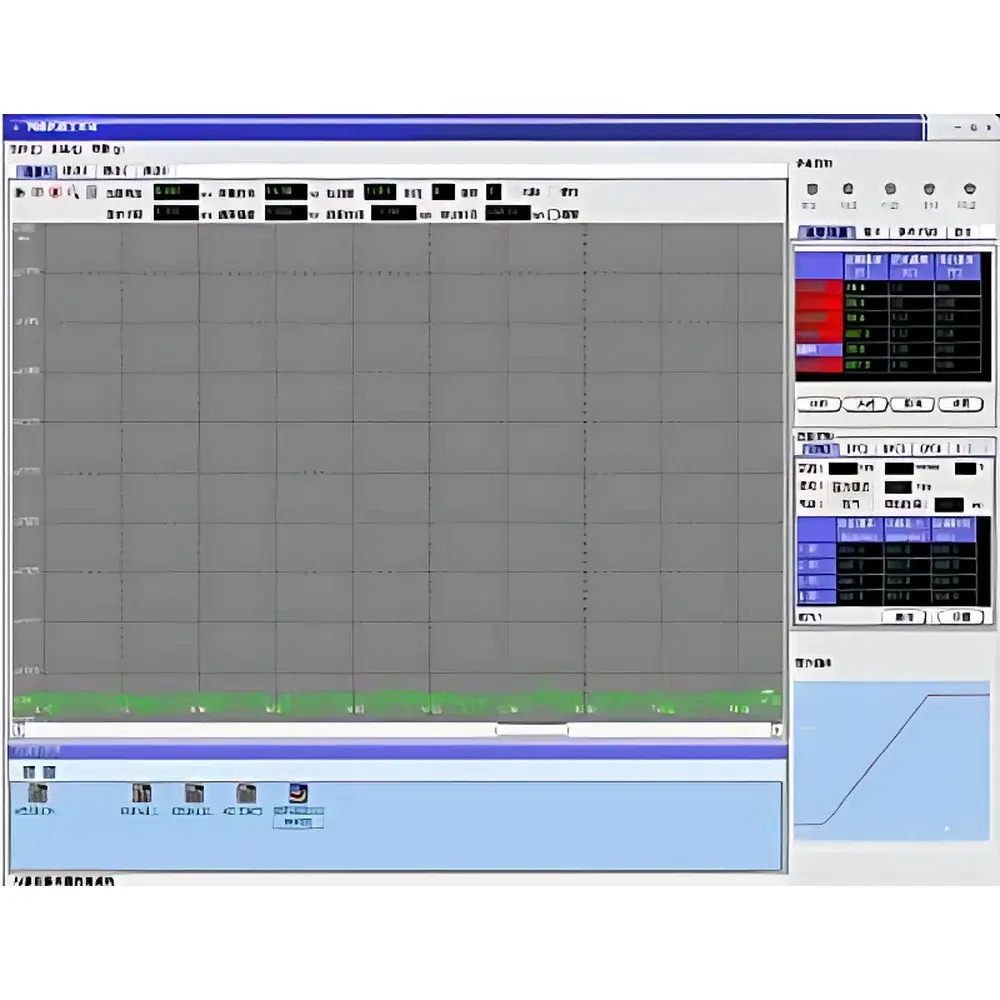
Beifen Sanpu GC-9860 Network-Enabled Gas Chromatography Data System
| Brand | Beifen Sanpu |
|---|---|
| Origin | Beijing, China |
| Manufacturer Type | Direct Manufacturer |
| Model | GC-9860 |
| Communication Interface | 10/100 Mbps Adaptive Ethernet |
| Max Concurrent Instruments | 5,000 |
| Data Import Format | AIA/CDF (ASTM E1947-compliant) |
| Analog Input Range | ±2.5 V |
| Integration Sensitivity | 0.05 µV·s |
| Minimum Resolution | 1 µV |
| Dynamic Range | 10⁷ |
| Linearity | ±0.005% |
| Repeatability | ±0.005% |
| Sampling Rate | Adjustable from 10 to 50 Hz |
| Peak Detection | Intelligent automated peak identification with baseline correction and deconvolution of co-eluting peaks |
| Quantitation Methods | Normalization, corrected normalization, single-point internal/external standard, multi-point internal/external calibration |
| Software Architecture | Multi-threaded, seat-scalable client-server system |
| Remote Data Export Protocols | HTTP/HTTPS, MODBUS TCP, CANopen, GPRS, 3G, private wireless network |
| Compliance | Designed for GLP/GMP environments |
Overview
The Beifen Sanpu GC-9860 Network-Enabled Gas Chromatography Data System is a purpose-built, server-centric chromatographic data management platform engineered for modern laboratory and industrial process environments requiring centralized control, high-throughput analysis, and regulatory-compliant data handling. Unlike legacy RS-232–based chromatography workstations—now obsolete due to hardware discontinuation and inherent limitations in bandwidth, distance, and scalability—the GC-9860 system implements a standards-based Ethernet architecture compliant with IEEE 802.3. It functions as a true distributed data acquisition and processing hub, supporting up to 5,000 concurrently connected gas chromatographs across geographically dispersed locations. The system captures raw analog detector signals (FID, TCD, ECD, etc.) via high-fidelity 24-bit ADC circuitry, applies real-time digital filtering to resolve peaks with amplitudes approaching baseline noise levels (≥0.05 µV·s integration sensitivity), and performs quantitative analysis using validated algorithms aligned with ASTM D3699 (hydrocarbon analysis), ISO 10101 (gas purity testing), and USP (chromatographic system suitability). Its deterministic multi-threaded architecture decouples signal acquisition, peak processing, and user interface rendering—ensuring uninterrupted operation during long-duration method runs or concurrent multi-instrument monitoring.
Key Features
- Fully networked, client-server architecture with 10/100 Mbps adaptive Ethernet interface—eliminates serial port dependency and enables deployment over LAN/WAN infrastructure.
- Scalable seat licensing model: supports single-operator desktop use or enterprise-wide deployment with multiple concurrent operator stations, each with role-based permissions.
- Intelligent peak detection engine utilizing adaptive baseline modeling and iterative deconvolution—minimizes manual parameter tuning for retention time alignment, peak width estimation, and overlapping peak resolution.
- Comprehensive quantitation suite compliant with pharmacopeial and industrial standards: normalization, single/multi-point internal and external calibration, response factor tables, and custom formula-driven calculations.
- High-resolution analog input stage (±2.5 V range, 1 µV minimum resolution, 10⁷ dynamic range) with ±0.005% linearity and repeatability—certified for trace-level impurity profiling and residual solvent analysis.
- Extensible communication framework: native support for MODBUS TCP, CANopen, HTTP(S), and cellular telemetry (GPRS/3G) for integration into SCADA, MES, and LIMS ecosystems.
- Audit-ready software design: configurable electronic signatures, timestamped action logs, and immutable raw data storage—aligned with FDA 21 CFR Part 11 Annex 11 and ISO/IEC 17025 documentation requirements.
Sample Compatibility & Compliance
The GC-9860 Data System is fully compatible with all Beifen Sanpu GC-9860-series gas chromatographs, including models equipped with split/splitless injectors, PTV inlets, and multi-detector configurations (FID/TCD/ECD/NPD). It accepts raw chromatographic data in standardized AIA/CDF format per ASTM E1947, enabling interoperability with Agilent ChemStation, Waters Empower, and Thermo Chromeleon platforms for cross-platform method validation and data reprocessing. All signal processing modules undergo periodic verification against NIST-traceable reference standards. The system supports ICH Q2(R2)-defined system suitability testing—including tailing factor, theoretical plates, resolution, and %RSD of replicate injections—and stores metadata (oven ramp profiles, carrier gas flow rates, detector voltages) alongside chromatograms to satisfy GLP audit trails. Hardware components meet CE EMC Directive 2014/30/EU and RoHS 2011/65/EU specifications.
Software & Data Management
Data organization follows hierarchical, time-stamped conventions: automatic creation of instrument-specific folders, date-based subdirectories (YYYY-MM-DD), and sequence-numbered filenames (e.g., “GC9860_20240521_001.cdf”). Users may define custom naming rules by shift, batch ID, or SOP version. Raw data files are write-once/read-many (WORM) archived with SHA-256 checksums; processed results export to PDF/A-1b, CSV, or XML formats with embedded metadata. The integrated “Component Content Monitoring Module” provides real-time statistical process control (SPC) dashboards—tracking component concentration trends, detecting deviations beyond user-defined thresholds, triggering email/SMS alerts, and auto-generating daily summary reports compliant with ISO 9001 clause 8.5.2. Secondary development is supported via documented RESTful API endpoints and COM/DCOM interfaces for custom algorithm injection or ERP integration.
Applications
The GC-9860 Data System is deployed in pharmaceutical QC labs for residual solvent testing (ICH Q3C), petrochemical refineries for hydrocarbon group-type analysis (ASTM D5186), environmental laboratories for EPA Method 8260/8270 volatile organic compound screening, and fine chemical plants for reaction endpoint monitoring and distillation cut optimization. Its remote telemetry capability enables unattended operation in hazardous areas (ATEX Zone 2/Class I Div 2), while its high channel density supports parallel analysis of feedstock, intermediates, and final products across continuous manufacturing lines. In regulated biomanufacturing, it serves as the primary data acquisition layer for PAT (Process Analytical Technology) initiatives under FDA Guidance for Industry (2019).
FAQ
Does the GC-9860 Data System support FDA 21 CFR Part 11 compliance?
Yes—it provides electronic signature enforcement, audit trail logging, and role-based access control. Full implementation requires customer-configured domain authentication and encrypted network transport.
Can legacy GC instruments be retrofitted to work with this system?
Only GC-9860-series instruments with Ethernet-enabled controller boards are natively supported. RS-232 instruments require third-party protocol converters certified for deterministic latency.
What is the maximum sampling rate for high-speed applications like fast-GC?
Configurable up to 50 Hz per channel, with synchronized multi-channel acquisition across up to 5,000 instruments via time-stamped UDP packet streaming.
Is raw data export to third-party statistical tools possible?
Yes—raw .CDF files and processed .CSV exports include full metadata headers compatible with JMP, MATLAB, and Python pandas workflows.
How is software validation handled for GxP environments?
A comprehensive IQ/OQ/PQ protocol package is provided, including test scripts for peak integration accuracy, calibration linearity, and network failover resilience—validated against USP analytical instrument qualification guidelines.
Related Products




