
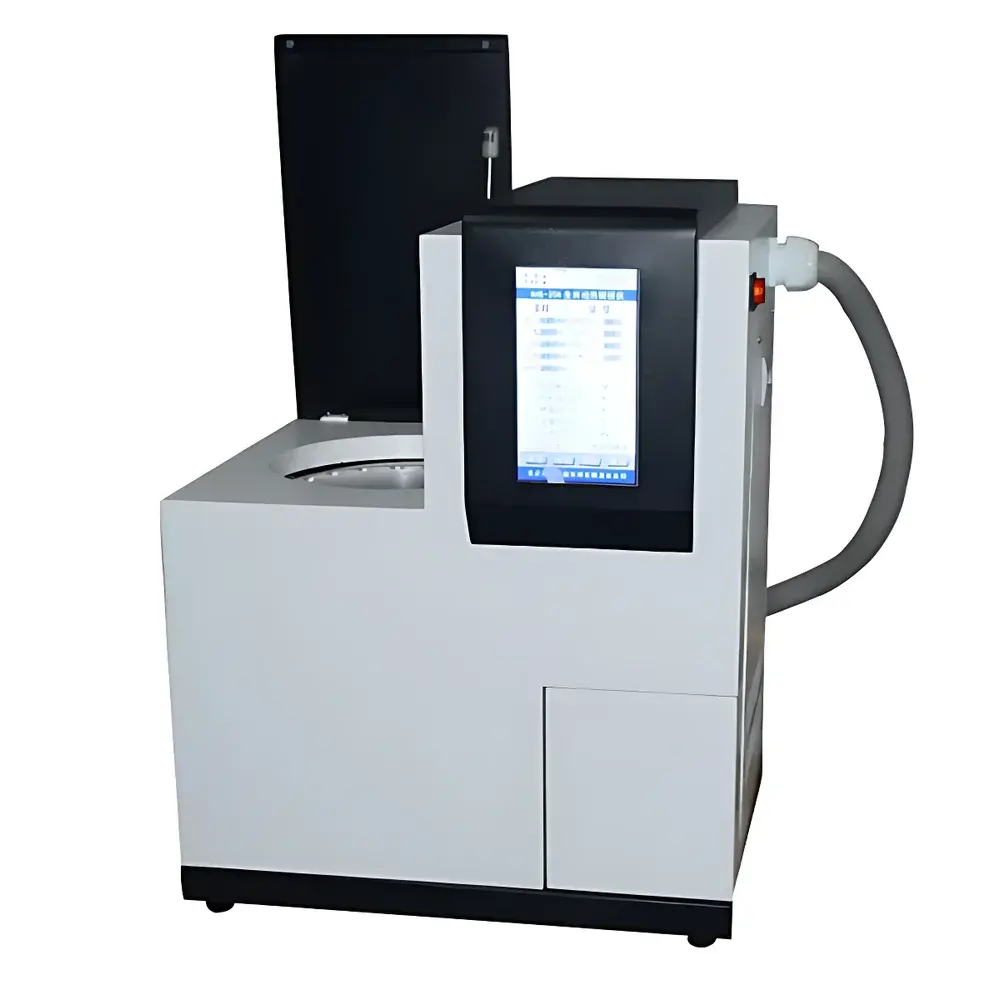
Beifen Sanpu AwTDS-20A Cryogenic Cold Trap Automated Two-Stage Thermal Desorber
| Brand | Beifen Sanpu |
|---|---|
| Origin | Beijing, China |
| Manufacturer Type | Direct Manufacturer |
| Model | AwTDS-20A |
| Temperature Control Range (Desorption 1) | Ambient to 450 °C (1 °C increments) |
| Valve & Transfer Line Temp Range | Ambient to 300 °C (1 °C increments) |
| Cryogenic Trap Temp Range | −35 °C to Ambient (1 °C increments, electronic cooling) |
| Temperature Accuracy | < ±0.5 °C |
| Desorption Recovery | >99% (compound-dependent) |
| RSD | ≤2.5% (benzene at 0.05 μg) |
| Sample Capacity | 20 positions |
| Sample Tube Format | 1/4″ OD × 3.5″ (ASTM D6196-compliant) |
| Re-injection & Backflush Flow | 0–100 mL/min (adjustable) |
| Simulated Sampling Flow | 0–160 mL/min (adjustable) |
| Enrichment Time | 0–60 min |
| Injection Time | 0–60 min |
| Heating Rate (2nd Stage) | >3000 °C/min |
| Dimensions | 350 × 450 × 510 mm |
| Weight | ~40 kg |
Overview
The Beifen Sanpu AwTDS-20A Cryogenic Cold Trap Automated Two-Stage Thermal Desorber is an engineered solution for quantitative trace analysis of volatile and semi-volatile organic compounds (VOCs and SVOCs) in air, indoor environments, building materials, food packaging headspace, and industrial emissions. It operates on the principle of two-stage thermal desorption: first, analytes are thermally released from sorbent tubes under controlled inert gas flow; second, they are cryogenically focused in a low-temperature trap (−35 °C minimum) prior to rapid, high-rate thermal desorption into the GC or GC-MS inlet. This process achieves analyte enrichment, peak sharpening, and superior sensitivity—critical for compliance with regulatory methods requiring sub-ppbv detection limits. The instrument is fully compatible with all major GC and GC-MS platforms—including Agilent, Thermo Fisher, Shimadzu, and PerkinElmer—via standardized pneumatic and electrical interfaces, including motor-driven six-port valve actuation and TTL-triggered GC start synchronization.
Key Features
- Fully automated 20-position sample carousel with self-calibrating tray positioning and real-time status monitoring via 7-inch capacitive touchscreen interface.
- Independent four-zone temperature control: primary desorption oven (ambient–450 °C), valve manifold (ambient–300 °C), transfer line (ambient–300 °C, 24 V low-voltage heating), and secondary desorption/cold trap zone (ambient–450 °C / −35 °C to ambient).
- Electronic Peltier-based cryogenic cooling system enabling precise, maintenance-free cold trap operation without liquid nitrogen or mechanical compressors.
- Programmable multi-step sequence: primary desorption → carrier gas purge → cryo-focusing → rapid thermal desorption (>3000 °C/min) → GC injection → post-run backflush of valve and transfer line.
- Integrated tube activation protocol with programmable heating, purging, and cooling cycles to ensure consistent sorbent conditioning between analyses.
- On-board simulated sampling module for direct calibration curve generation using certified standard gases or permeation sources—eliminating external dynamic dilution systems.
- Quartz-lined or fused silica transfer tubing option for enhanced recovery of reactive or polar analytes (e.g., aldehydes, organic acids, amines).
- Backflush capability for valve and transfer line with adjustable flow (0–100 mL/min) to prevent carryover and cross-contamination across sequential samples.
- Self-diagnostics at power-on, real-time fault logging, and visual/audible alerts for heater failure, temperature deviation, or valve timing error.
Sample Compatibility & Compliance
The AwTDS-20A accepts standard 1/4″ OD × 3.5″ stainless steel or glass sorbent tubes compliant with ASTM D6196, ISO 16017-1, and US EPA TO-17 specifications. It supports multi-bed sorbents (e.g., Tenax TA, Carbopack B/C, Carboxen 1000) and accommodates both single- and dual-tube configurations. The system meets method requirements for HJ 644–2013 (ambient air VOCs), HJ 583–2010 (benzene series), HJ 734–2014 (stationary source VOCs), GB/T 18883–2002 (indoor air quality), and GB 50325–2020 (civil construction pollution control). Its hardware architecture and software logic support audit-ready operation under GLP and ISO/IEC 17025-accredited laboratories; time-stamped method parameters, run logs, and calibration records are retained locally with optional export to LIMS via CSV or direct database API.
Software & Data Management
Control and data acquisition are managed through embedded firmware with a browser-accessible web interface (no proprietary drivers required). Users define full analytical sequences—including temperature ramps, dwell times, gas flows, and GC trigger events—via intuitive drag-and-drop timeline programming. All method files are digitally signed and version-controlled. Instrument logs include timestamped heater profiles, valve actuation events, temperature deviations, and error codes—fully traceable for FDA 21 CFR Part 11 compliance when paired with validated network storage and user access controls. Raw thermal desorption event metadata (e.g., trap temperature stability, desorption efficiency metrics) is exported alongside chromatographic data for QC review.
Applications
- Environmental monitoring: ambient and stack emission VOC profiling per EPA Method TO-17 and Chinese HJ-series standards.
- Indoor air quality assessment: quantification of benzene, toluene, ethylbenzene, xylenes (BTEX), formaldehyde precursors, and total volatile organic compounds (TVOC) in residential/commercial spaces.
- Material emissions testing: VOC screening from carpets, adhesives, paints, insulation, and automotive interior components per ISO 16000-9 and VDA 278.
- Food and packaging safety: residual solvents (e.g., ethyl acetate, hexane) and migration compounds from polymer films and laminates.
- Occupational hygiene: personal and area sampling for workplace exposure limit (WEL) verification in chemical manufacturing, printing, and coating facilities.
- Forensic and failure analysis: identification of off-gassing species in electronics enclosures, medical devices, and battery housings.
FAQ
How does the cryogenic cold trap improve chromatographic performance?
By condensing desorbed analytes into a narrow band at −35 °C prior to rapid thermal release, the cold trap reduces band broadening and yields sharper peaks—enhancing signal-to-noise ratio and lowering method detection limits by up to 5× compared to single-stage desorption.
Can the AwTDS-20A be integrated into an existing LIMS or ELN environment?
Yes. The instrument supports HTTP-based RESTful API endpoints for remote method upload, run initiation, and status polling. Audit trail exports comply with ISO/IEC 17025 Annex A.5 requirements for digital record integrity.
Is method validation support available for regulatory submissions?
Beifen Sanpu provides IQ/OQ documentation templates aligned with ASTM E2656 and ISO/IEC 17025. Performance qualification data—including recovery, repeatability (RSD ≤2.5%), linearity (r² ≥0.999), and LOD/LOQ determination—is included in the factory acceptance test report.
What maintenance is required for the electronic cooling system?
No consumables or scheduled servicing. The Peltier module operates continuously with passive heatsink cooling; annual verification of thermal stability (±0.3 °C over 30 min at −30 °C) is recommended as part of routine PQ.
Does the system support unattended overnight operation?
Yes. The 20-position autosampler, coupled with automatic tube activation and method sequencing, enables fully autonomous batch processing—including weekend runs—with built-in safety interlocks for overtemperature and pressure excursion.






