
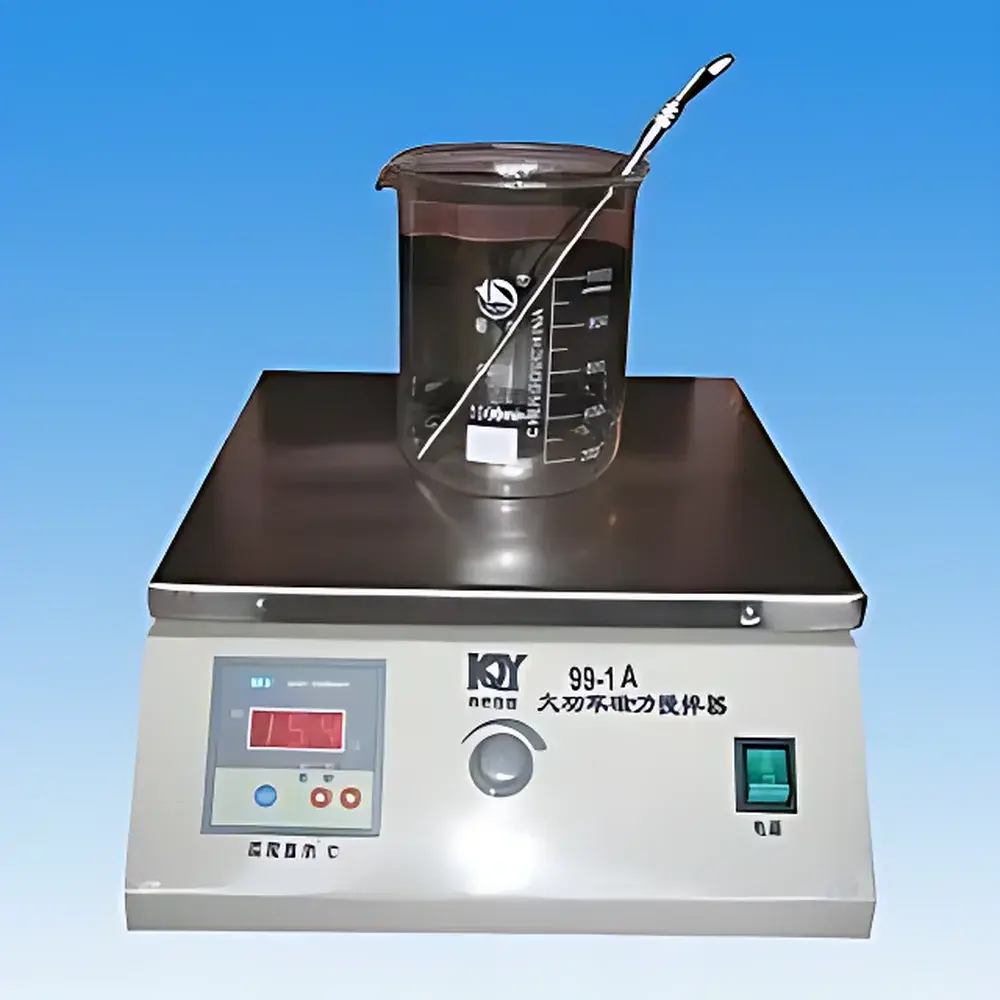
Beifen Sanpu 99-1A Digital Display High-Power Magnetic Stirrer with Integrated Heating
| Brand | Beifen Sanpu |
|---|---|
| Model | 99-1A |
| Power Supply | AC 220 V ±10%, 50 Hz |
| Motor Power | 40 W |
| Heating Power | 600 W |
| Speed Range | 0–2600 rpm (continuously variable) |
| Temperature Control Range | Ambient to 100 °C (digital PID controller) |
| Max. Stirring Volume | 10,000 mL |
| Construction | Stainless steel work surface, permanent-magnet DC motor |
| Compliance | Designed for GLP-compliant laboratories |
Overview
The Beifen Sanpu 99-1A Digital Display High-Power Magnetic Stirrer with Integrated Heating is an industrial-grade benchtop mixing instrument engineered for reproducible, temperature-controlled homogenization of viscous and high-volume liquid samples in regulated laboratory environments. It operates on the principle of magnetic coupling—where a rotating permanent magnet beneath the inert, corrosion-resistant stainless steel platform induces synchronous rotation of a PTFE- or glass-coated stir bar immersed in the sample vessel. Unlike hotplate stirrers relying on induction heating alone, the 99-1A integrates a resistive heating element directly beneath the platform, enabling simultaneous precise stirring and thermostatic control via a digital PID temperature controller. Its 600 W heating capacity and 40 W brushless DC motor deliver robust torque at low speeds and stable rotational performance up to 2600 rpm—making it suitable for demanding applications such as buffer preparation, cell culture media conditioning, reagent synthesis, and dissolution testing where thermal uniformity and mechanical consistency are critical.
Key Features
- High-torque permanent-magnet DC motor ensures consistent rotational stability across the full speed range (0–2600 rpm), with smooth, stepless adjustment via rotary encoder
- Digital PID temperature controller with LED display provides accurate setpoint resolution of ±0.5 °C over ambient to 100 °C, with overshoot suppression and auto-tuning capability
- 600 W integrated heating system enables rapid thermal equilibration in large-volume vessels (up to 10 L), supported by thermal cutoff protection and overtemperature alarm
- Non-porous, electropolished stainless steel work surface resists chemical corrosion, prevents rust formation, and facilitates rapid decontamination between runs
- No open flame, no audible motor noise, and minimal electromagnetic interference—ideal for cleanrooms, biosafety cabinets, and QA/QC labs operating under ISO/IEC 17025 or FDA 21 CFR Part 11-aligned workflows
- Ground-fault protected power input and insulated probe housing meet IEC 61010-1 safety standards for Class II laboratory equipment
Sample Compatibility & Compliance
The 99-1A accommodates standard borosilicate glass vessels—including beakers (50 mL to 5000 mL), Erlenmeyer flasks, and jacketed reactors—when paired with appropriately sized magnetic stir bars (e.g., 30–80 mm length, PTFE-coated). Its platform geometry supports flat-bottom containers only; conical or uneven bases may induce stir-bar instability. The device is routinely deployed in pharmaceutical manufacturing support labs (e.g., formulation development, stability testing), biologics process development, and academic research requiring USP dissolution method validation. While not certified to ASTM E2912 or ISO 13485 out-of-the-box, its design aligns with core elements of GMP Annex 11 and GLP Annex 1 documentation practices—including manual logbook traceability for temperature setpoints, runtime, and speed profiles. Optional calibration certificates (NIST-traceable temperature and speed verification) are available upon request.
Software & Data Management
The 99-1A operates as a standalone analog-digital hybrid instrument with no embedded firmware or network interface. All operational parameters—stirring speed and target temperature—are configured manually using front-panel controls. Real-time values are displayed on dual 3-digit LED indicators. For audit-ready data capture, users integrate external USB or RS-232 data loggers connected to the optional analog output ports (0–5 V DC proportional to temperature and speed). This architecture supports 21 CFR Part 11 compliance when paired with validated third-party software platforms that enforce electronic signatures, audit trails, and role-based access control—commonly deployed in regulated QC labs performing routine equipment qualification (IQ/OQ/PQ).
Applications
- Preparation of high-viscosity buffers and agarose gels in molecular biology workflows
- Thermal conditioning of cell culture media prior to sterile filtration (e.g., DMEM/F12, RPMI-1640)
- Dissolution testing of solid oral dosage forms per USP apparatus II protocols
- In-process mixing during API crystallization and solvent exchange steps
- Homogenization of nanoparticle suspensions and colloidal dispersions requiring extended low-shear agitation
- Calibration verification of thermometers and RTDs using stirred water baths (ASTM E77)
FAQ
What is the maximum recommended continuous operating time at high speed?
At speeds above 1800 rpm, continuous operation should not exceed 4 hours to maintain motor longevity and thermal stability.
Can the unit be used without heating while stirring?
Yes—the heating function is fully independent of the stirring circuit; the temperature controller can be disabled while maintaining rotational control.
Is the temperature probe interchangeable or user-replaceable?
The integrated stainless steel temperature probe is permanently mounted and calibrated at the factory; replacement requires recalibration by authorized service personnel.
Does the device support external temperature feedback from a separate probe?
No—the unit relies exclusively on its built-in immersion probe; no external sensor input port is provided.
What maintenance is required for long-term reliability?
Monthly inspection of the work surface for scratches or residue buildup, annual verification of temperature accuracy using a calibrated reference thermometer, and periodic cleaning of ventilation grilles to prevent thermal throttling.



