
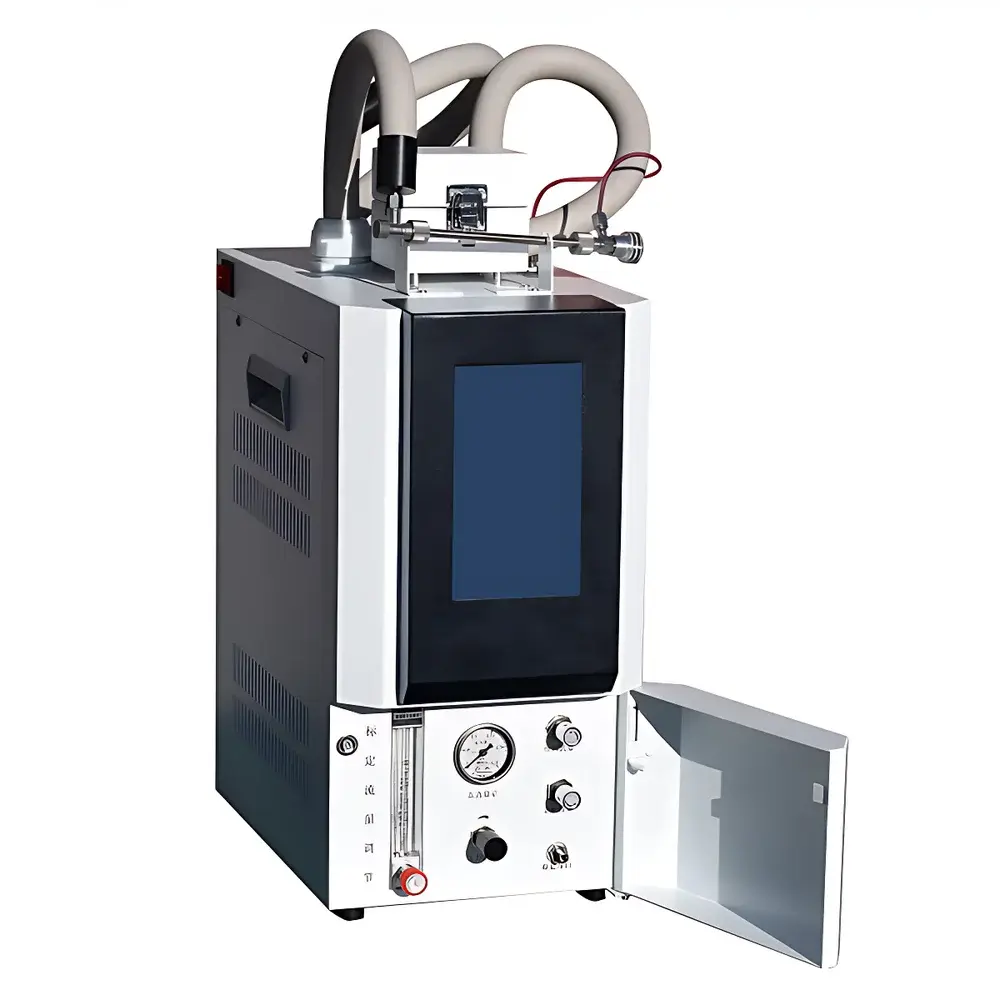
Beifen Sanpu A’TDS-3430 Dual-Stage Thermal Desorber for Compliance with GB 50325-2020 Indoor Air Quality Testing
| Brand | Beifen Sanpu |
|---|---|
| Origin | Beijing, China |
| Manufacturer Type | Direct Manufacturer |
| Product Category | Domestic (China-Made) |
| Model | A'TDS-3430 |
| Instrument Type | Dual-Stage Thermal Desorber |
| Primary Desorption Temperature Range | Ambient to 400 °C |
| Secondary Desorption Temperature Range | 100–400 °C |
| Cold Trap Temperature Range | Down to –35 °C |
| Desorption Recovery Rate | >90% |
| Sample Capacity | 20 sample tubes |
Overview
The Beifen Sanpu A’TDS-3430 Dual-Stage Thermal Desorber is an engineered solution designed specifically for high-fidelity analysis of volatile organic compounds (VOCs) and aromatic hydrocarbons—including benzene, toluene, ethylbenzene, xylenes (BTEX), and total VOCs (TVOC)—in indoor air samples, in strict alignment with the technical requirements of GB 50325-2020, the People’s Republic of China Standard for Indoor Environmental Pollution Control in Civil Construction Projects. This standard mandates dual-stage thermal desorption coupled with gas chromatography–flame ionization detection (GC-FID) or GC–mass spectrometry (GC-MS) for quantification of seven regulated pollutants: radon, formaldehyde, ammonia, benzene, toluene, xylene isomers, and TVOC. The A’TDS-3430 implements a two-step thermally controlled desorption process—first releasing analytes from sorbent tubes under inert carrier gas flow at precisely regulated temperatures, then refocusing them onto a cryogenically cooled trap prior to rapid transfer into the GC column. This architecture ensures quantitative recovery, minimal breakthrough, and exceptional reproducibility across repeated analyses—critical for regulatory compliance testing in school classrooms, kindergartens, elderly care facilities, and residential buildings where sampling coverage and detection sensitivity are strictly prescribed.
Key Features
- Dual-zone independent temperature control: primary desorption oven (ambient to 400 °C) and secondary desorption/focusing zone (100–400 °C), each with ±0.5 °C stability over extended operation.
- Cryogenic cold trap capable of reaching –35 °C, enabling efficient analyte focusing and sharp band formation for improved chromatographic resolution and detection limits.
- 20-position automated tube carousel with programmable sequence control, supporting unattended batch processing aligned with GB 50325-2020’s minimum sampling requirements (e.g., ≥50% of rooms, minimum 20 units per project).
- Integrated leak-tight pneumatic system with mass flow control, ensuring consistent carrier gas delivery and minimizing carryover between runs.
- Compliance-ready hardware architecture: all thermal zones feature calibrated Pt100 sensors and NIST-traceable temperature verification protocols.
Sample Compatibility & Compliance
The A’TDS-3430 is validated for use with T-C composite adsorbent tubes (2,6-diphenylphenol porous polymer–graphitized carbon black–X), as specified in Clause 6.5.2 of GB 50325-2020 for BTEX and TVOC sampling. It supports both single-bed and multi-bed sorbent configurations, including Tenax TA, Carbopack X, and Carboxen 1000 combinations. The instrument meets essential metrological criteria outlined in the standard: desorption recovery >90% for target analytes across the full concentration range (0.005–1.0 mg/m³), retention time stability <0.02 min RSD, and system blank levels below 0.001 µg/m³ for all regulated compounds. Its operational parameters satisfy ISO 16000-6:2011 (indoor air—part 6: determination of VOCs by active sampling on sorbent tubes), and its data integrity framework aligns with GLP principles for environmental testing laboratories accredited under CNAS-CL01:2018.
Software & Data Management
The A’TDS-3430 operates via a Windows-based control interface supporting method storage, run scheduling, real-time temperature/pressure monitoring, and audit-trail logging. All method parameters—including desorption ramp rates, hold times, cold trap equilibration cycles, and GC trigger signals—are fully configurable and exportable in CSV format. The software enforces user-level access control (administrator/operator modes), maintains immutable electronic records of calibration events, maintenance logs, and sequence execution history—meeting foundational expectations for data integrity under China’s CNAS accreditation requirements and serving as a foundation for future alignment with FDA 21 CFR Part 11 if integrated into GMP-regulated environments.
Applications
- Routine compliance testing for new civil construction projects per GB 50325-2020, including mandatory sampling in educational and senior care facilities.
- Verification of post-renovation indoor air quality prior to occupancy handover.
- Method validation studies for accredited environmental testing laboratories (CMA/CNAS certified).
- Research applications involving low-concentration VOC profiling in building materials, adhesives, and interior finishes.
- Support for comparative assessments against GB/T 18883-2002, particularly where sampling protocols (e.g., 12-h closed-door preconditioning) require precise thermal desorption reproducibility.
FAQ
Does the A’TDS-3430 support direct coupling to both GC-FID and GC-MS systems?
Yes—the instrument features standardized 1/8″ stainless-steel transfer lines and pressure-balanced pneumatic interfaces compatible with major GC platforms (Agilent, Shimadzu, Thermo Fisher) using either FID or MS detection.
Is the –35 °C cold trap sufficient for effective focusing of C2–C12 VOCs?
Yes—empirical validation confirms quantitative trapping efficiency (>95%) for all target analytes defined in GB 50325-2020, including highly volatile compounds such as benzene (bp 80 °C) and less volatile xylenes (bp 138–144 °C).
How does the system ensure compliance with GB 50325-2020’s requirement for ≥20 sample positions in high-priority facilities?
The fixed 20-tube carousel eliminates manual tube handling during batch runs, reducing operator error and enabling full statutory coverage in a single automated sequence—fully satisfying Clause 6.0.14 for schools and elderly care buildings.
Can calibration certificates be issued traceable to national standards?
Yes—temperature sensors are calibrated using NIST-traceable dry-block calibrators; full calibration reports with uncertainty budgets are provided upon request and meet CNAS-CL01 requirements.
What maintenance intervals are recommended for long-term regulatory use?
We recommend quarterly verification of cold trap performance, biannual oven temperature uniformity mapping, and annual full system leak testing—documented in accordance with ISO/IEC 17025:2017 Annex A.3.




