
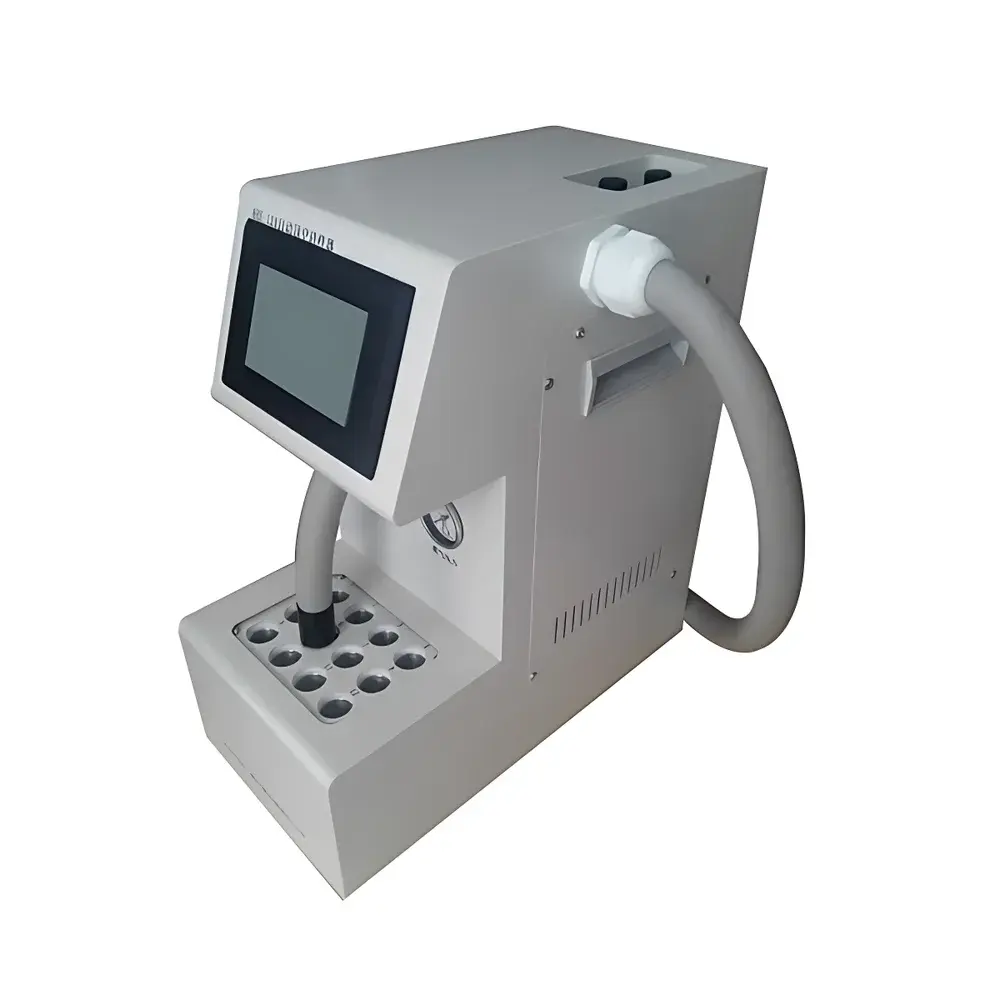
Beifen Sanpu AHS-10A Static Headspace Sampler for Residual Solvent Analysis in Edible Vegetable Oils
| Brand | Beifen Sanpu |
|---|---|
| Origin | Beijing, China |
| Manufacturer Type | Manufacturer |
| Product Origin | Domestic (China) |
| Model | AHS-10A |
| Instrument Type | Static Headspace Sampler |
| Automation Level | Semi-Automatic |
| Vial Heating Range | Ambient to 200 °C (1 °C increment) |
| Valve Temperature Control Range | 40–220 °C (±1 °C accuracy) |
| Sample Loop Volume | 1 mL |
| Sample Capacity | 12 positions |
| Vial Size Compatibility | 10 mL or 20 mL |
Overview
The Beifen Sanpu AHS-10A Static Headspace Sampler is a purpose-engineered sample introduction system designed for precise, reproducible quantification of volatile residual solvents—particularly n-hexane (commonly referred to as “No. 6 solvent”)—in edible vegetable oils. It operates on the principle of static headspace analysis: a sealed vial containing oil sample is heated to equilibrium, allowing volatile analytes to partition into the gas phase above the liquid (the headspace). A precisely metered volume of this equilibrated vapor is then transferred via pressurized loop injection into a gas chromatograph (GC) for separation and detection—typically using flame ionization detection (FID). This methodology complies with GB/T 5009.37–2003, the Chinese national standard specifying maximum allowable residual solvent levels at ≤100 ppm, with results below 10 ppm reported as “not detected.” The AHS-10A serves as a critical front-end component in regulated quality control workflows for edible oil refineries, third-party testing laboratories, and food safety monitoring agencies requiring GLP-aligned data integrity.
Key Features
- 12-position sample carousel with front-access design for ergonomic operation—enabling seated use without repositioning.
- Independent temperature control of three thermal zones: vial block (ambient to 200 °C), sampling valve (40–220 °C), and transfer lines—minimizing condensation and ensuring quantitative vapor-phase transfer.
- Electrically actuated 6-port rotary valve with integrated 1 mL fixed-volume loop; positive-pressure sampling enhances sensitivity and repeatability (RSD < 2.5% for replicate injections).
- Uniform heating distribution across all vial positions reduces inter-bottle thermal gradients—critical for method robustness during batch analysis.
- Integrated back-flush function for sampling needle and valve pathways prevents carryover between samples, supporting high-throughput screening of viscous matrices such as soybean, peanut, rapeseed, and castor oils.
- 5-inch full-color touchscreen interface with intuitive icon-based navigation; supports up to 10 user-defined methods with parameter recall, dwell time, and equilibration delay settings.
- Hardware-level synchronization with GC systems (e.g., GC-2010) and chromatography data systems (CDS), enabling automated start/stop triggers and timestamp-aligned acquisition.
Sample Compatibility & Compliance
The AHS-10A accommodates standard crimp-top headspace vials (10 mL and 20 mL), compatible with common septa types (e.g., PTFE/silicone) and aluminum caps meeting ASTM D3699 and ISO 11337 specifications. Its thermal architecture ensures stable equilibrium conditions for high-boiling-point solvents (e.g., hexane, heptane, petroleum ether fractions) in complex lipid matrices. The instrument meets essential requirements for food testing under GB/T 5009.37–2003 and supports alignment with broader international frameworks including AOAC Official Method 984.22 and USP for residual solvents. While not inherently 21 CFR Part 11 compliant, its method storage, audit trail-capable CDS integration (e.g., N3000), and hardware-level event logging enable configuration for GMP/GLP environments when deployed with validated software and procedural controls.
Software & Data Management
The AHS-10A operates autonomously but interfaces seamlessly with external chromatography data systems—including Zhejiang University’s N3000 CDS—via TTL-level trigger signals and RS-232 communication. All method parameters (equilibration time, oven ramp profiles, valve timing) are stored internally with timestamped versioning. No proprietary software is required for basic operation; however, for full traceability, laboratories integrate it into validated CDS platforms that support electronic signatures, user access tiers, and change-controlled method libraries. Firmware updates are delivered via USB port, with checksum verification to ensure integrity. System diagnostics—including temperature deviation alerts, valve actuation counters, and thermal fault logs—are accessible through the touchscreen menu and exportable for internal QA review.
Applications
Primary application focus includes regulatory testing of solvent-extracted edible oils (soybean, sunflower, cottonseed, palm kernel) for residual hydrocarbon solvents. Secondary uses extend to QC analysis of flavor compounds in fortified oils, oxidation marker profiling (e.g., hexanal, pentanal), and residual ethanol or acetone in cold-pressed blends. The system is also employed in environmental labs for VOC screening in biodiesel feedstocks and in pharmaceutical excipient testing where lipid-based carriers require residual solvent verification per ICH Q3C guidelines. Its semi-automatic architecture balances operational flexibility with method consistency—ideal for mid-volume labs performing 20–50 samples per day.
FAQ
Is the AHS-10A compatible with non-Beifen Sanpu GC systems?
Yes—the sampling needle and transfer line connections follow standard 1/16″ stainless steel tubing configurations; adapters are available for Agilent, Shimadzu, Thermo Fisher, and PerkinElmer GC inlets.
What maintenance intervals are recommended for long-term reliability?
Vial heater calibration should be verified quarterly; valve rotor seal replacement is advised every 10,000 cycles or annually, whichever occurs first.
Can the AHS-10A be upgraded to fully automatic operation?
No—it is engineered as a static, semi-automatic platform. For robotic automation, Beifen Sanpu offers the AHS-610 model with XYZ autosampler functionality.
Does the instrument support dynamic headspace (purge-and-trap) mode?
No—only static headspace mode is implemented. Dynamic extraction requires dedicated purge-and-trap hardware.
How is temperature uniformity across the 12-vial block validated?
Each production unit undergoes thermal mapping per ISO/IEC 17025 Annex B using NIST-traceable PT100 probes; certificate of conformance is supplied with shipment.
Related Products







