
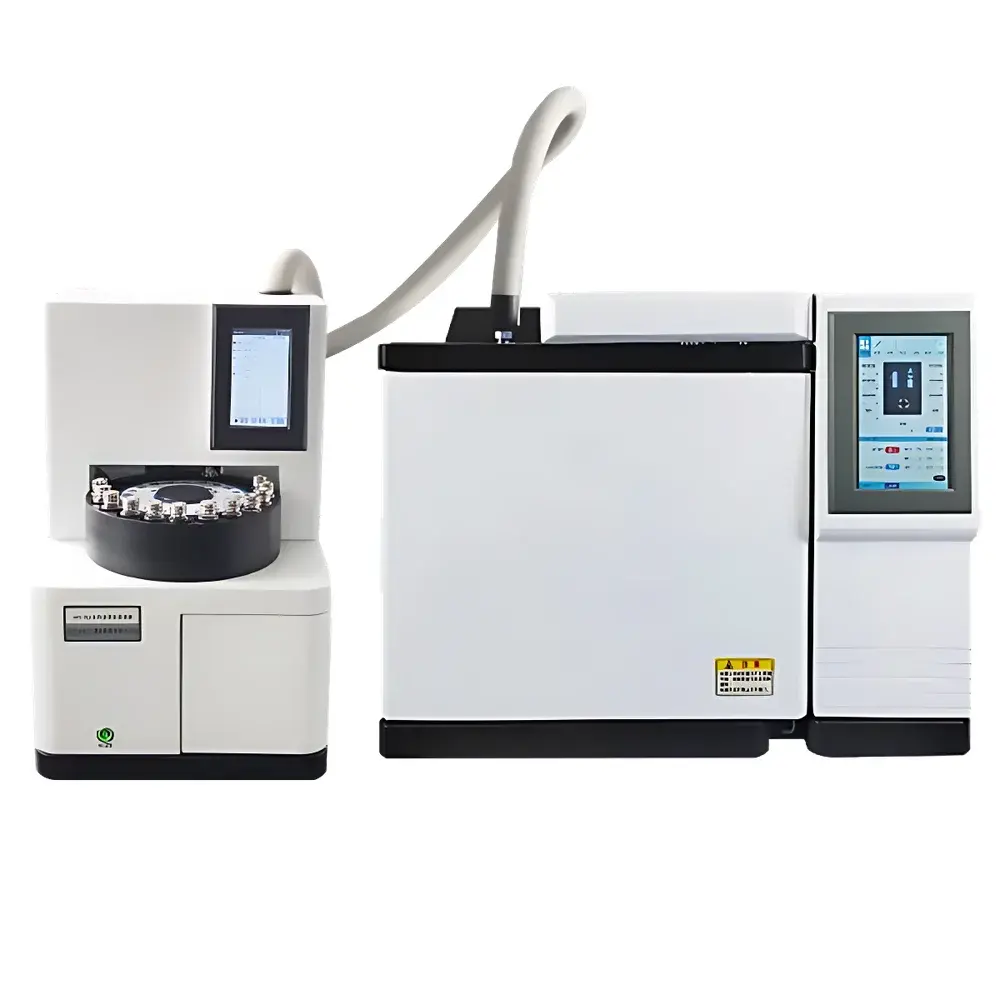
Beifen Sanpu GC1-9860 Gas Chromatograph with Automated Headspace Sampler for Hexane Solvent Residue Analysis in Food
| Brand | Beifen Sanpu |
|---|---|
| Origin | Beijing, China |
| Manufacturer Type | Direct Manufacturer |
| Instrument Type | Laboratory Gas Chromatograph |
| Detection Method | Flame Ionization Detection (FID) |
| Column Configuration | Capillary Column (30 m × 0.25 mm × 0.25 µm) |
| Headspace Autosampler | AHS-20A (20-position) |
| Application Field | Food Industry–Specific Solvent Residue Testing |
| Compliance Standard | GB/T 5009.262–2016 |
Overview
The Beifen Sanpu GC1-9860 Gas Chromatograph integrated with the AHS-20A automated headspace sampler is a purpose-built analytical system designed for the quantitative determination of residual “No. 6 solvent” (a commercial mixture primarily composed of n-hexane, n-heptane, and other C5–C7 aliphatic hydrocarbons) in food matrices—particularly edible oils and oilseed meal (e.g., soybean meal, rapeseed meal). The instrument operates on the principle of gas chromatography coupled with static headspace sampling: volatile solvent residues partition from the solid or liquid sample matrix into the equilibrated headspace vapor phase under controlled temperature and time conditions, followed by precise transfer and separation on a fused-silica capillary column. Detection is performed using a high-stability flame ionization detector (FID), delivering linear response over the legally mandated regulatory range (0–500 mg/kg) as defined in GB/T 5009.262–2016. This configuration eliminates manual injection variability, ensures thermal stability during equilibration, and maintains method robustness across routine QC laboratories performing daily batch analysis.
Key Features
- Integrated dual-module architecture: GC1-9860 main unit with FID and split/splitless capillary inlet, synchronized with AHS-20A 20-position headspace autosampler via digital I/O and software-level bidirectional control.
- Thermally stable oven design with ±0.1 °C temperature uniformity across 30–250 °C operating range, critical for reproducible retention time alignment of low-boiling hydrocarbons (e.g., n-hexane RT ≈ 2.8 min; n-heptane RT ≈ 4.3 min under standard conditions).
- Capillary column optimized for hydrocarbon resolution: 30 m × 0.25 mm ID × 0.25 µm film thickness bonded-phase polydimethylsiloxane column, enabling baseline separation of all major No. 6 solvent components without co-elution artifacts.
- Headspace vial handling system compliant with 20 mL crimp-top vials; includes programmable equilibration temperature (40–120 °C), incubation time (5–60 min), and pressurized transfer loop with inert gas (N₂ or He) purge to minimize carryover.
- FID detector with auto-ignition, linear dynamic range >10⁷, and real-time signal digitization at 100 Hz for accurate peak integration of trace-level solvent peaks against complex lipid-derived background volatiles.
Sample Compatibility & Compliance
The system is validated for two primary food matrices per GB/T 5009.262–2016: refined vegetable oils (e.g., soybean, peanut, sunflower) and defatted oilseed meals (e.g., soybean meal, cottonseed meal). For oils, 5.0 g samples are spiked with n-heptane internal standard (68 mg/kg) prior to headspace equilibration. For meal samples, 3.0 g is hydrated with 400 µL deionized water to enhance solvent release kinetics. All calibration standards are matrix-matched and prepared in triplicate to account for matrix-induced partition coefficient shifts. The method meets ISO/IEC 17025 requirements for method validation—including specificity, linearity (r² ≥ 0.999), LOD (≤ 1 mg/kg), LOQ (≤ 3 mg/kg), repeatability (RSD ≤ 5% at 10 mg/kg), and intermediate precision. Full audit trail capability supports GLP-compliant environments and FDA 21 CFR Part 11 readiness when paired with validated chromatography data system (CDS) software.
Software & Data Management
The GC1-9860 is controlled via PC-based chromatography data system (CDS) supporting full instrument reverse control, sequence definition, and real-time monitoring. The software enables automatic calibration curve generation using internal standard normalization, peak identification via retention time locking, and customizable reporting templates aligned with GB/T 5009.262–2016 reporting requirements (e.g., mg/kg results, uncertainty estimation, analyst ID, instrument ID, date/time stamps). Raw data files (.cdf or .axd) are stored with embedded metadata including method parameters, vial position, equilibration history, and detector diagnostics. Electronic signatures, user access levels (admin/operator/auditor), and secure database backup protocols ensure data integrity throughout the analytical lifecycle.
Applications
This system is deployed in food safety laboratories for regulatory compliance testing, supplier qualification, and in-process quality control. Typical use cases include: verification of solvent removal efficiency post-extraction in edible oil refineries; release testing of solvent-depleted oilseed meals prior to animal feed formulation; forensic investigation of adulterated or improperly processed products; and method transfer between central and satellite QC labs. Its configuration also supports extension to related volatile residue analyses—such as residual acetone in starch-based products or ethanol in flavor extracts—via minor method revalidation.
FAQ
What is the regulatory basis for No. 6 solvent testing in China?
GB/T 5009.262–2016 specifies the gas chromatographic method for determining residual “No. 6 solvent” in edible oils and oilseed meals, with maximum allowable limits of 10 mg/kg for refined oils and 50 mg/kg for meal products.
Can this system analyze other solvents beyond No. 6?
Yes—the GC1-9860 platform supports method development for other low-boiling organic solvents (e.g., hexane, heptane, acetone, ethyl acetate) using appropriate column selection, temperature programming, and detector optimization.
Is the AHS-20A compatible with third-party CDS software?
The autosampler provides RS-232 and USB communication interfaces and supports ASTM E1957-compliant command protocols, enabling integration with major commercial CDS platforms including Chromeleon, OpenLab CDS, and Empower.
How is carryover minimized during high-throughput analysis?
The AHS-20A incorporates a heated transfer line (up to 150 °C), inert gas purge cycles between injections, and a dedicated needle wash station using methanol or isopropanol—reducing carryover to <0.05% across consecutive 200 mg/kg standards.
What maintenance is required for long-term FID stability?
Routine maintenance includes weekly jet cleaning, quarterly ceramic igniter inspection, and biannual replacement of the FID collector electrode and insulator—procedures documented in the instrument’s GLP-aligned maintenance log template.





