
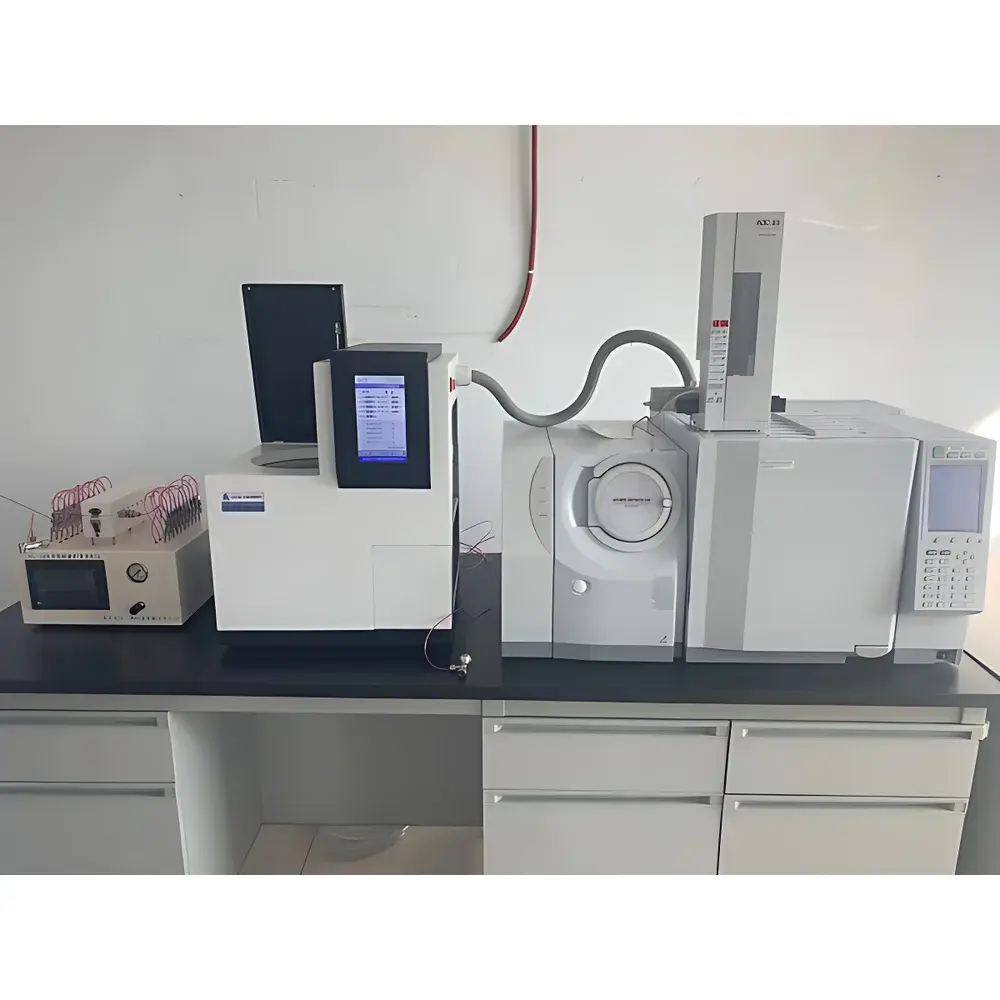
Beifen Sanpu ATDS-20A Automated Dual-Stage Thermal Desorber for HJ/583–2010 Benzene Homologues Analysis in Ambient Air
| Brand | Beifen Sanpu |
|---|---|
| Origin | Beijing, China |
| Manufacturer Type | Direct Manufacturer |
| Instrument Type | Dual-Stage Thermal Desorber |
| Primary Desorption Temp Range | Ambient to 450 °C |
| Secondary Desorption Temp Range | 100–450 °C |
| Cold Trap Temp Range | −35 °C to Ambient |
| Desorption Recovery Rate | >99% (compound-dependent) |
| Sample Capacity | 20 adsorption tubes |
| Tube Format | 1/4″ OD × 3.5″ (ASTM D6196-compliant) |
| Temperature Control Precision | ±0.5 °C |
| RSD | ≤2.5% (for 0.05 μg benzene in methanol) |
Overview
The Beifen Sanpu ATDS-20A is an automated dual-stage thermal desorption system engineered for high-fidelity analysis of volatile organic compounds (VOCs), particularly benzene and its homologues (toluene, ethylbenzene, xylenes—BTEX), in ambient and indoor air matrices per Chinese Environmental Monitoring Standard HJ/583–2010. It implements a two-step thermally driven desorption process: first, analytes are thermally released from Tenax® TA or equivalent sorbent tubes under controlled inert gas flow; second, the evolved vapors are cryogenically focused in a Peltier-cooled trap (−35 °C minimum), then rapidly re-desorbed as a narrow band into the GC inlet. This architecture minimizes band broadening, maximizes sensitivity, and ensures reproducible peak shape and retention time stability—critical for regulatory compliance and multi-laboratory data comparability. The system is fully compatible with both domestic and international gas chromatographs (GC) and GC–MS platforms, supporting seamless integration into ISO/IEC 17025-accredited environmental testing workflows.
Key Features
- Automated 20-position sample carousel with robotic tube handling—enabling unattended overnight operation and full batch processing.
- Independent four-zone temperature control: primary desorption oven, secondary desorption chamber, cold trap, and transfer line—all adjustable in 1 °C increments (range: ambient to 450 °C for ovens; −35 °C to ambient for cold trap).
- High-speed secondary desorption (>3000 °C/min ramp rate) coupled with electronic cooling ensures sharp, symmetrical chromatographic peaks and sub-part-per-trillion (pptv) detection capability when paired with FID or MS detection.
- Integrated back-flush functionality for the transfer line and six-port valve prevents cross-contamination between samples and extends consumable lifetime.
- Programmable method sequences support full thermal cycle automation: desorption → carrier gas purge → cold trapping → rapid thermal injection → post-run valve/line bake-out.
- Onboard tube activation protocol allows in-situ conditioning of sorbent tubes prior to sampling—eliminating off-line aging steps and improving method robustness.
- Native GC synchronization via TTL trigger or external software command (e.g., Agilent ChemStation, Thermo Xcalibur, or OpenLab CDS) enables precise timing alignment between desorption event and GC acquisition start.
Sample Compatibility & Compliance
The ATDS-20A is validated for use with standard 1/4″ OD × 3.5″ stainless steel or quartz-lined sorbent tubes conforming to ASTM D6196 and ISO 16017-1 specifications. It supports common sorbent combinations—including Tenax® TA, Carbopack™ B/C, and graphitized carbon black—for comprehensive VOC profiling across boiling points up to 350 °C. The instrument meets functional requirements of multiple national and international standards, including but not limited to: HJ/583–2010 (ambient air benzene homologues), HJ/644–2013 (VOCs by TD-GC–MS), HJ/T 400–2007 (in-vehicle VOCs), GB/T 18883–2002 (indoor air quality), GB 50325–2020 (civil building indoor pollution control), and HJ 734–2014 (stationary source VOC emissions). All thermal zones feature NIST-traceable calibration certificates and real-time temperature logging—supporting GLP/GMP audit readiness and 21 CFR Part 11-compliant electronic records when used with validated chromatography data systems.
Software & Data Management
The ATDS-20A operates via an embedded industrial-grade touchscreen interface running deterministic real-time firmware. Method parameters—including desorption durations, temperature ramps, trap hold times, and GC trigger delays—are stored in encrypted configuration files with version timestamps. Audit trail functionality logs all user actions (login/logout, method edits, run starts/stops, error events) with operator ID and UTC timestamp. Raw thermal event logs (temperature vs. time, valve status, pressure readings) export in CSV format for traceability. When interfaced with compliant chromatography data systems (CDS), the instrument supports electronic signature capture, role-based access control, and secure data archiving—fully aligned with ISO/IEC 17025 clause 7.7 (result reporting) and EU Annex 11 principles for computerized system validation.
Applications
The ATDS-20A serves as a core sample introduction module in environmental laboratories performing routine monitoring of aromatic hydrocarbons and semi-volatile organics in complex air matrices. Typical applications include: ambient air quality surveillance networks (urban, rural, roadside); indoor air quality assessments in residential, commercial, and healthcare facilities; occupational exposure evaluations in petrochemical, paint, printing, and adhesive manufacturing settings; emission testing from building materials (e.g., carpets, adhesives, composite panels) per GB 50325–2020; and forensic VOC profiling in fire debris or contamination incident investigations. Its dual-stage architecture delivers superior recovery (>99%) and precision (RSD ≤2.5%) for low-concentration BTEX species—even at sub-ppbv levels—without derivatization or solvent extraction.
FAQ
Is the ATDS-20A compatible with Agilent, Thermo Fisher, and Shimadzu GC systems?
Yes—dedicated hardware interfaces and TTL/RS-232 protocols are provided for seamless synchronization with all major GC and GC–MS platforms.
Can the cold trap operate continuously at −35 °C during extended batch runs?
Yes—the solid-state Peltier cooling system maintains stable sub-ambient temperatures over multi-hour sequences without liquid cryogens or maintenance downtime.
Does the instrument support method validation per ISO 17025 requirements?
Yes—temperature uniformity mapping, recovery studies, carryover testing, and repeatability verification protocols are documented in the Installation Qualification (IQ)/Operational Qualification (OQ) package.
What tube conditioning procedures are supported?
The onboard “Tube Activation” mode executes programmable heating cycles (up to 350 °C) under purified helium flow, with optional post-conditioning cool-down and leak-check routines.
How is data integrity ensured during long-term unattended operation?
All thermal events and system states are logged locally with cyclic redundancy check (CRC) protection; logs auto-backup to USB storage and support SHA-256 hash verification for forensic audit trails.







