
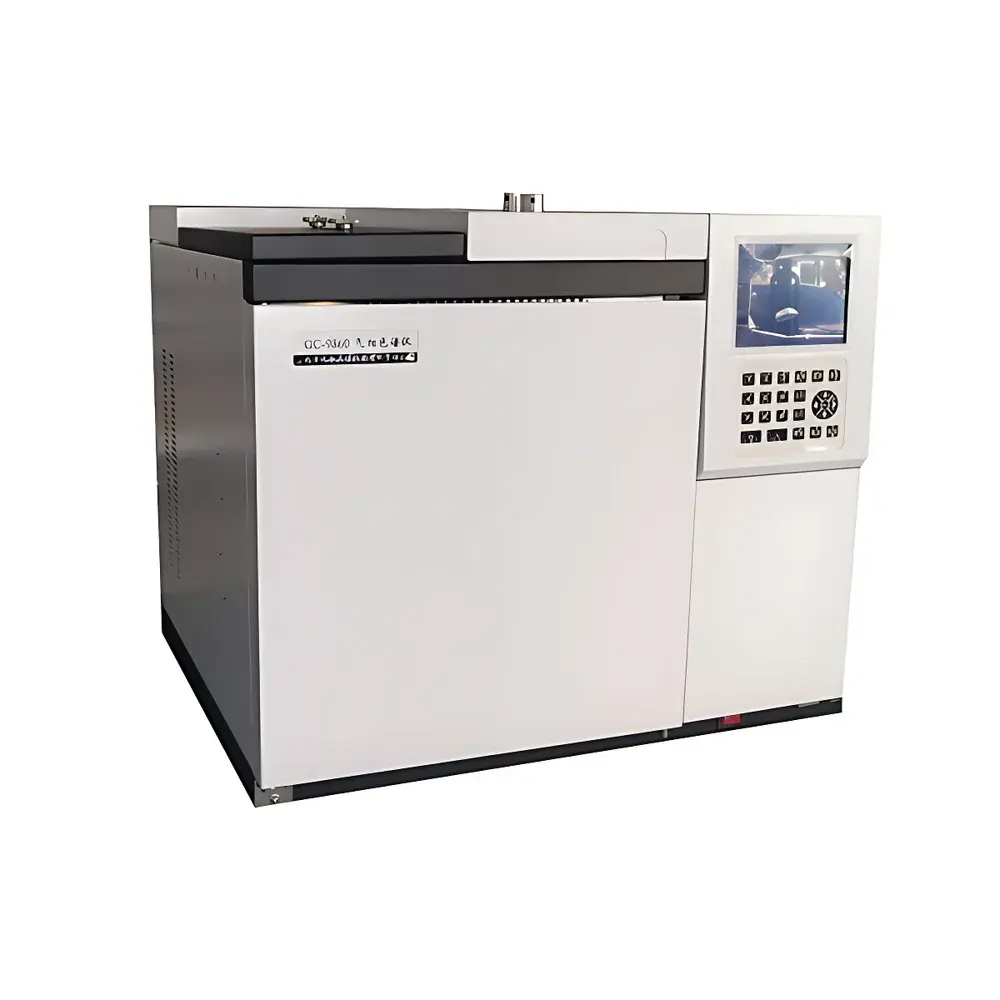
Beifen Sanpu GC-9860 Non-Methane Hydrocarbons (NMHC) Analysis Gas Chromatograph
| Brand | Beifen Sanpu |
|---|---|
| Origin | Beijing, China |
| Manufacturer Type | Original Equipment Manufacturer (OEM) |
| Instrument Type | Laboratory Gas Chromatograph |
| Application Field | Environmental Monitoring |
| Oven Temperature Range | 5 °C above ambient to 400 °C |
| Temperature Programming | 8-step linear ramping |
| Max. Heating Rate | 0.1–50 °C/min |
| Cooling Rate | ~6 min from 350 °C to 100 °C |
| Carrier Gas Flow Control Range | 0–1200 mL/min |
| Carrier Gas Pressure Control Range | 0–970 kPa |
| Injector Temperature Range | 100–350 °C |
| Injector Pressure Setting Range | 0–970 kPa |
| Total Injector Flow Setting Range | 0–1000 mL/min |
| Column Compatibility | Packed columns (3–5 mm OD), capillary columns (standard 6-inch mounting span) |
| Detectors Supported | Up to four simultaneous (FID, TCD, ECD, FPD, NPD) |
| Data Storage | 20 method/data sets onboard |
| Display | 5.7″ LCD (320×240), bilingual Chinese/English interface |
| Power Supply | 220 V ±10%, 2500 W |
| Dimensions (L×H×W) | 520×480×500 mm |
| Net Weight | 50 kg |
Overview
The Beifen Sanpu GC-9860 is a dedicated laboratory gas chromatograph engineered for precise quantification of non-methane hydrocarbons (NMHC) in ambient air, stack emissions, and industrial process gases—fully compliant with Chinese EPA Method HJ 38-2017 and aligned with international NMHC measurement principles defined in ASTM D6667 and ISO 11890-2. It employs dual-column differential separation coupled with flame ionization detection (FID), where total hydrocarbons (THC) are measured first, followed by methane-selective removal via a catalytic converter (optional but recommended for NMHC mode), enabling accurate subtraction-based NMHC calculation. The instrument’s column oven features an intelligent dual rear-door design that achieves stable near-ambient temperature control (down to 5 °C above ambient), critical for retaining volatile C₂–C₅ aliphatics without condensation or breakthrough. Its microprocessor-controlled pneumatic system delivers high reproducibility in carrier gas flow and pressure—essential for retention time stability across multi-day environmental monitoring campaigns.
Key Features
- Industrial-grade chassis with ergonomic layout, front-access service panels, and reinforced thermal insulation for long-term operational stability in 24/7 lab environments.
- Eight-stage programmable temperature ramping with 0.1 °C/min resolution and ±0.1 °C oven temperature accuracy over 100–350 °C range—validated per IEC 61000-4-30 for thermal consistency.
- Dual independent detector bays supporting concurrent operation of up to four detectors—including dual FID (for THC/NMHC split analysis), dual TCD (for permanent gas screening), or hybrid configurations (e.g., FID + ECD for halogenated VOCs).
- Advanced FID with auto-ignition, low-noise current amplification (≤2×10⁻¹⁴ A), and linear dynamic range ≥10⁷—meeting USP and EP 2.2.46 requirements for trace hydrocarbon linearity.
- TCD with dual post-column makeup gas channels enables flexible column configurations: single-packed, dual-packed, or capillary-only modes—eliminating hardware reconfiguration during method switching.
- Integrated power-fail protection, carrier gas depletion sensing, and real-time platinum RTD diagnostics with on-screen fault localization—reducing downtime and supporting GLP-compliant maintenance logs.
- Bilingual (Chinese/English) 5.7″ LCD interface with 20 customizable display screens and non-volatile FLASH memory—ensuring data integrity without battery backup dependency.
Sample Compatibility & Compliance
The GC-9860 accommodates standard 6-inch (152.4 mm) column mounting interfaces for both stainless-steel/glass packed columns (3–5 mm OD) and fused-silica capillaries (0.1–0.53 mm ID). It supports direct injection, split/splitless modes, and optional integration with thermal desorption units, headspace samplers, or online gas valves for unattended environmental monitoring. Regulatory alignment includes full compatibility with China’s HJ 38-2017 for NMHC in fixed pollution sources, as well as technical equivalence to U.S. EPA Method 25A and EN 12619 for stationary source VOC analysis. All firmware and data handling routines adhere to audit-trail requirements under ISO/IEC 17025:2017 Clause 7.7 and support 21 CFR Part 11–compliant electronic signatures when paired with validated LIMS software.
Software & Data Management
The instrument operates standalone via embedded firmware or integrates with third-party chromatography data systems (CDS) via RS-232/USB. Onboard storage retains up to 20 complete method files—including temperature programs, detector parameters, and integration settings—with timestamped recall capability. All chromatograms and calibration curves are exportable in ASCII (.csv) or standard .cdf format for external validation. Firmware supports user-defined event markers (e.g., valve switching, detector toggling) synchronized to retention time—enabling complex NMHC workflows such as backflush, heart-cutting, or detector switching within a single run. System diagnostics generate automated log files (error codes, sensor drift trends, pressure deviations) suitable for internal QA reviews and regulatory inspections.
Applications
- Regulatory NMHC monitoring at municipal wastewater treatment plants, landfills, and petrochemical fence-line sites per local environmental bureau mandates.
- Method validation and routine QC for VOC emissions testing in coating, printing, and composite manufacturing facilities.
- Research-grade hydrocarbon speciation in atmospheric chemistry studies—especially C₂–C₁₀ alkane/alkene/alkyne profiling using customized capillary columns.
- Pharmaceutical residual solvent analysis (ICH Q3C) when equipped with headspace autosampler and cryo-focused cold trap.
- Food packaging migration testing (e.g., mineral oil hydrocarbons, MOAH/MOSH) following DIN SPEC 1050-1 protocols.
FAQ
What detection technologies does the GC-9860 support for NMHC analysis?
It primarily uses dual-FID configuration: one channel measures total hydrocarbons (THC), while a second—paired with a methane-specific catalytic converter—measures residual methane; NMHC is derived by subtraction.
Can the GC-9860 meet U.S. EPA or EU regulatory requirements?
While designed to meet China’s HJ 38-2017, its hardware specifications (FID sensitivity, temperature precision, pneumatic stability) are technically equivalent to instruments used in EPA Method 25A and EN 12619 laboratories; formal compliance requires local method validation.
Is remote monitoring or network connectivity supported?
Yes—via optional Ethernet-to-RS232 converter or USB-host interface; raw data and status reports can be streamed to centralized SCADA or LIMS platforms.
What maintenance intervals are recommended for routine environmental use?
FID jet cleaning every 200 injections; column bake-out weekly; carrier gas filter replacement quarterly; annual calibration verification against certified NMHC standards (e.g., TO-14/TO-15 mixtures).
Does the system support audit-trail functionality required for GLP/GMP labs?
The embedded firmware logs all parameter changes, run starts/stops, and error events with timestamps; full 21 CFR Part 11 compliance requires integration with validated third-party CDS software.




