
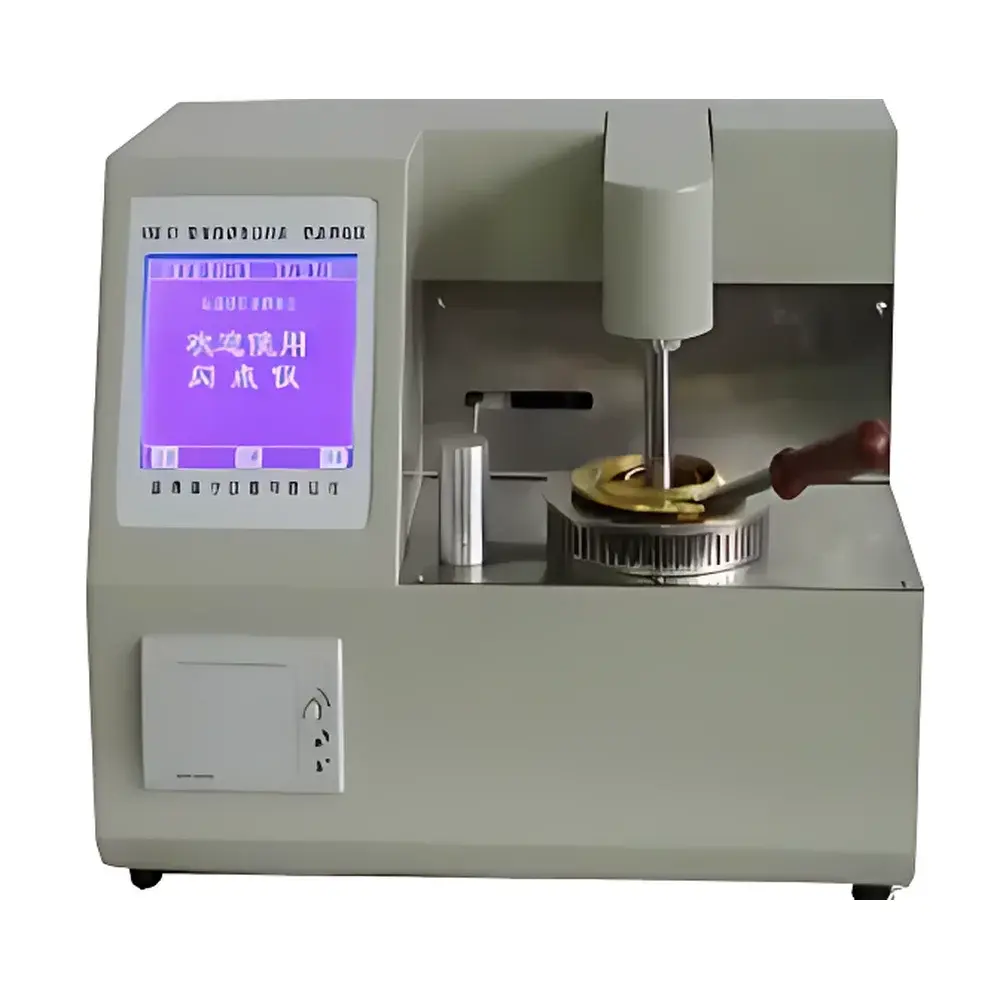
Beifen Sanpu KS100 Fully Automated Cleveland Open-Cup Flash Point and Fire Point Tester
| Brand | Beifen Sanpu |
|---|---|
| Origin | Hebei, China |
| Manufacturer Type | Direct Manufacturer |
| Model | KS100 |
| Compliance | GB/T 267–1988, GB/T 3536–2008, GB/T 1671–2008, ASTM D92 |
| Measurement Range | Ambient to 400 °C |
| Accuracy | ±2 °C |
| Repeatability | ≤3 °C |
| Temperature Resolution | 0.1 °C |
| Sensor | Imported Class A PT100 Platinum Resistance Thermometer |
| Ignition Detection | Ionization Ring Sensor |
| Power Supply | AC 220 V ±20%, 50 Hz ±10% |
| Rated Power | 400 W |
| Dimensions | 440 × 280 × 290 mm |
| Weight | 18 kg |
| Operating Environment | 0–40 °C, ≤85% RH |
| Control Interface | Capacitive Touchscreen with Screen Protection |
| Data Storage | 255 Test Records with Timestamps |
| Heating Control | Adaptive PID Algorithm per Standard Protocols |
| Atmospheric Compensation | Integrated Barometric Sensor with Auto-Calibration |
| Ignition Options | Selectable Electronic Spark or Gas Flame Ignition |
| Multi-Furnace Capability | Single Host Controls Multiple Independent Test Furnaces |
| Automation Level | Full Cycle Automation (Heating, Lid Opening, Ignition, Flash Detection, Alarm, Cooling, Reporting) |
| Built-in Thermal Printer | High-Speed, Dot-Matrix, Offline Printing Support |
| Self-Diagnostic System | Real-Time Sensor Health Monitoring and Over-Temperature Safeguard |
Overview
The Beifen Sanpu KS100 Fully Automated Cleveland Open-Cup Flash Point and Fire Point Tester is an engineered solution for precise, repeatable determination of flash point and fire point in petroleum-based liquids and related hydrocarbon products. Based on the Cleveland Open-Cup (COC) method—standardized under ASTM D92, GB/T 3536–2008, and GB/T 267–1988—the instrument measures the lowest temperature at which vapors above a heated sample ignite momentarily (flash point) and sustain combustion for at least 5 seconds (fire point). Its design adheres to fundamental thermodynamic and combustion principles governing vapor-phase flammability thresholds, making it suitable for safety-critical applications in aviation fuel certification, transformer oil qualification, lubricant stability assessment, and refinery process control.
Key Features
- Modular multi-furnace architecture: A single control unit synchronously manages up to three independent Cleveland test furnaces, enabling parallel analysis of heterogeneous samples without cross-contamination or scheduling delays.
- Adaptive PID thermal regulation: Dynamically adjusts heating rate in real time to comply with stepwise ramp profiles specified in ASTM D92 and GB/T 3536, ensuring strict conformance to standard-defined temperature gradients (e.g., 5–6 °C/min near expected flash point).
- Dual ignition configuration: Field-selectable electronic spark ignition (low-maintenance, no consumables) or propane/gas flame ignition (for validation against legacy reference methods), both integrated with fail-safe gas flow cutoff and flame monitoring.
- Real-time atmospheric pressure compensation: Onboard barometric sensor continuously measures ambient pressure and applies automatic correction to flash point values per ASTM E1–2022 Annex A1, eliminating manual correction errors.
- Ionization-ring flash detection: High-sensitivity ring electrode detects minute ion current changes during vapor ignition—more robust than optical sensors in high-soot or opaque samples—and rejects false positives from thermal noise.
- Full-cycle automation: Covers lid actuation, timed ignition sweeps, flash confirmation logic, audible/visual alarm triggering, forced-air cooling, and report generation—all without operator intervention post-initiation.
- Self-diagnostic firmware: Monitors PT100 sensor integrity, heater resistance drift, ignition circuit continuity, and thermal runaway conditions; halts testing and logs fault codes upon deviation beyond ISO/IEC 17025–compliant thresholds.
Sample Compatibility & Compliance
The KS100 accommodates viscous and low-volatility samples including aviation turbine fuels (Jet A-1, JP-8), insulating oils, heavy fuel oils, bitumen emulsions, and biodiesel blends. Its open-cup geometry and standardized crucible dimensions meet ASTM D92 physical requirements. Instrument validation documentation supports traceable calibration against NIST-traceable reference standards. The system satisfies analytical data integrity requirements under GLP and GMP frameworks: audit-trail-enabled operation logs (including user ID, timestamp, parameter set, raw temperature curve, and final result) are stored locally with write-protection and export capability via USB. All firmware and control algorithms are designed to support FDA 21 CFR Part 11 compliance when deployed with optional networked authentication and electronic signature modules.
Software & Data Management
Operation is managed through a 7-inch capacitive touchscreen interface with configurable screen timeout and dynamic brightness control to extend display service life in laboratory lighting environments. Test parameters—including target ramp rate, ignition interval, pass/fail criteria, and atmospheric correction mode—are programmable per test sequence. Historical results (max. 255 entries) include full thermal profile graphs, detected flash/fire events, ambient pressure readings, and operator annotations. Data export supports CSV format for LIMS integration. The embedded thermal printer delivers ANSI-compliant reports with instrument ID, test date/time, sample ID, method reference, measured values, and operator signature field—retaining full traceability even in offline operation.
Applications
- Airline maintenance depots: Routine flash point verification of jet fuel prior to aircraft refueling per IATA DG Regulations and FAA Advisory Circular 150/5200–37.
- Power generation facilities: Dielectric fluid testing for transformers and switchgear per IEEE C57.106 and IEC 60296.
- Petrochemical QC labs: Batch release testing of base oils, asphalt binders, and cutting fluids aligned with ASTM D92 and EN ISO 2592.
- Academic research: Combustion kinetics studies requiring reproducible open-cup ignition thresholds across biofuel formulations.
- Regulatory testing laboratories: Accredited testing per CNAS-CL01 (equivalent to ISO/IEC 17025) for third-party certification of lubricants and specialty fluids.
FAQ
Does the KS100 support ASTM D93 (Pensky-Martens closed-cup) testing?
No—the KS100 is specifically configured for Cleveland open-cup methodology per ASTM D92. Closed-cup testing requires distinct hardware design, pressure containment, and vapor recovery systems not present in this model.
Can test data be exported to a laboratory information management system (LIMS)?
Yes—CSV-formatted result files with full metadata (including timestamps, raw temperature arrays, and atmospheric corrections) can be transferred via USB mass storage mode for direct ingestion into LIMS platforms.
Is calibration traceable to national metrology institutes?
Yes—factory calibration uses NIST-traceable PT100 reference probes and certified flash point standards (e.g., n-decane, tetradecane). Calibration certificates include uncertainty budgets per ISO/IEC 17025 requirements.
What maintenance intervals are recommended for the ionization ring sensor?
The ionization ring requires cleaning with isopropyl alcohol after every 50 tests or when baseline current drift exceeds ±5% of nominal output—procedure documented in the operator manual.
How does the system handle high-boiling, residue-prone samples like bitumen?
The furnace design incorporates removable crucible holders and a dedicated post-test thermal soak cycle (up to 450 °C for 10 minutes) to volatilize residual carbon deposits, minimizing carryover between runs.
Related Products





