
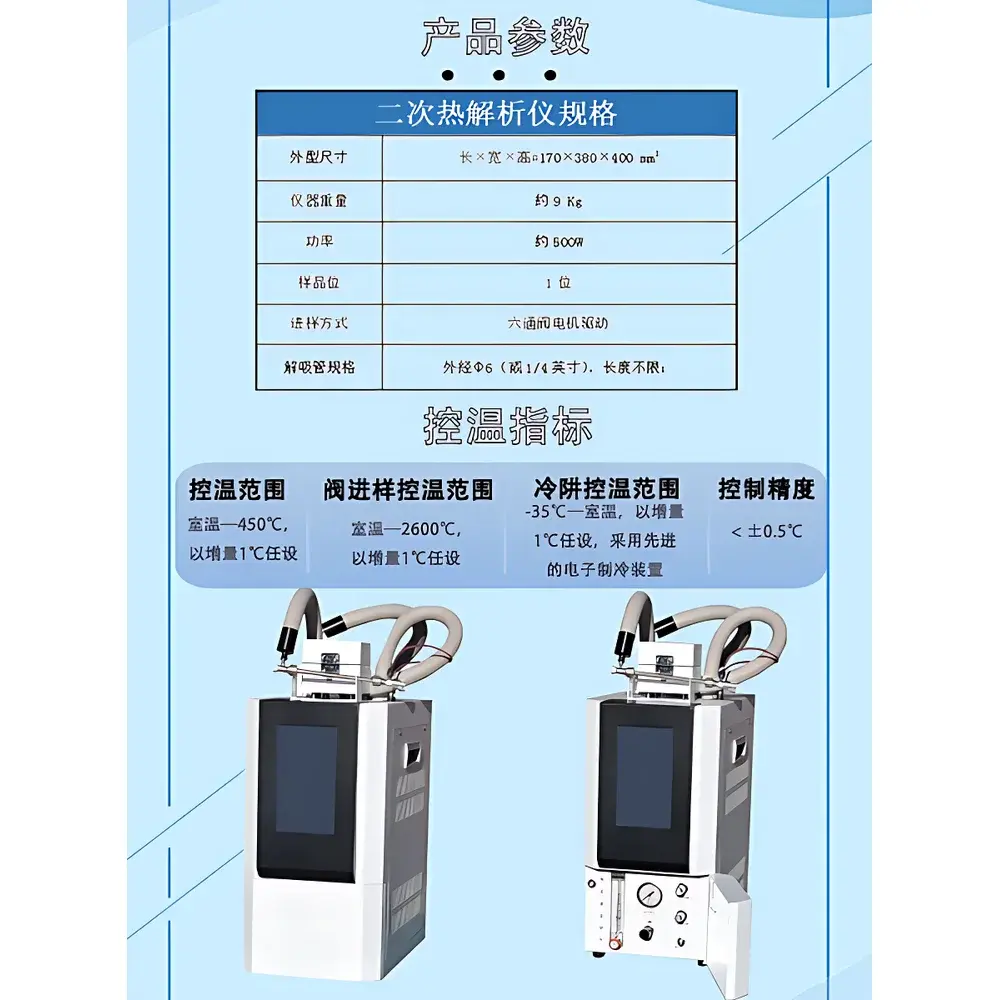
Beifen Sanpu ATDS-3430 Dual-Stage Thermal Desorber with Cryogenic Trap
| Brand | Beifen Sanpu |
|---|---|
| Origin | Beijing, China |
| Manufacturer Type | Manufacturer |
| Product Origin | Domestic (China) |
| Model | ATDS-3430 |
| Instrument Type | Dual-stage thermal desorber, cryogenic trap thermal desorber |
| Desorption Temperature Range | Ambient to 450 °C |
| Cold Trap Temperature Range | −35 °C to ambient |
| Desorption Recovery Rate | >99% (compound-dependent) |
| Sample Capacity | 1 tube per run |
Overview
The Beifen Sanpu ATDS-3430 is a dual-stage thermal desorber engineered for high-fidelity preconcentration and quantitative transfer of volatile and semi-volatile organic compounds (VOCs and SVOCs) from sorbent tubes prior to gas chromatographic analysis. It operates on the principle of sequential thermal desorption: first-stage desorption releases analytes from the primary sorbent tube into a cryogenically cooled trap (−35 °C to ambient), where they are refocused; second-stage flash desorption rapidly injects the condensed analyte band into the GC inlet under controlled thermal ramping. This architecture ensures minimal band broadening, maximized sensitivity, and reproducible quantitation—critical for compliance testing against stringent indoor air quality standards such as GB/T 18883 and GB 50325. Designed for integration with FID- or MS-equipped GC systems, the ATDS-3430 supports method-defined workflows for benzene, toluene, ethylbenzene, xylenes (BTEX), formaldehyde (via derivatization), TVOC, and radon progeny-associated organics.
Key Features
- Programmable dual-zone thermal control: independent heating of desorption oven (ambient–450 °C) and valve/transfer line (up to 180 °C) to prevent condensation and carryover.
- Cryogenic cold trap with Peltier cooling: stable temperature control from −35 °C to ambient, enabling efficient analyte focusing and improved detection limits (sub-pptr range achievable with optimized GC-MS coupling).
- Automated tube handling and sequence execution: single-tube configuration supports unattended operation with integrated bake-out and blank validation cycles.
- Onboard calibration functionality: built-in standard vapor generation mode allows routine system suitability checks using certified VOC reference mixtures.
- Robust stainless-steel flow path and inert surface treatment: minimizes adsorption losses for polar and reactive compounds including aldehydes and organic acids.
- Compliance-ready timing precision: programmable desorption, trapping, flash, and back-flush durations meet ISO 16000-6, ASTM D6196, and HJ 644–2013 timing requirements.
Sample Compatibility & Compliance
The ATDS-3430 is validated for use with standard 6-mm OD stainless steel or glass sorbent tubes packed with multi-bed media (e.g., Tenax TA, Carbopack B/C, Carboxen 1000). It fully supports the sampling and analytical protocols specified in both GB/T 18883–2022 (Indoor Air Quality Standard) and GB 50325–2020 (Control Standard for Indoor Environmental Pollution in Civil Building Engineering). Key distinctions between these standards inform instrument configuration: GB/T 18883 mandates 12-h closed-chamber sampling and evaluates 19 parameters—including physical, biological, radioactive, and chemical indicators—requiring broader compound coverage and lower detection thresholds; GB 50325 specifies 1-h sampling and focuses on five regulated pollutants (formaldehyde, benzene, ammonia, TVOC, radon), with stricter pass/fail limits for construction acceptance. The ATDS-3430’s recovery rate >99% across target analytes satisfies GLP-aligned validation criteria per CNAS-CL01 and supports audit trails required under China’s CMA accreditation framework.
Software & Data Management
Instrument control and method management are executed via embedded firmware with USB interface and optional PC-based software (Windows 10/11 compatible). All thermal programs, valve events, and timing sequences are stored with timestamped metadata. System logs record desorption temperature profiles, cold trap stability, pressure transients, and error codes—enabling full traceability per GB/T 27417–2017 guidelines for chemical testing laboratories. Raw method files support export in CSV format for integration with LIMS platforms. While the ATDS-3430 does not incorporate 21 CFR Part 11 electronic signature capability natively, its deterministic operational logic and immutable event logging provide foundational elements for laboratory-developed Part 11 compliance packages.
Applications
- Routine monitoring of residential, office, and school indoor air per GB/T 18883–2022 and GB 50325–2020.
- Verification of post-renovation off-gassing profiles for flooring, adhesives, paints, and composite wood products.
- Method development and validation for emerging contaminants including methyl tert-butyl ether (MTBE), naphthalene, and chlorinated benzenes.
- Support for occupational hygiene assessments under GBZ 159 and ISO 16200–1.
- Research applications in environmental chemistry, material emissions testing, and building product certification (e.g., GREENGUARD, CARB ATCM).
FAQ
What is the difference between GB/T 18883 and GB 50325 in terms of regulatory scope and enforcement?
GB/T 18883 is a health-oriented, non-mandatory national recommendation issued by the Ministry of Health and the Ministry of Ecology and Environment, defining acceptable indoor air conditions for human occupancy. GB 50325 is a mandatory construction code issued by the Ministry of Housing and Urban-Rural Development, governing environmental acceptance of civil engineering projects prior to occupancy.
Can the ATDS-3430 be used for both standards simultaneously?
Yes—the instrument’s adjustable desorption parameters, cold trap resolution, and recovery performance enable method-specific optimization for either standard without hardware modification.
Does the ATDS-3430 comply with ISO 16000-6 for VOC analysis?
Its thermal desorption protocol—including defined desorption time, trap temperature, and flash rate—aligns with ISO 16000-6 Annex A recommendations for sorbent tube-based sampling and analysis.
Is method validation documentation available for GB 50325–2020 compliance?
Beifen Sanpu provides application notes detailing ATDS-3430/GC-FID system performance data for all five regulated analytes, including LOD/LOQ, linearity (r² ≥ 0.999), and inter-day precision (RSD < 5%).
What maintenance intervals are recommended for long-term reliability?
Valve seals and O-rings should be inspected quarterly; cold trap heat exchangers require annual cleaning; desorption tube ovens are calibrated annually per JJG 805–2013 verification procedures.
Related Products







