
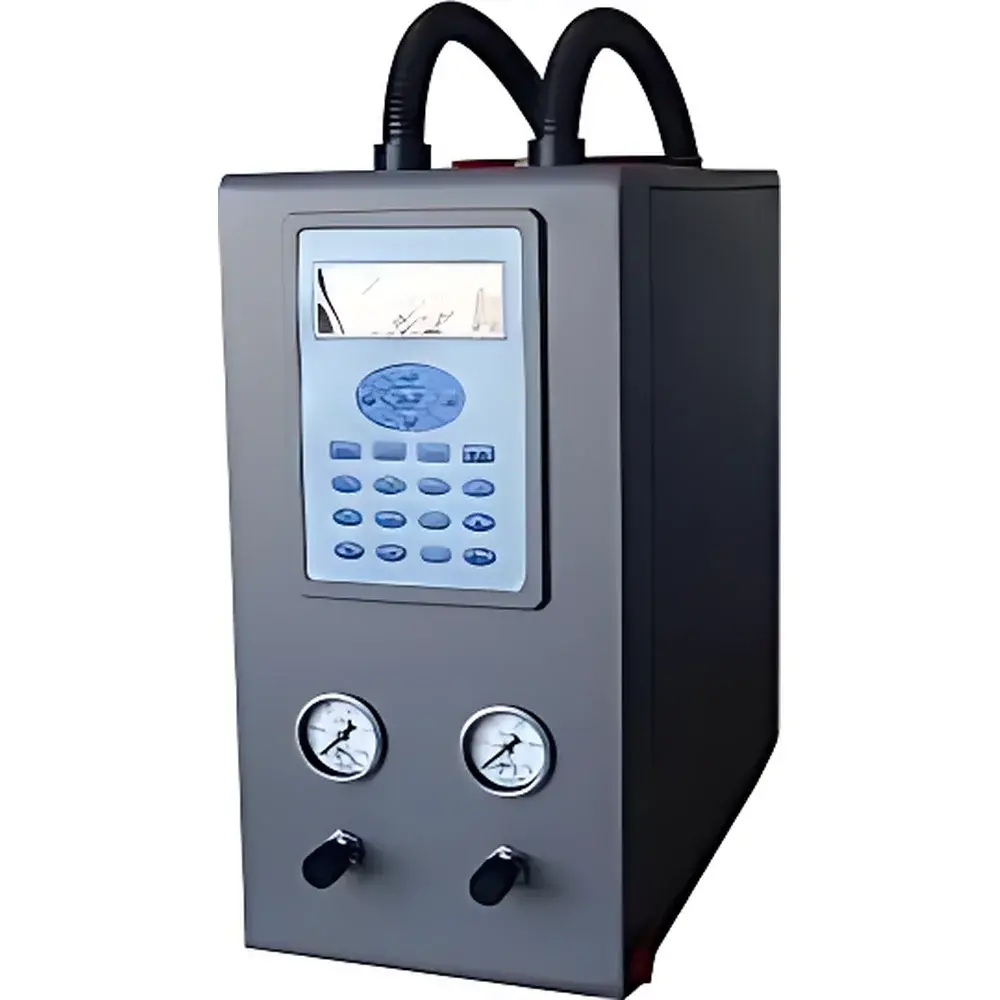
Beifen Sanpu DK-6900 Automated Static Headspace Sampler
| Brand | Beifen Sanpu |
|---|---|
| Origin | Beijing, China |
| Manufacturer Type | Manufacturer |
| Instrument Type | Static Headspace Sampler |
| Automation Level | Semi-Automatic |
| Vial Heating Range | Ambient to 200 °C (1 °C increments) |
| Valve & Loop Heating Range | Ambient to 200 °C (1 °C increments) |
| Sample Transfer Line Heating Range | Ambient to 200 °C (1 °C increments) |
| Temperature Control Accuracy | ±0.1 °C |
| Temperature Uniformity (Gradient) | < ±0.5 °C |
| Loop Volume | 1 mL (optional: 0.5 mL or 3 mL) |
| Vial Capacity | 20 mL (optional: 10 mL) |
| Vial Positions | 9 |
| RSD for Injection Precision | ≤1.5% (n = 5, 40 ppm ethanol in water) |
| Purge/Flush Flow Rate | 0–50 mL/min (continuously adjustable) |
| Synchronization | GC trigger, chromatography data system (CDS) event, or external TTL pulse |
Overview
The Beifen Sanpu DK-6900 Automated Static Headspace Sampler is a dedicated sample introduction system engineered for precise, reproducible analysis of volatile and semi-volatile organic compounds via gas chromatography (GC). It operates on the principle of static headspace equilibrium: a sealed sample vial is heated to promote partitioning of analytes between the condensed phase (liquid or solid matrix) and the vapor phase above it. Once thermodynamic equilibrium is achieved, a defined volume of the equilibrated headspace gas is withdrawn under positive pressure and introduced directly into the GC inlet via a thermostatted six-port electric valve and fixed-volume loop. This methodology eliminates liquid-phase injection artifacts, reduces matrix interference, and enhances detection sensitivity—particularly for trace-level volatiles in complex aqueous or polymeric matrices. The DK-6900 is designed for routine compliance-driven laboratories performing residual solvent analysis, environmental monitoring, food safety testing, and pharmaceutical quality control in accordance with established regulatory frameworks including USP , ICH Q3C(R8), EPA Method 502.2, and ISO 11843-2.
Key Features
- Electrically actuated, high-cycle-life six-port valve with integrated 1 mL quantitative loop (field-replaceable with 0.5 mL or 3 mL alternatives); ensures consistent loop filling and minimal carryover.
- Triple-zone independent temperature control: vial block (ambient–200 °C), valve/loop assembly (ambient–200 °C), and transfer line (ambient–200 °C), all with ±0.1 °C setpoint accuracy and < ±0.5 °C inter-vial thermal gradient across the 9-position carousel.
- Positive-pressure sampling architecture eliminates vacuum-induced fractionation effects and improves quantitative fidelity for low-boiling analytes.
- Integrated back-flush capability (0–50 mL/min, continuously adjustable) purges residual analyte from the sampling needle and valve pathways after each injection, minimizing cross-contamination between runs.
- Nine programmable method storage slots enable rapid method recall and unattended operation across diverse sample types and regulatory protocols.
- Hardware-level synchronization interfaces support TTL-triggered start of GC oven ramp, CDS acquisition, or external lab automation systems—ensuring temporal alignment critical for retention time stability and data integrity.
- Microprocessor-based controller with LCD interface and membrane keypad provides real-time parameter monitoring, error logging, and configurable safety limits—including overtemperature cutoff and thermal runaway protection.
- Modular needle design allows mechanical and thermal compatibility with standard GC inlets from Agilent, Thermo Fisher, Shimadzu, PerkinElmer, and other major OEM platforms.
Sample Compatibility & Compliance
The DK-6900 accommodates standard 20 mL crimp-top headspace vials (with optional 10 mL support), compatible with common septa materials (PTFE/silicone, BTO, or butyl) and automated capping systems. Its thermal management architecture prevents condensation in the transfer path—a key requirement for reliable analysis of polar volatiles (e.g., alcohols, ketones, chlorinated solvents). The instrument meets functional requirements for GLP-compliant environments: audit-trail-capable method storage, parameter lockout options, and deterministic timing behavior suitable for FDA 21 CFR Part 11–aligned workflows when paired with validated CDS software. It supports validation per ASTM D7217 (residual solvents in pharmaceuticals) and ISO 17025 calibration traceability protocols when operated within documented SOPs.
Software & Data Management
The DK-6900 operates as a peripheral device controlled either manually via front-panel interface or externally through digital I/O signals. While it does not include proprietary PC software, its TTL-compatible triggering and status outputs integrate natively with all major GC data systems—including OpenLab CDS, Chromeleon, Empower, and GCMSsolution—enabling synchronized run initiation, sequence control, and electronic record linkage. All temperature setpoints, loop volumes, equilibration times, and purge durations are stored in non-volatile memory with timestamped versioning. Firmware supports firmware update via USB port, and operational logs (including temperature deviations, valve actuation counts, and error codes) are accessible for internal review and QA auditing.
Applications
- Pharmaceutical QC: Residual solvents (ICH Q3C Class 1–3) in APIs and finished dosage forms.
- Environmental testing: Volatile halogenated hydrocarbons (e.g., chloroform, carbon tetrachloride) in drinking water per EPA 502.2.
- Food & beverage safety: Ethanol quantification in vinegar, acetaldehyde in PET packaging, hexane residues in edible oils.
- Clinical toxicology: Blood alcohol concentration (BAC) and volatile metabolite profiling (acetone, isopropanol) in forensic specimens.
- Polymer & coating analysis: Monomer release (styrene, vinyl chloride) from cured resins and industrial coatings.
- Flavor & fragrance chemistry: Headspace profiling of volatile terpenes and esters in tea, hops, and essential oils.
FAQ
What sample vial formats does the DK-6900 support?
Standard 20 mL screw-thread or crimp-top headspace vials; 10 mL vials are supported with optional adapter inserts.
Is the DK-6900 compliant with FDA 21 CFR Part 11 requirements?
The hardware itself provides deterministic, time-stamped operational logs and method locking capability; full Part 11 compliance requires integration with a validated chromatography data system supporting electronic signatures and audit trails.
Can the loop volume be changed without tools?
Loop replacement requires manual disassembly of the valve manifold and is intended as a maintenance procedure—not field-swappable during routine operation.
Does the system support dynamic headspace (purge-and-trap) mode?
No—the DK-6900 is strictly a static headspace sampler and does not include trapping columns, cryofocusing, or carrier gas sparging functionality.
What is the typical equilibration time required for aqueous samples?
Equilibration time is method-dependent and must be empirically determined; typical ranges are 10–30 minutes at 70–90 °C for small-molecule volatiles in water, per USP guidance.





