
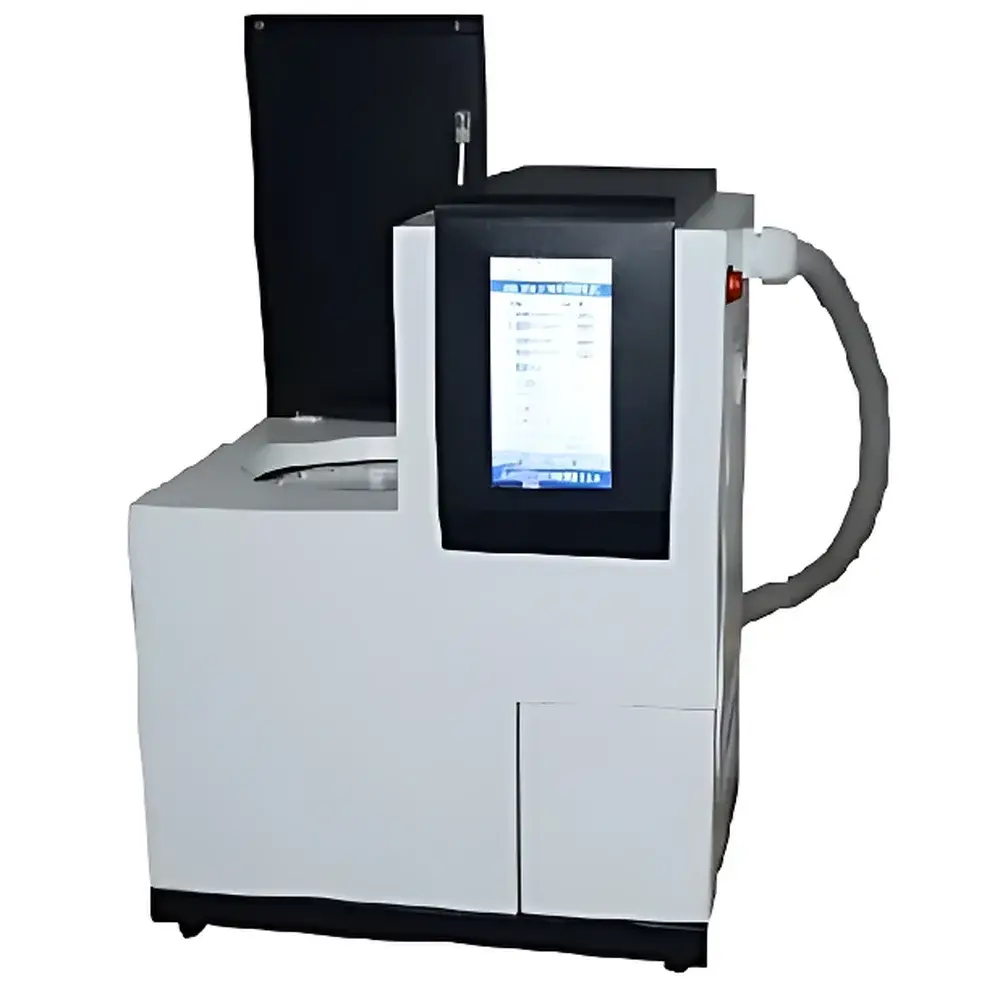
Beifen Sanpu AsTDS-20A Automated Two-Stage Thermal Desorber for Indoor Air Quality Analysis
| Brand | Beifen Sanpu |
|---|---|
| Origin | Beijing, China |
| Manufacturer Type | Direct Manufacturer |
| Product Category | Domestic |
| Model | AsTDS-20A |
| Instrument Type | Automated Two-Stage Thermal Desorber |
| Primary Desorption Temperature Range | Ambient to 450 °C |
| Secondary Desorption Temperature Range | 100–450 °C |
| Cold Trap Temperature Range | −35 °C to Ambient |
| Desorption Recovery Rate | >99% (compound-dependent) |
| Sample Capacity | 20 positions |
| Cold Trap Cooling Method | Electronic Refrigeration |
Overview
The Beifen Sanpu AsTDS-20A Automated Two-Stage Thermal Desorber is an engineered solution for trace-level volatile organic compound (VOC) analysis in indoor air, vehicle cabin air, building materials, and environmental monitoring applications. It operates on the principle of two-stage thermal desorption coupled with gas chromatography–flame ionization detection (GC–FID), enabling quantitative determination of total volatile organic compounds (TVOC) as defined by ISO 16000-6 and GB/T 18883–2002. In this method, ambient air is drawn through a sorbent tube packed with Tenax TA (or equivalent polymeric adsorbent), where VOCs—including benzene, toluene, ethylbenzene, xylenes (BTEX), styrene, butyl acetate, and C6–C16 aliphatic/aromatic hydrocarbons—are retained. The AsTDS-20A then performs sequential thermal release: first-stage desorption transfers analytes to a cryogenically focused cold trap (−35 °C); second-stage rapid desorption (≥3000 °C/min ramp rate) injects a narrow, solvent-free analyte band into the GC column. This two-stage architecture significantly improves chromatographic resolution, sensitivity, and reproducibility compared to single-stage systems—particularly for low-concentration, high-boiling-point VOCs in complex matrices.
Key Features
- Automated unattended operation for up to 20 sample tubes per sequence, reducing manual intervention and improving laboratory throughput.
- Independent temperature control across four zones: primary desorption oven (ambient–450 °C), secondary desorption chamber (ambient–450 °C), valve manifold (ambient–300 °C), and transfer line (ambient–300 °C), each adjustable in 1 °C increments with stability better than ±0.5 °C.
- Integrated electronic cooling system maintaining cold trap temperatures from −35 °C to ambient, eliminating reliance on liquid nitrogen or mechanical compressors.
- Motor-driven six-port switching valve with programmable timing for precise control of desorption, purge, reinjection, and back-flush cycles.
- Onboard calibration capability via built-in simulated sampling mode, supporting direct generation of calibration curves without external gas standards.
- Automatic tube reactivation protocol post-analysis, extending sorbent tube lifetime and ensuring consistent breakthrough performance.
- Configurable hardware options including ambient-temperature or cryo-enhanced secondary desorption modules, adaptable to method-specific requirements (e.g., HJ 644–2013 vs. HJ 734–2014).
- Low-voltage (24 V DC) heating elements for transfer lines, enhancing operational safety and electromagnetic compatibility in shared lab environments.
Sample Compatibility & Compliance
The AsTDS-20A accommodates standard 1/4″ × 3.5″ (OD × length) stainless steel or quartz sorbent tubes compliant with ASTM D6196, ISO 16017-1, and US EPA TO-17 specifications. Its design supports both Tenax TA and multi-bed sorbent configurations (e.g., Carbopack B/C, Carboxen 1000) for broad volatility coverage (C3–C16). The instrument meets data integrity requirements under GLP and GMP frameworks through audit-trail-enabled method storage, user-access logging, and time-stamped event records. It is validated for use in regulatory methods including GB/T 18883–2002, GB 50325–2020, HJ 644–2013, HJ 583–2010, HJ 734–2014, and HJ/T 400–2007—ensuring full alignment with Chinese national environmental monitoring protocols and internationally recognized VOC measurement practices.
Software & Data Management
Control and sequencing are managed via an embedded industrial-grade touchscreen interface running deterministic real-time firmware. All method parameters—including temperature ramps, dwell times, carrier gas flows (0–100 mL/min purge; 0–160 mL/min simulated sampling), and valve actuation logic—are programmable and stored with versioned naming. The system supports external synchronization with third-party GC instruments and data systems (e.g., BF-2002, Chromeleon, OpenLab) via TTL or RS232 triggers. Raw thermal desorption events are timestamped and logged locally; export formats include CSV and XML for integration into LIMS platforms. No proprietary software license is required for basic operation, and firmware updates are delivered via USB—minimizing IT dependency in regulated QC laboratories.
Applications
The AsTDS-20A serves as a core preconcentration module in laboratories performing compliance testing for indoor air quality (IAQ), automotive interior emissions, construction material off-gassing, and workplace exposure assessments. Typical use cases include quantification of TVOC and individual aromatic compounds in residential and commercial buildings; screening of formaldehyde co-eluters in furniture and laminate flooring; validation of low-VOC paint formulations; and source identification in odor investigations. Its robustness and repeatability (RSD ≤2.5% at 0.05 µg benzene in methanol) make it suitable for routine monitoring in accredited environmental testing labs operating under CNAS (ISO/IEC 17025) or CMA accreditation scopes.
FAQ
What sorbent tubes are compatible with the AsTDS-20A?
Standard 1/4″ OD × 3.5″ length stainless steel or quartz tubes packed with Tenax TA, Carbopack B/C, or custom multi-bed sorbents meeting ISO 16017-1 dimensional and performance criteria.
Does the instrument support method validation per ISO/IEC 17025?
Yes—full parameter logging, user authentication, and audit-trail functionality enable documentation of system suitability tests, carryover checks, and recovery experiments required for accredited testing.
Can the AsTDS-20A be integrated with GC–MS systems?
Yes—its universal valve interface and TTL synchronization output allow seamless coupling with domestic and international GC–MS platforms for compound identification and confirmatory analysis.
Is cold trap maintenance required?
No consumables or periodic replacement parts are needed; the solid-state electronic cooler requires only ambient airflow clearance and has no moving parts or refrigerant charges.
How is carryover minimized between samples?
Programmable back-flush of the transfer line and six-port valve using inert carrier gas, combined with high-temperature bake-out cycles, ensures <0.1% cross-contamination across consecutive runs.
Related Products





