
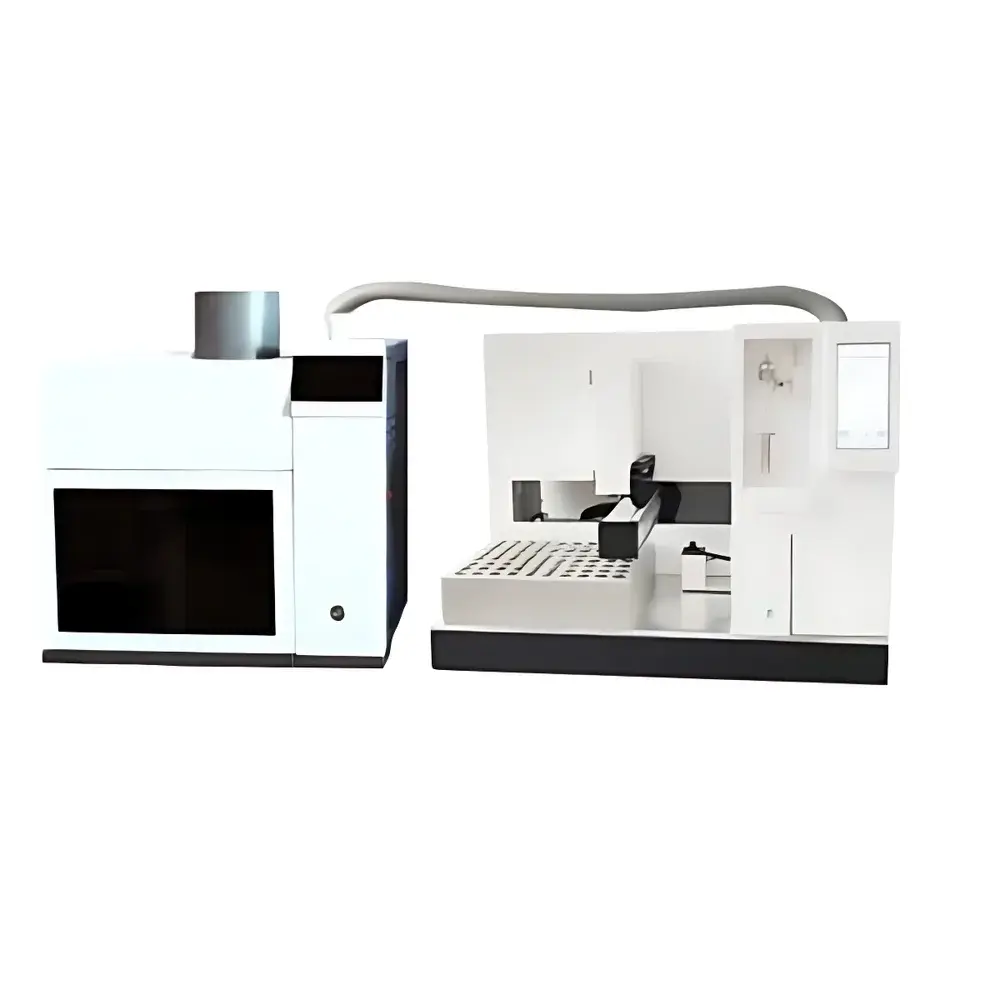
Beifen Sanpu Multi-2025 Multi-Functional Alkylmercury Analyzer
| Brand | Beifen Sanpu |
|---|---|
| Origin | Beijing, China |
| Manufacturer Type | Original Equipment Manufacturer (OEM) |
| Instrument Type | Laboratory Gas Chromatograph |
| Detection Principle | Purge-and-Trap / Gas Chromatography–Cold Vapor Atomic Fluorescence Spectrometry (PT-GC-CVAFS) |
| Application Domain | Environmental Monitoring |
| Compliance | HJ 977–2018, HJ 1269–2022, HJ 1268–2022, SNT 5517–2023 |
| Sample Compatibility | Aqueous, Soil, Sediment, Biological Tissues, Food & Feed Matrices |
| Column Configuration | Modified OV-3 Packed Column |
| Thermal Decomposition Module | Up to 1050 °C |
| Integrated Hydride Generation Module | 3D-Printed Monolithic Reactor |
| Elemental Coverage | As, Hg, Pb, Se, Sb, Bi, Cd, Te, Sn, Ge, Zn, Au (12 elements) |
| Software | Graphical GUI with Real-Time System Status Monitoring, Consumables Lifetime Tracking, and Multi-Format Reporting (PDF/Excel/Word) |
Overview
The Beifen Sanpu Multi-2025 Multi-Functional Alkylmercury Analyzer is a dual-mode analytical platform engineered for trace-level speciation and total elemental quantification of mercury species—particularly methylmercury (MeHg) and ethylmercury (EtHg)—in complex environmental and biological matrices. It integrates purge-and-trap (PT) sample introduction with gas chromatographic separation and cold vapor atomic fluorescence spectrometric (CVAFS) detection—a methodologically robust configuration validated under multiple Chinese national environmental standards (HJ 977–2018, HJ 1269–2022, HJ 1268–2022). Unlike conventional single-purpose GC or AFS instruments, the Multi-2025 implements a hybrid architecture: its GC-CVAFS channel delivers speciated alkylmercury analysis at sub-pg/L sensitivity in aqueous samples, while its hydride generation–atomic fluorescence (HG-AFS) channel supports quantitative determination of total As, Hg, Se, Sb, Bi, Cd, and seven additional elements across solid and liquid samples. This dual-path design eliminates cross-platform calibration drift and ensures metrological continuity between speciation and total-element workflows.
Key Features
- Modular PT-GC-CVAFS architecture compliant with EPA Method 1630 and ISO 17294-2 for alkylmercury speciation in water and sediment extracts.
- Thermally stable packed column using modified OV-3 stationary phase—optimized for alkylmercury retention, resolution, and column lifetime (>2,000 injections under routine operation).
- High-temperature pyrolysis module (up to 1050 °C) enabling complete thermal cleavage of organomercury compounds prior to CVAFS detection.
- Monolithic 3D-printed hydride generation reactor integrating gas–liquid separation, reaction chamber, and vapor transport into a single inert polymer structure—eliminating dead volume, reducing memory effects, and minimizing carryover (<0.05% for Hg).
- Material compatibility with low-adsorption fluoropolymer and fused silica components throughout fluidic pathways, critical for maintaining integrity of ultra-trace Hg standards.
- Real-time system diagnostics including carrier gas pressure monitoring, detector lamp intensity tracking, and automated valve sequencing validation.
Sample Compatibility & Compliance
The Multi-2025 accommodates diverse sample types without matrix-specific hardware reconfiguration: filtered surface water, acid-digested soils, enzymatically extracted biological tissues (e.g., fish muscle, human blood), and solvent-extracted feedstuffs. Its PT interface accepts standard 40-mL VOA vials and is fully compatible with third-party purge-and-trap concentrators (e.g., Tekmar Atomx, OI 4100), enabling integration into existing laboratory automation ecosystems. Regulatory alignment includes full support for HJ 977–2018 (water), HJ 1269–2022 (soil/sediment), HJ 1268–2022 (LC-AFS alternative validation), and SNT 5517–2023 (export seafood testing). Data integrity meets GLP-compliant audit requirements through timestamped method logs, electronic signature support, and 21 CFR Part 11–ready user access controls.
Software & Data Management
The proprietary graphical control software provides instrument orchestration via intuitive drag-and-drop method building. Real-time visualization includes dynamic status mapping of GC oven temperature ramping, trap desorption timing, CVAFS lamp warm-up progress, and HG-AFS reaction cycle synchronization. Built-in consumables management tracks cumulative usage hours for quartz lamps, peristaltic pump tubing, and trapping sorbent beds—triggering configurable alerts before performance degradation occurs. All raw chromatograms, peak tables, and calibration curves are stored in vendor-neutral HDF5 format. Reporting modules export compliant analytical reports directly to PDF (with embedded digital signatures), Excel (for LIMS ingestion), and Word (for regulatory submission packages), all retaining full metadata traceability.
Applications
This system serves as a reference-grade solution for laboratories performing accredited environmental testing, food safety surveillance, and clinical toxicology screening. Primary use cases include: quantification of MeHg/EtHg in wastewater effluents per HJ 977–2018; speciation analysis in coastal sediments subject to HJ 1269–2022; total arsenic and mercury screening in rice and infant formula under GB 5009.11/5009.12; and high-throughput monitoring of seafood exports per SNT 5517–2023. Its dual-channel capability also supports method development for emerging organometallic contaminants (e.g., phenylmercury, propylmercury) and inter-laboratory comparison studies requiring orthogonal detection confirmation.
FAQ
Does the Multi-2025 require dedicated purge-and-trap hardware?
No—it features standardized PT interface protocols and accepts analog/digital I/O signals from commercially available concentrators, allowing reuse of existing instrumentation.
Can the same calibration curve be used for both alkylmercury speciation and total mercury analysis?
No—speciation requires matrix-matched alkylmercury standards (e.g., MeHgCl), while total Hg quantification uses inorganic Hg²⁺ standards; separate calibration verification is mandatory per ISO/IEC 17025.
Is the 3D-printed reaction module replaceable as a field-serviceable unit?
Yes—modules are serialized, pre-aligned, and installed without tools; replacement takes <3 minutes and requires no post-installation recalibration.
What data security protocols are implemented for audit readiness?
All method files, raw data, and report exports are digitally signed and time-stamped; audit trails record user actions, parameter changes, and instrument events with immutable timestamps.
How is mercury memory effect mitigated during high-sensitivity analysis?
Through integrated gold-coated quartz traps, optimized carrier gas flow profiles, and programmable high-temperature bake-out cycles—validated to achieve <0.1 pg carryover after 10 pg MeHg injection.




