
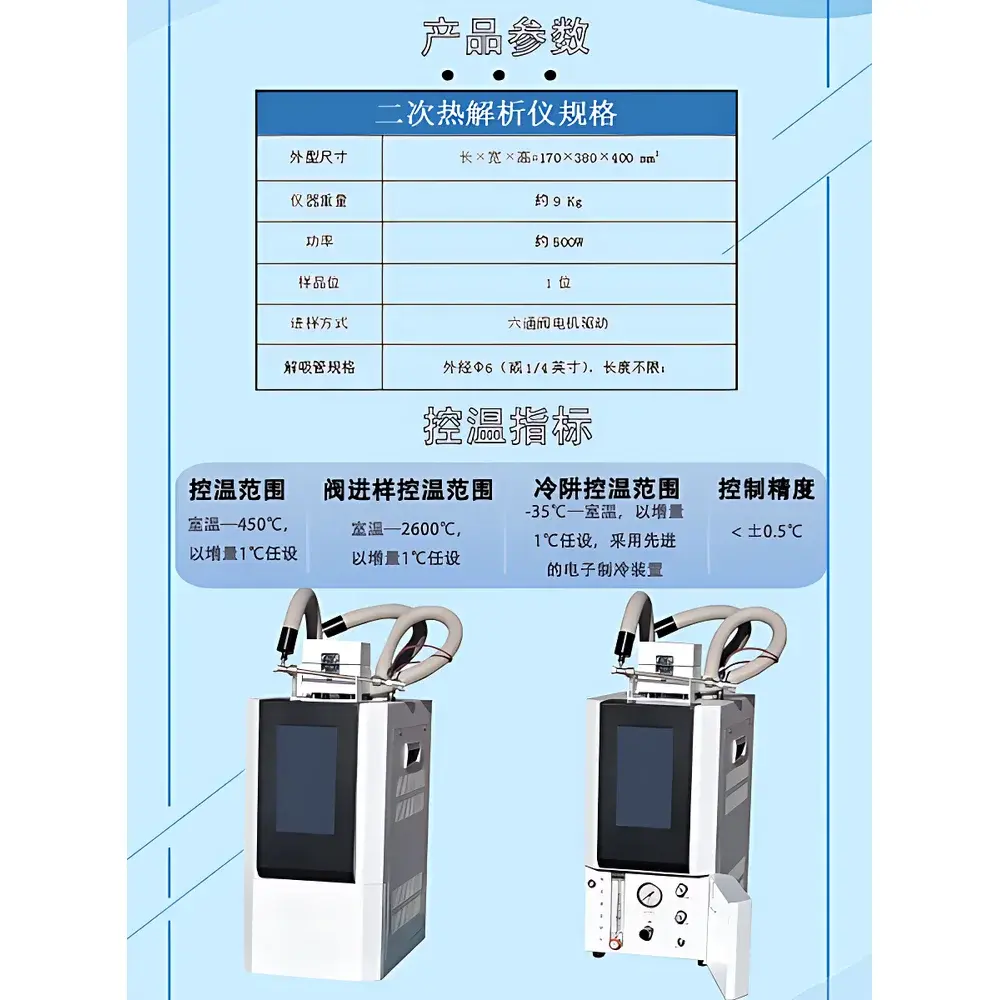
Beifen Sanpu ATDS-3430 Dual-Stage Thermal Desorber for GB 50325-2020 Compliant VOC Analysis
| Brand | Beifen Sanpu |
|---|---|
| Origin | Beijing, China |
| Manufacturer Type | Direct Manufacturer |
| Instrument Type | Dual-Stage Thermal Desorber |
| Automation Level | Semi-Automatic |
| Primary Desorption Temperature Range | Ambient to 400 °C |
| Secondary Desorption (Cold Trap Flash) Temperature Range | 100–400 °C |
| Valve Oven Temperature Range | Ambient to 200 °C |
| Transfer Line Temperature Range | Ambient to 200 °C |
| Cold Trap Temperature Range | Down to −35 °C |
| Temperature Control Accuracy | < ±0.1 °C |
| Analyte Recovery Rate | >90% |
| Sample Capacity | 20 Adsorption Tubes |
Overview
The Beifen Sanpu ATDS-3430 is a semi-automatic dual-stage thermal desorber engineered for precise, reproducible analysis of volatile organic compounds (VOCs) in indoor air samples—specifically designed to meet the stringent requirements of GB 50325-2020, the People’s Republic of China National Standard for Indoor Environmental Pollution Control in Civil Construction Projects. Unlike single-stage desorption systems, the ATDS-3430 implements a two-step thermal desorption process: primary desorption from the sorbent tube at controlled elevated temperature, followed by cryo-focusing and rapid flash desorption from a thermoelectrically cooled cold trap (down to −35 °C). This architecture enables sharp band focusing, enhanced sensitivity for trace-level benzene, toluene, ethylbenzene, xylenes (BTEX), and C6–C16 TVOC components, and minimizes breakthrough or degradation artifacts common in high-boiling analytes. The system interfaces directly with gas chromatographs equipped with flame ionization detection (FID) or mass spectrometric detection (GC-MS), supporting fully validated workflows aligned with ISO 16000-6, ASTM D6196, and EPA TO-17 methodologies.
Key Features
- Dual-stage thermal desorption architecture with independent temperature control for primary furnace, secondary cold trap, valve oven, and transfer line—ensuring full thermal integrity across the entire analytical path.
- Cryo-cooled cold trap using Peltier technology, capable of stable operation down to −35 °C, enabling efficient trapping of low-volatility VOCs (e.g., n-decane to n-hexadecane) without liquid cryogens.
- High-precision temperature regulation (< ±0.1 °C) across all heated zones, critical for method reproducibility and regulatory compliance in accredited laboratories.
- 20-position sample carousel accommodating standard 6 mm OD stainless steel or glass sorbent tubes—including T-C composite tubes (2,6-diphenylphenol porous polymer–graphitized carbon black–X) specified in GB 50325-2020 Annex D.
- Integrated tube aging and calibration standard introduction capability—supporting routine system suitability testing and QC verification per GLP guidelines.
- Modular valve manifold with inert, passivated flow paths to minimize adsorption losses and memory effects—validated for BTEX and aldehyde stability over repeated cycles.
Sample Compatibility & Compliance
The ATDS-3430 is validated for use with a broad range of sorbent media, including Tenax TA, Carbopack B/X, Carboxen 1000, and the T-C composite adsorbent mandated in GB 50325-2020 for simultaneous quantification of benzene, toluene, ethylbenzene, o/m/p-xylene, and TVOC. It supports both active sampling (pumped air collection) and passive badge-based collection when coupled with appropriate conditioning and elution protocols. All thermal desorption parameters—including primary desorption time/temperature, cold trap hold time, flash rate, and back-flush duration—are programmable and auditable, satisfying documentation requirements under CNAS-CL01 (equivalent to ISO/IEC 17025) and supporting 21 CFR Part 11-compliant data governance when paired with compliant chromatography data systems (CDS). The instrument meets electromagnetic compatibility (EMC) Class B requirements per GB/T 18268.1 and electrical safety standards per GB 4793.1.
Software & Data Management
Operation is managed via embedded firmware with a tactile LCD interface and configurable method templates. While the ATDS-3430 itself does not include proprietary PC software, its RS-232 and dry-contact I/O ports enable seamless synchronization with third-party GC control platforms (e.g., Agilent OpenLab, Thermo Chromeleon, Shimadzu GCsolution) for timed event triggering—desorption start, valve actuation, GC oven ramp initiation, and detector signal acquisition. Method parameters are stored with timestamped audit trails, and all temperature logs can be exported in CSV format for QA review. When deployed in GLP or GMP-regulated environments, the system supports integration into validated CDS environments with full electronic signature, user access control, and change history tracking—ensuring traceability from sample loading through peak integration.
Applications
- Routine compliance testing of residential, commercial, and institutional buildings per GB 50325-2020, including mandatory 50% sampling coverage for kindergartens, schools, dormitories, and elderly care facilities.
- Validation of low-emission building materials, adhesives, coatings, and furniture per JC/T 1074 and HJ 583.
- Occupational hygiene monitoring in manufacturing, printing, and coating facilities where solvent exposure risk is elevated.
- Method development and reference material analysis for national metrology institutes and provincial CDC laboratories performing inter-laboratory proficiency testing.
- Research on sorbent breakthrough behavior, desorption kinetics, and matrix interference under variable humidity and co-analyte conditions.
FAQ
Does the ATDS-3430 support fully automated unattended operation?
No—it is classified as semi-automatic: tube loading/unloading and method initiation require manual intervention, though all thermal and pneumatic sequences execute autonomously once started.
Is the cold trap compatible with liquid nitrogen cooling?
No. The ATDS-3430 uses solid-state thermoelectric (Peltier) cooling exclusively; no LN₂ port or dewar interface is provided.
Can the system be used with GC-MS instruments?
Yes—its ultra-low dead volume transfer line, inert flow path, and precise flash timing ensure compatibility with both quadrupole and time-of-flight MS detectors.
What sorbent tube formats are supported?
Standard 6 mm OD × 89 mm length stainless steel or quartz tubes; custom-length tubes may be accommodated with optional adapters.
How is system performance verified for GB 50325-2020 compliance?
Recovery studies using certified BTEX and TVOC reference standards (e.g., AccuStandard TO-17 mix), carried out across the full 20-tube carousel, must demonstrate ≥90% mean recovery and ≤5% RSD—documented in laboratory SOPs and QA records.





