
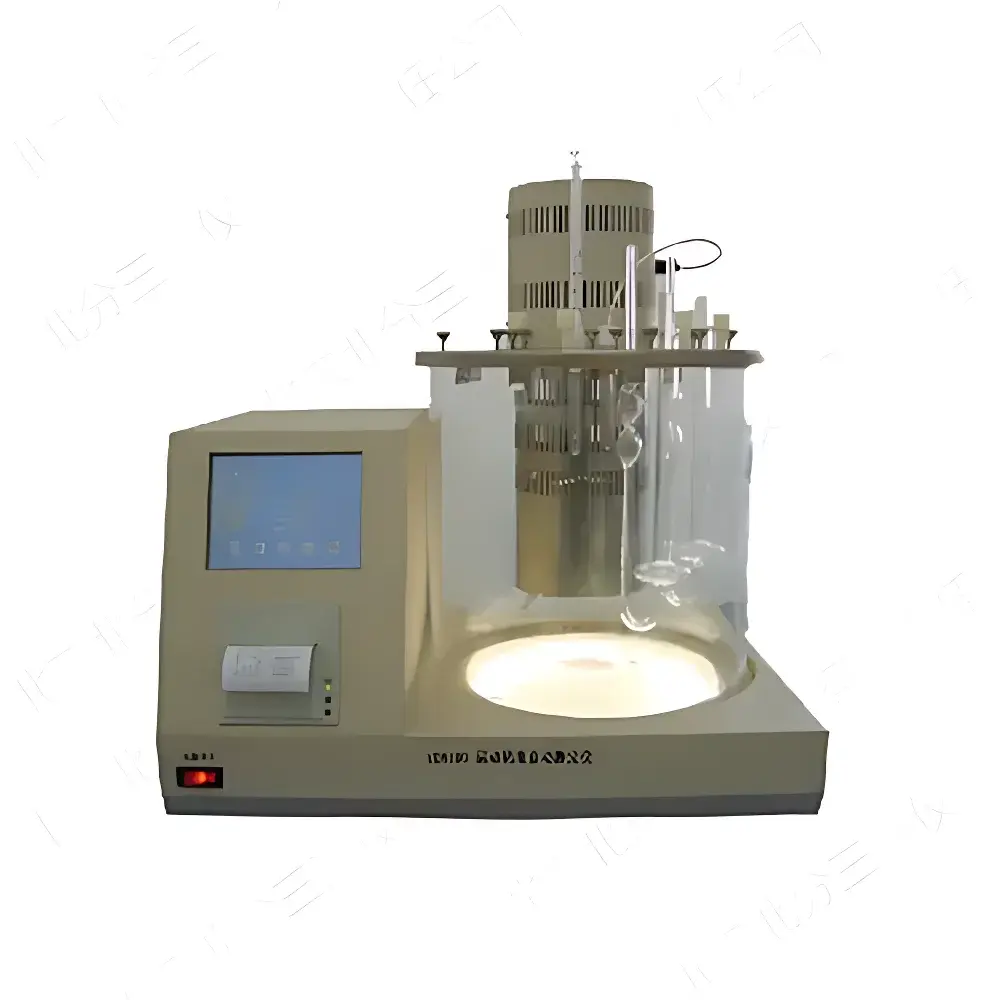
Beifen Sanpu YDN100 Kinematic Viscometer for Petroleum Products
| [Brand | Beifen Sanpu |
|---|---|
| Origin | Beijing, China |
| Manufacturer Type | Direct Manufacturer |
| Model | YDN100 |
| Display | 5-inch Color LCD with Chinese UI & Touchscreen Control |
| Kinematic Viscosity Range | 0.5–20,000 mm²/s |
| Dynamic Viscosity Range | 0.3–40,000 mPa·s |
| Temperature Control Range | Ambient to 150 °C |
| Temperature Accuracy | ±0.03 °C |
| Temperature Sensing Resolution | 0.01 °C |
| Timing Accuracy | ±0.1 s |
| Bath Volume | 10 L |
| Heating Power | 1000 W |
| Stirring Speed | 1300 rpm |
| Test Stations | 4 |
| Data Storage | 256 test records (non-volatile memory) |
| Power Supply | 220 V ±10%, 50 Hz |
| Dimensions | 440 × 320 × 450 mm |
| Compliance | GB/T 265, SY/T 5651, GB 1660, GB 1841, ASTM D445, GB/T 11137, SH/T 0173, JJG 155] |
Overview
The Beifen Sanpu YDN100 Kinematic Viscometer is a precision-engineered instrument designed specifically for the determination of kinematic viscosity, dynamic viscosity, and Ubbelohde-type capillary flow time in Newtonian liquid petroleum products. It operates on the principle of capillary viscometry—measuring the time required for a fixed volume of sample to flow under gravity through a calibrated glass capillary tube at a precisely controlled temperature. This method aligns with classical Poiseuille flow theory and serves as the foundational technique referenced in major international standards including ASTM D445 and ISO 3104 (equivalent to GB/T 265). The YDN100 integrates microprocessor-based thermal regulation, high-stability German-sourced platinum resistance temperature sensors (PT100-class), and automated timing logic to ensure repeatability and traceability in routine QC laboratories and refinery testing facilities.
Key Features
- Four independent test stations enabling parallel analysis of up to four samples or reference standards per cycle
- 10-liter borosilicate glass constant-temperature bath with optimized thermal mass and uniform circulation via high-speed magnetic stirrer (1300 rpm)
- Fuzzy logic temperature control algorithm delivering ±0.03 °C stability across the full operating range (ambient to 150 °C)
- Integrated 5-inch color LCD touchscreen interface with native Chinese language support and intuitive workflow navigation
- Automated calculation engine that derives both kinematic viscosity (mm²/s) and dynamic viscosity (mPa·s) directly from measured efflux time, density input (if provided), and calibration constants
- Thermal printer module with real-time result output and non-volatile memory storage for 256 test records—including date/time stamp, bath temperature, efflux time, and calculated viscosity values
- Comprehensive hardware compatibility with standardized capillary viscometers conforming to SH/T 0173 and JJG 155 specifications, including Ubbelohde, Cannon-Fenske, and Ostwald types
Sample Compatibility & Compliance
The YDN100 is validated for use with transparent and opaque Newtonian liquids meeting the scope definitions of GB/T 265 and ASTM D445, including base oils, diesel fuels, lubricants, transformer oils, and light hydrocarbon fractions. It supports inverse-flow measurement per GB/T 11137 for dark-colored petroleum products. All thermal and timing subsystems are calibrated against national metrological standards traceable to CNAS-accredited reference laboratories. The instrument satisfies technical requirements outlined in SY/T 5651 (Petroleum Product Kinematic Viscometer Specifications), GB 1660 (plasticizer viscosity), and GB 1841 (polyolefin resin dilute solution viscosity). While not inherently 21 CFR Part 11 compliant, audit-ready data logs and manual signature fields in printed reports facilitate integration into GLP/GMP environments where electronic signatures are applied externally.
Software & Data Management
The embedded firmware implements deterministic real-time scheduling for temperature stabilization, efflux timing, and arithmetic computation—eliminating reliance on external PCs or proprietary software. All measurements are timestamped and stored locally in EEPROM with power-loss protection. Export functionality is limited to hardcopy output; however, users may manually transcribe results into LIMS or Excel-based QA databases. The system supports manual entry of sample ID, operator name, and density value (required for dynamic viscosity derivation), ensuring alignment with internal SOP documentation practices. Firmware updates are performed via USB port using factory-issued binaries, with version logging retained in device history.
Applications
- Routine quality control of crude oil distillates and finished lubricants in refinery laboratories
- Viscosity grading of industrial hydraulic fluids and turbine oils per ISO VG classification
- Stability assessment of fuel blends during oxidation or thermal stress testing
- Batch release testing of transformer oils per IEC 60296 and ASTM D877
- Research-grade characterization of synthetic ester-based dielectric fluids
- Verification of viscosity index improvers (VIIs) in multigrade engine oils
FAQ
What capillary viscometers are compatible with the YDN100?
The instrument accepts all standard glass capillary viscometers meeting SH/T 0173 and JJG 155 dimensional and calibration tolerances—including Ubbelohde, Cannon-Fenske, and suspended-level types—with nominal constants ranging from 0.1 to 10 mm²/s².
Does the YDN100 support automatic density input for dynamic viscosity calculation?
No. Density must be entered manually prior to test initiation; the system uses this value to compute dynamic viscosity (η = ν × ρ) in real time.
Can the bath temperature be set below ambient?
No. The YDN100 features resistive heating only and does not include refrigeration; its minimum operational temperature is ambient.
Is calibration certificate included with shipment?
A factory calibration report verifying temperature sensor accuracy and timing circuit performance is supplied with each unit, referencing national metrological standards.
How often should the capillary viscometers be recalibrated?
Per JJG 155, working capillary viscometers require periodic verification—at least annually—or after mechanical shock, cleaning, or changes in test fluid class.
Related Products







