
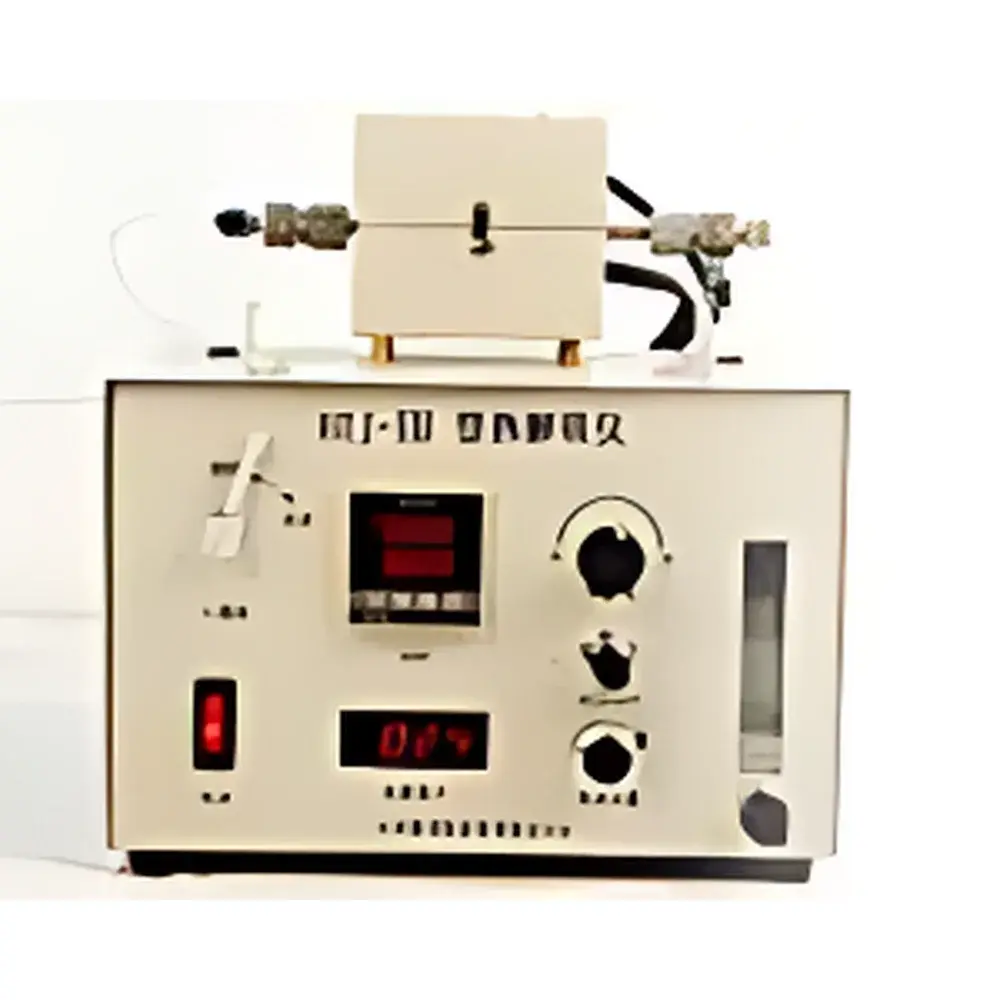
Beifen Sanpu TDS-3400 Thermal Desorber
| Brand | Beifen Sanpu |
|---|---|
| Origin | Beijing, China |
| Manufacturer Type | Direct Manufacturer |
| Product Origin | Domestic (China) |
| Model | TDS-3400 Thermal Desorber |
| Power Supply | 220 VAC, 50 Hz |
| Power Consumption | <200 VA |
| Temperature Control Accuracy | ±2 °C |
| Timing Range | 1 s to 99 min 59 s |
| Purge/Backflush Flow Rate Adjustment | 0–100 mL/min |
| Dimensions (H×W×D) | 265 × 255 × 185 mm |
| Net Weight | ~5 kg |
Overview
The Beifen Sanpu TDS-3400 Thermal Desorber is a benchtop, fully integrated thermal desorption unit engineered for quantitative analysis of volatile and semi-volatile organic compounds (VOCs and SVOCs) in environmental, occupational health, and indoor air quality applications. It operates on the principle of controlled thermal desorption—where analytes pre-concentrated on sorbent tubes are rapidly heated under inert carrier gas flow, releasing trapped compounds for direct transfer into a gas chromatograph (GC) via a heated transfer line. Unlike cryogenic or multi-stage desorption systems, the TDS-3400 employs a single-zone, dual-directional heating architecture that ensures uniform thermal energy distribution across the entire adsorbent bed—minimizing breakthrough, carryover, and memory effects. Its design enables seamless coupling with GC systems from major international manufacturers (e.g., Agilent, Thermo Fisher, Shimadzu, PerkinElmer), supporting both split and splitless injection modes without hardware modification. The instrument complies with core methodological frameworks including EPA TO-17, ISO 16017-1, and ASTM D6196—making it suitable for regulatory-compliant VOC monitoring in laboratories operating under GLP or ISO/IEC 17025 accreditation requirements.
Key Features
- Integrated dual-zone heating system: Independent temperature control for the adsorbent tube holder and transfer line ensures full thermal management—eliminating cold spots and reducing analyte adsorption losses.
- Self-contained thermal control architecture: No external chiller, oven, or auxiliary temperature controller required; all critical zones—including the six-port switching valve and internal tubing—are actively heated and maintained at user-defined setpoints.
- Onboard mass flow regulation: Integrated digital flow meter and precision needle valve enable real-time adjustment and verification of purge/backflush gas flow (0–100 mL/min), critical for reproducible desorption efficiency and quantitative recovery.
- Programmable timing module: High-resolution timer (1-second resolution, up to 99 minutes 59 seconds) supports precise control over desorption duration, cool-down intervals, and tube conditioning cycles.
- Ergonomic safety design: External housing surface temperature remains below 45 °C during operation, minimizing burn risk; all electrical components meet IEC 61010-1 safety standards for laboratory equipment.
- Modular GC interface: Heated capillary connection directly mates with standard GC inlet ports (e.g., split/splitless injectors), eliminating need for custom adapters or third-party interface kits.
Sample Compatibility & Compliance
The TDS-3400 supports standard 1/4-inch OD stainless steel or quartz sorbent tubes (e.g., Tenax TA, Carbopack B/C, Carboxen 1000), accommodating both single-bed and multi-bed configurations. It is validated for use with EPA Method TO-17 target analytes—including benzene, toluene, ethylbenzene, xylenes (BTEX), C2–C12 aliphatics, and total volatile organic compounds (TVOCs). All wetted surfaces are passivated stainless steel or fused silica, ensuring low background and minimal catalytic degradation. The system meets mechanical and electromagnetic compatibility (EMC) requirements per EN 61326-1 and is designed to support audit-ready documentation workflows aligned with FDA 21 CFR Part 11 when paired with compliant GC data systems.
Software & Data Management
While the TDS-3400 operates as a standalone hardware unit with front-panel digital controls and LED display, it is fully compatible with industry-standard GC data systems (e.g., OpenLab CDS, Chromeleon, Empower) via TTL-triggered start/stop signals. All operational parameters—including temperature setpoints, timing sequences, and flow settings—are manually configured and retained in non-volatile memory. For laboratories requiring electronic record integrity, the unit supports external logging via RS-232 or optional USB-to-serial interface, enabling timestamped event capture (e.g., desorption initiation, valve actuation, end-of-cycle signal) within LIMS or ELN environments.
Applications
- Indoor air quality (IAQ) assessment per ISO 16000-6 and GB/T 18883–2002
- Workplace exposure monitoring for OSHA and NIOSH-regulated VOCs
- Building material emission testing (e.g., carpets, adhesives, paints)
- Environmental site assessment and vapor intrusion studies
- Method development and validation for accredited environmental testing labs
- Quality control of activated carbon filters and sorbent media
FAQ
Does the TDS-3400 support automated tube loading or robotic integration?
No—the TDS-3400 is a manually loaded system designed for laboratories performing ≤20 samples per day. It does not include auto-sampler capability, but its compact footprint and standardized tube dimensions allow integration with third-party autosamplers equipped with thermal desorption modules.
Can the instrument perform tube aging (baking) and desorption in a single sequence?
Yes—user-defined multi-step protocols can be programmed to sequentially execute tube conditioning (aging), sample desorption, and post-run bake-out using independent temperature and timing parameters for each phase.
Is the flow rate calibrated traceably to NIST standards?
The built-in flow meter is factory-calibrated against reference mass flow controllers; calibration certificates are provided with each unit. Users may perform periodic verification using a NIST-traceable bubble flowmeter or electronic calibrator.
What GC inlet types are compatible with the heated transfer line?
The 0.25 mm ID fused silica transfer line terminates in a standard 1/4-inch compression fitting, compatible with Agilent 7890/8890 split/splitless inlets, Thermo Trace 1300/1310, and Shimadzu GC-2010 Plus injector ports.
Does the system include validation documentation for IQ/OQ/PQ?
A comprehensive User Requirements Specification (URS)-aligned qualification protocol package—including installation checklist, operational test scripts, and performance verification templates—is available upon request for GxP-regulated environments.






