
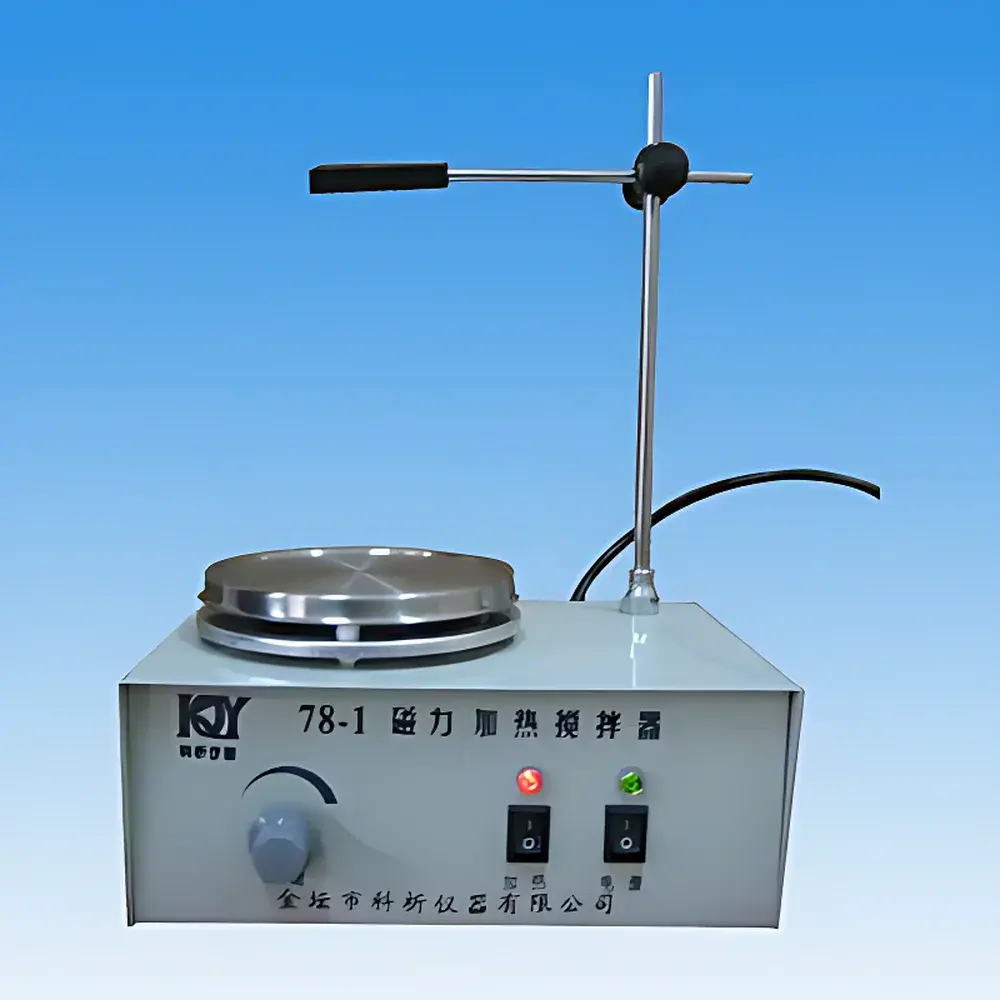
Beifen Sanpu 79-1 Magnetic Hotplate Stirrer
| Brand | Beifen Sanpu |
|---|---|
| Model | 79-1 |
| Power Supply | 220 V, 50 Hz |
| Motor Speed Range | 0–2400 rpm (continuously adjustable) |
| Motor Power | 20 W |
| Heating Power | 200 W |
| Max. Heating Capacity | ~70–80 °C in 100 mL aqueous solution (ambient 20 °C, ~10 min) |
| Construction | Cold-rolled steel housing with epoxy powder coating |
| Duty Cycle | 8 h continuous at medium speed |
| Safety | Grounded design, integrated thermal protection, non-corrosive PTFE-coated stir bar included |
| Compliance | Designed for general laboratory use under GLP-aligned workflows |
Overview
The Beifen Sanpu 79-1 Magnetic Hotplate Stirrer is a compact, benchtop laboratory instrument engineered for precise, simultaneous magnetic stirring and conductive heating of liquid samples in glass vessels. It operates on the principle of rotating magnetic coupling: a permanent magnet rotor beneath the ceramic-coated aluminum or stainless-steel hotplate generates a rotating magnetic field that drives a PTFE- or glass-coated magnetic stir bar immersed in the sample. Heat is transferred via conduction from the heated plate surface to the vessel bottom, enabling controlled temperature elevation during mixing. Designed for routine preparation, dissolution, homogenization, and reaction support in analytical, quality control, and teaching laboratories, the 79-1 delivers stable rotational output and uniform thermal distribution without mechanical shaft penetration—eliminating contamination risk and simplifying cleaning. Its robust architecture supports long-term reliability in environments where consistent, low-maintenance operation is essential.
Key Features
- Brushless permanent-magnet DC motor rated for >10,000 hours of continuous no-load operation, ensuring extended service life and minimal maintenance.
- Smooth, stepless speed control (0–2400 rpm) via front-panel rotary knob—optimized for gentle suspension dispersion or vigorous mixing without abrupt torque surges.
- 200 W resistive heating element with rapid thermal response; achieves 70–80 °C in 100 mL water (20 °C ambient) within approximately 10 minutes.
- Cold-rolled steel chassis fabricated by precision spot welding and finished with corrosion-resistant epoxy powder coating for durability in humid or chemically exposed lab settings.
- Integrated grounding terminal and built-in thermal cutoff to prevent overheating during extended use or accidental dry-run conditions.
- Low-noise, vibration-free operation—critical for sensitive applications such as cell culture media preparation or gravimetric standard dissolution.
Sample Compatibility & Compliance
The 79-1 accommodates standard round-bottom and flat-bottom glassware (e.g., beakers, Erlenmeyer flasks) up to 1000 mL capacity, provided vessel base diameter matches the 130 mm active heating/stirring zone. Compatible with PTFE-, glass-, or ceramic-coated stir bars (included: one 30 mm PTFE-coated bar). Not suitable for highly viscous (>500 mPa·s), volatile, or explosive solvents without additional engineering controls. While not certified to IEC 61010-1 or UL 61010B as a standalone safety-certified device, its grounded construction, overtemperature protection, and electrical isolation meet baseline requirements for general-purpose laboratory equipment used under institutional safety policies. Supports documentation practices aligned with GLP (Good Laboratory Practice) when operated with defined SOPs, logbook entries, and periodic functional verification.
Software & Data Management
The 79-1 is an analog-controlled instrument with no embedded microprocessor, display, or digital interface. All operational parameters—speed and heating—are set manually and monitored externally (e.g., via external thermometer or tachometer). This design prioritizes simplicity, electromagnetic compatibility (EMC), and immunity to firmware-related failure modes—making it ideal for regulated environments where software validation overhead must be minimized. Users maintain traceability through manual entry into laboratory notebooks or LIMS-integrated forms, recording batch number, start/stop time, setpoints, and observed behavior per run. No data export, remote control, or audit trail functionality is present—consistent with ISO/IEC 17025 Clause 6.4.9 requirements for equipment with no automated data handling.
Applications
- Preparation of calibration standards and reference solutions in environmental testing (e.g., EPA Method 200.7, ASTM D511).
- Dissolution testing of pharmaceutical tablets per USP , requiring controlled agitation and temperature maintenance.
- Buffer and reagent formulation in molecular biology and clinical diagnostics labs.
- Sample homogenization prior to filtration, centrifugation, or instrumental analysis (HPLC, AAS, ICP-OES).
- Teaching laboratory demonstrations of reaction kinetics, solubility equilibria, and heat transfer principles.
- Supporting ASTM D937 (petrolatum penetration) and ISO 6721-1 (polymer viscosity) sample conditioning protocols.
FAQ
What is the maximum recommended operating volume for optimal stirring efficiency?
For consistent vortex formation and thermal uniformity, use ≤500 mL in standard 80–100 mm diameter beakers. Volumes exceeding 750 mL may require larger-diameter stir bars or reduced speed to prevent splashing or incomplete mixing.
Can the unit be used without heating while maintaining stirring function?
Yes—the stirring motor and heating element operate independently. The “Heat” switch can remain off while speed is adjusted normally.
Is the 79-1 compliant with FDA 21 CFR Part 11 requirements?
No—this is a manually operated analog device with no electronic data capture, user authentication, or audit trail capability. It may be used in Part 11-regulated facilities only where process parameters are recorded manually and verified per written procedures.
What maintenance is required to ensure long-term performance?
Wipe the hotplate surface after each use with a damp lint-free cloth; avoid abrasive cleaners. Inspect the stir bar for PTFE chipping before reuse. Verify grounding continuity annually using a calibrated earth bond tester.
Does the unit include overload or stall protection?
The motor incorporates inherent thermal protection; prolonged stalling under high-viscosity load will trigger automatic shutdown after ~2–3 minutes. Resume operation only after cooling and load reduction.



