
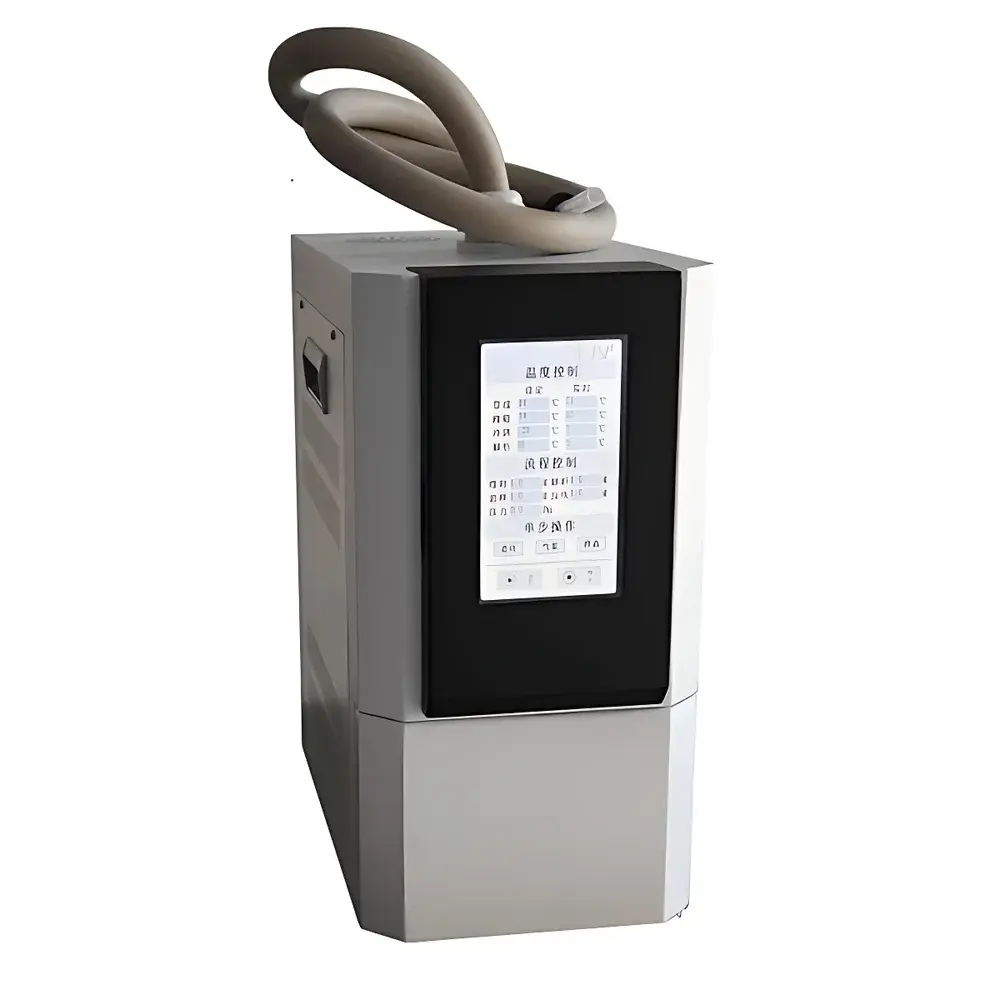
Beifen Sanpu HP2-6900N Automated Cryo-Focusing Atmospheric Sampler for GB/T 14678–1993
| Brand | Beifen Sanpu |
|---|---|
| Origin | Beijing, China |
| Manufacturer Type | Direct Manufacturer |
| Instrument Type | Dual-Stage Thermal Desorber with Cryogenic Trapping |
| Desorption Temperature Range | Ambient to 350 °C |
| Cold Trap Temperature Range | −35 °C to Ambient |
| Temperature Control Accuracy | < ±0.5 °C |
| Sample Loop Capacity | N/A (Continuous Air Sampling) |
| Dimensions | 400 × 220 × 420 mm |
| Power Consumption | ~300 W |
| Weight | ~20 kg |
Overview
The Beifen Sanpu HP2-6900N Automated Cryo-Focusing Atmospheric Sampler is an engineered solution designed explicitly for compliance with GB/T 14678–1993, “Ambient Air — Determination of Hydrogen Sulfide, Methanethiol, Dimethyl Sulfide, and Dimethyl Disulfide.” It integrates semiconductor-based cryogenic trapping with programmable dual-stage thermal desorption to achieve quantitative preconcentration and transfer of volatile sulfur compounds (VSCs) from ambient air matrices. Unlike conventional thermal desorbers optimized for solid-phase microextraction (SPME) or sorbent tube analysis, the HP2-6900N implements continuous, flow-controlled atmospheric sampling followed by cryo-focusing at −35 °C, enabling sub-part-per-trillion (pptv) detection limits when coupled to gas chromatography (GC) or GC–MS systems. Its architecture follows established principles of cryo-trap–desorb–inject workflows defined in ISO 16017-1 and ASTM D6196, supporting trace-level environmental monitoring in regulatory, industrial hygiene, and research laboratory settings.
Key Features
- Four independently controlled temperature zones: desorption oven (ambient to 350 °C), valve manifold (ambient to 220 °C), transfer line (ambient to 220 °C), and cryogenic trap (−35 °C to ambient), each adjustable in 1 °C increments
- Integrated semiconductor cooling system eliminates reliance on liquid nitrogen or mechanical compressors—ensuring operational safety, low maintenance, and stable cold trap performance
- Programmable time-sequence control for full automation: sample adsorption, cryo-focusing, thermal desorption, GC injection, and post-run purge/flush cycles
- Dual-flow regulation: mass flow sensor-enabled sampling (0–300 mL/min) and programmable back-flush (0–160 mL/min) to prevent carryover between analyses
- Inertized internal gas pathways—including electropolished stainless-steel lines and silonite-treated valves—minimize analyte adsorption or catalytic degradation of reactive VSCs
- 7-inch capacitive touchscreen interface with real-time status display, date/time stamping, run logging, and intuitive parameter configuration
- Hardware-level synchronization with GC/GC–MS instruments via TTL trigger output; supports simultaneous initiation of instrument acquisition and data system logging
- PC-based configuration software enables remote setup, method storage, audit trail generation, and export of calibration logs compatible with GLP-compliant documentation requirements
Sample Compatibility & Compliance
The HP2-6900N is validated for direct sampling of ambient air, indoor air, and stack effluent gases containing hydrogen sulfide (H₂S), methanethiol (CH₃SH), dimethyl sulfide ((CH₃)₂S), and dimethyl disulfide ((CH₃)₂S₂). Its design conforms to the sampling volume, flow rate, and thermal desorption parameters specified in GB/T 14678–1993. The system supports both active sampling (via built-in pump with calibrated flow control) and passive integration into existing air monitoring networks. All wetted components meet USP Class VI and ASTM E2654 inertness criteria for trace sulfur analysis. For laboratories operating under ISO/IEC 17025 or EPA Method TO-15/TO-17 frameworks, the HP2-6900N provides configurable audit trails, electronic signature support, and method validation templates aligned with FDA 21 CFR Part 11 data integrity expectations.
Software & Data Management
Control and method development are managed through a Windows-compatible desktop application that supports multi-user access control, versioned method libraries, and automated report generation (PDF/CSV). Each analytical sequence records timestamped metadata—including actual trap temperature, measured flow rate, desorption ramp profile, and valve actuation timing—for full traceability. Raw log files are stored in ASCII format for third-party LIMS integration. Software updates are delivered via secure HTTPS channel with SHA-256 signature verification. Optional add-ons include IQ/OQ documentation packages and GxP-compliant electronic lab notebook (ELN) connectors.
Applications
- Regulatory monitoring of odorant emissions from wastewater treatment plants, landfills, and pulp/paper facilities per national ambient air quality standards
- Occupational exposure assessment in refineries, chemical manufacturing units, and biogas processing sites
- Method validation and reference material analysis for certified reference laboratories accredited to ISO/IEC 17025
- Research studies on atmospheric sulfur chemistry, including oxidation kinetics and secondary aerosol formation pathways
- Calibration verification using liquid standard injection modules (optional accessory) for quantitative recovery assessment across concentration ranges (0.05–500 ng/m³)
FAQ
Is the HP2-6900N compatible with Agilent, Thermo Fisher, and Shimadzu GC systems?
Yes—it features universal TTL triggering, analog voltage outputs, and standardized pneumatic interfaces for seamless integration with all major GC and GC–MS platforms.
Does the system support unattended overnight operation?
Yes—fully programmable sequences, hardware watchdog timers, and automatic error recovery enable 24/7 deployment in fixed-site monitoring applications.
What maintenance intervals are recommended for long-term reliability?
Semiconductor coolers require no scheduled replacement; annual calibration of flow sensors and temperature probes is advised per ISO/IEC 17025 maintenance protocols.
Can the cold trap be operated continuously at −35 °C during extended sampling?
Yes—the thermoelectric module is rated for continuous duty at full cooling capacity, with thermal stability maintained within ±0.3 °C over 8-hour periods.
Is validation documentation available for pharmaceutical or environmental compliance use?
Yes—factory-issued IQ/OQ protocols, as well as customizable PQ templates aligned with USP , are provided upon request.




