
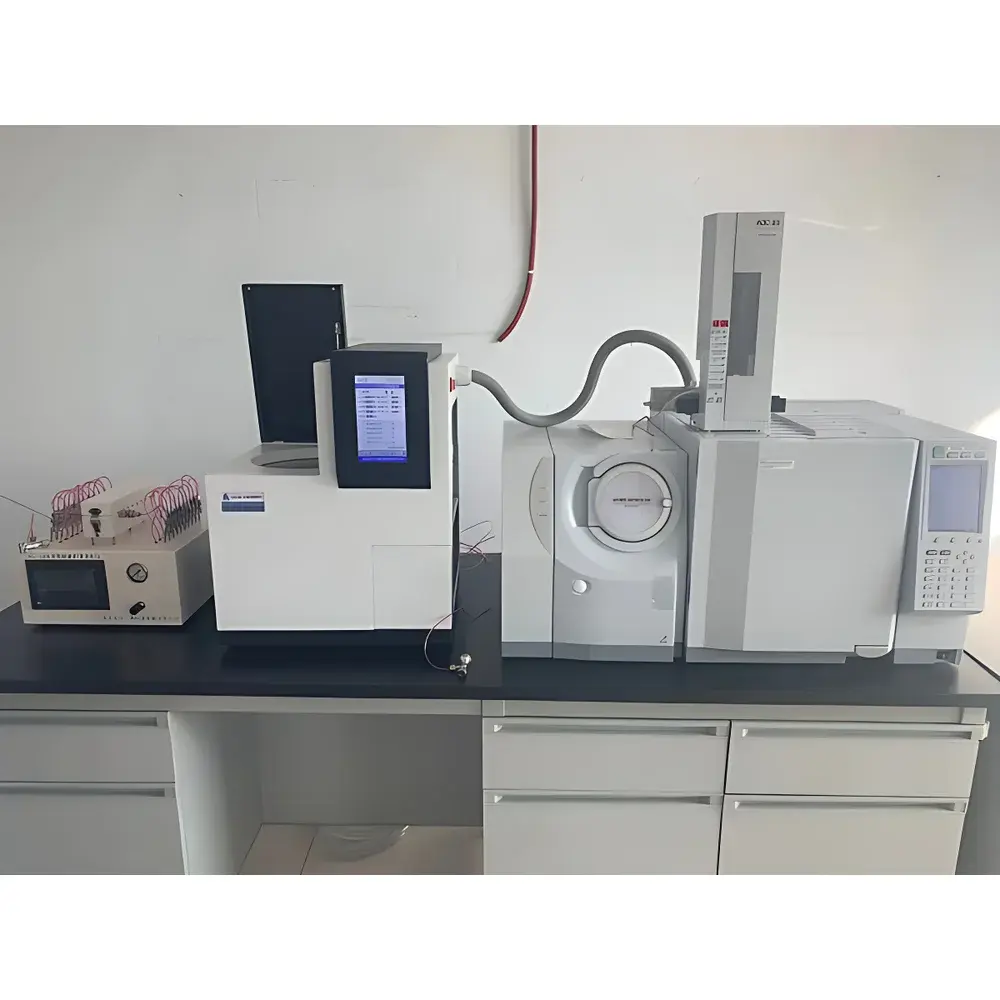
Beifen Sanpu ATDS-20A Automated Two-Stage Thermal Desorber for Volatile Organic Compounds (VOCs) Analysis in Air and Emission Sources
| Brand | Beifen Sanpu |
|---|---|
| Origin | Beijing, China |
| Manufacturer Type | OEM Manufacturer |
| Instrument Type | Two-Stage Thermal Desorber |
| Model | ATDS-20A |
| Desorption Stage 1 Temperature Range | Ambient to 450 °C |
| Desorption Stage 2 Temperature Range | Ambient to 450 °C |
| Cryo-Focusing Trap Temperature Range | −35 °C to Ambient |
| Sample Capacity | 20 adsorption tubes |
| Desorption Recovery Rate | >99% (compound-dependent) |
| Temperature Control Precision | ±0.5 °C |
| RSD | ≤2.5% (benzene at 0.05 μg) |
| Tube Specification | 1/4″ OD × 3.5″ length (ASTM D6196-compliant) |
Overview
The Beifen Sanpu ATDS-20A is an automated two-stage thermal desorption system engineered for high-fidelity quantification of volatile organic compounds (VOCs) in ambient air, workplace atmospheres, and fixed emission sources. It operates on the principle of cryogenic focusing coupled with sequential thermal desorption—first releasing analytes from sorbent tubes under controlled heating (Stage 1), then refocusing them onto a low-temperature trap (−35 °C), followed by rapid flash desorption (Stage 2) directly into the GC inlet. This architecture ensures minimal band broadening, enhanced sensitivity, and reproducible transfer of thermally labile and semi-volatile species—including benzene, toluene, ethylbenzene, xylenes (BTEX), C2–C12 alkanes, chlorinated solvents, and oxygenated VOCs—per regulatory methods HJ 644–2013 and HJ 734–2014. The system integrates seamlessly with all commercially available gas chromatographs (GC) and GC–MS platforms, supporting both split and splitless injection modes via motor-driven 6-port valve actuation and standardized 1/4″ tube interface geometry.
Key Features
- Full automation for unattended analysis of 20 sorbent tubes per sequence, reducing manual intervention and operator variability.
- Independent four-zone temperature control: Stage 1 desorption oven, valve manifold, transfer line, and Stage 2 desorption/focusing zone—all programmable in 1 °C increments with stability <±0.5 °C.
- Electronic Peltier-based cryo-trap capable of reaching −35 °C, enabling sharp focusing of early-eluting VOCs and improved chromatographic resolution.
- Integrated sample tube activation module with programmable heating profiles (up to 450 °C) and inert gas purge, eliminating carryover and ensuring consistent tube conditioning prior to sampling.
- Time-resolved sequence programming: automated execution of desorption, carrier gas purge, cryo-trapping, rapid thermal release, GC trigger synchronization, and post-run valve/line back-flush (0–100 mL/min, continuously adjustable).
- Real-time status monitoring via 7-inch capacitive touchscreen interface, displaying temperature curves, valve positions, timing progress, and fault diagnostics with audible/visual alerts.
- Configurable secondary desorption path: optional ambient-temperature or cryogenically enhanced Stage 2 configuration to accommodate method-specific volatility requirements.
- Gas-tight stainless-steel and fused-silica transfer lines; optional quartz-lined tubing available for active compound analysis (e.g., aldehydes, organic acids).
Sample Compatibility & Compliance
The ATDS-20A accepts standard 1/4″ OD × 3.5″ sorbent tubes compliant with ASTM D6196, ISO 16017-1, and EPA TO-17 specifications. It supports multi-bed sorbents (e.g., Tenax TA, Carbopack B/C, Carboxen 1000) and is validated for use with both whole-air sampling and passive/active grab sampling protocols. The instrument meets critical performance criteria outlined in HJ 644–2013 (ambient air VOCs) and HJ 734–2014 (stationary source emissions), including recovery >99%, RSD ≤2.5% (benzene at 0.05 μg), and linear dynamic range spanning three orders of magnitude. Its hardware design and firmware architecture support GLP-compliant operation: audit trails, user access levels, electronic signatures, and data integrity safeguards align with FDA 21 CFR Part 11 readiness when paired with compliant chromatography data systems (CDS).
Software & Data Management
Control and method development are performed via embedded microprocessor firmware with intuitive graphical workflow builder. Users define multi-step thermal programs—including ramp rates (>3000 °C/min for Stage 2), hold times (0–60 min each stage), and gas flow parameters—with full timestamping and event logging. The system provides native TTL-level GC start triggering and accepts external start commands via RS-232 or dry-contact input. Raw thermal event logs (temperatures, valve states, timing) are exportable as CSV for traceability. When integrated with third-party CDS (e.g., Shimadzu GCMSsolution, Thermo Chromeleon, Agilent OpenLab), it enables synchronized acquisition, peak integration, and calibration curve generation—including built-in standard vapor generation mode for direct working curve construction without external calibrators.
Applications
The ATDS-20A serves laboratories performing environmental monitoring (EPA Region IV–VI compliance), industrial hygiene assessments (OSHA/NIOSH method 0031 adaptation), indoor air quality studies (IAQ), and product emissions testing (e.g., building materials per ISO 16000-6). It is routinely deployed in municipal environmental protection bureaus, third-party testing labs accredited to CNAS (ISO/IEC 17025), university research facilities studying atmospheric chemistry, and pharmaceutical manufacturing sites conducting residual solvent analysis per ICH Q3C guidelines. Its robustness in handling complex matrices—such as humid ambient air, stack gas condensates, and particulate-laden duct samples—has been verified across over 120 field installations in China’s provincial EPB network since 2020.
FAQ
Does the ATDS-20A support EPA Method TO-17?
Yes—the instrument conforms to TO-17 requirements for thermal desorption parameters, tube dimensions, flow control, and calibration traceability when operated with certified sorbent tubes and appropriate GC–MS detection.
Can it be used with non-Chinese GC brands such as Agilent or PerkinElmer?
Yes—standardized 1/4″ tube interface, TTL trigger compatibility, and configurable valve timing ensure seamless integration with all major GC and GC–MS platforms.
Is remote monitoring or network connectivity supported?
The unit features RS-232 serial port and optional Ethernet module (firmware v3.2+) for integration into centralized lab instrument management systems.
What maintenance intervals are recommended for the cryo-trap and valves?
Peltier cooler performance should be verified quarterly; valve seals require replacement every 10,000 cycles or annually—whichever occurs first—using genuine Beifen Sanpu service kits.
How is method validation documented for regulatory audits?
Each run generates a timestamped .log file containing all setpoints, actual temperatures, valve actuation events, and error codes; these files meet ALCOA+ principles for attributable, legible, contemporaneous, original, accurate, complete, consistent, enduring, and available records.





