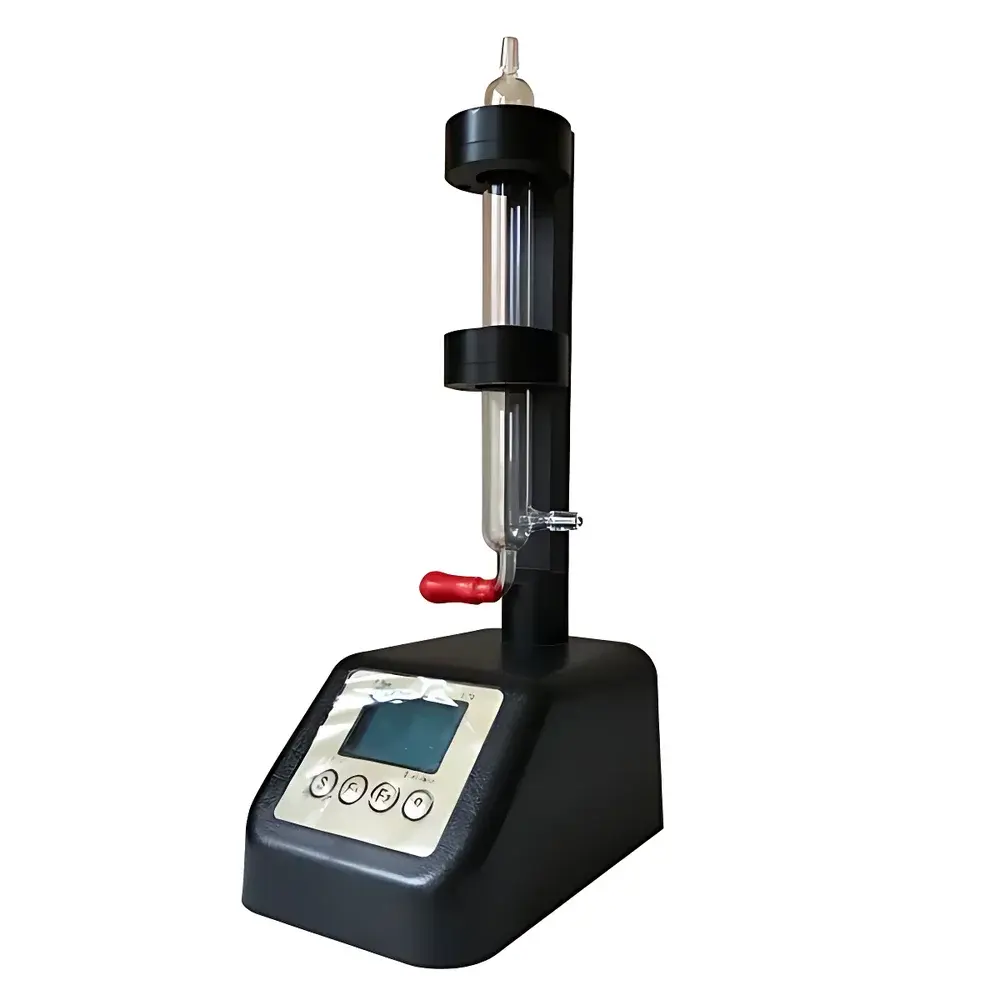
Beifen Sanpu ZM-103 Portable Intelligent Electronic Soap Film Flowmeter for Environmental Laboratories
| Brand | Beifen Sanpu |
|---|---|
| Model | ZM-103 |
| Type | Volumetric Flowmeter |
| Measurement Principle | Soap Film Displacement (Volumetric Timing Method) |
| Flow Range | 5 mL/min – 5 L/min |
| Accuracy | ±1% of reading |
| Repeatability | < 0.5% |
| Flow Resolution | 0.1 mL/min |
| Time Resolution | 0.01 s (displayed as 0.1 s) |
| Temperature & Pressure Compensation | Yes, user-adjustable |
| Operating Power | Internal 4.8 V / 700 mAh rechargeable battery (standby >24 h) |
| Auto Power Management | Backlight off after 1 min idle |
| Dimensions | 90 mm × 150 mm × 280 mm |
| Weight | ~1.3 kg |
| Compliance | Fully conforms to JJG 586–2006 “Verification Regulation for Soap Film Flowmeters” |
Overview
The Beifen Sanpu ZM-103 Portable Intelligent Electronic Soap Film Flowmeter is a precision volumetric flow calibration instrument engineered for traceable, low-flow gas measurement in environmental monitoring laboratories, occupational health facilities, and analytical instrumentation service environments. It operates on the fundamental principle of soap film displacement — a gravimetrically traceable, time-based volumetric method where a calibrated soap film traverses a precisely dimensioned glass tube between two optical sensors. The elapsed time between sensor triggers, combined with the known cross-sectional area of the tube and real-time ambient temperature and pressure readings, enables calculation of volumetric flow rate (mL/min or L/min) with high reproducibility. Unlike thermal mass or differential pressure flowmeters, the ZM-103 delivers absolute flow values without reliance on gas composition or calibration curves, making it ideal for primary calibration of critical sampling devices where regulatory traceability is mandatory.
Key Features
- Integrated microprocessor-controlled timing system with automatic data acquisition and real-time display of flow rate (volumetric and mass-corrected), elapsed time, temperature, pressure, and displaced volume.
- Dual optical sensor array with independent signal monitoring and user-accessible sensitivity adjustment via internal potentiometers — enabling optimization for varying film opacity and ambient lighting conditions.
- Onboard temperature and barometric pressure compensation algorithms compliant with standard reference conditions (e.g., 25 °C, 101.325 kPa), supporting conversion to standardized flow units (e.g., mL/min @ STP).
- Embedded rechargeable 4.8 V / 700 mAh Ni-MH battery with intelligent power management: backlight deactivation after 60 seconds of inactivity and full shutdown after 300 seconds — extending operational readiness in field deployments.
- Compact monolithic architecture integrating optical sensors, calibrated soap film tube, control electronics, and battery into a single handheld unit (90 × 150 × 280 mm; ~1.3 kg), optimized for mobility across sampling sites and lab benches.
- External 9 V DC input port supports concurrent operation and battery recharging, with automatic transition to float charge mode upon full capacity detection — ensuring uninterrupted use during extended verification campaigns.
Sample Compatibility & Compliance
The ZM-103 is validated for use with clean, non-corrosive, non-condensing gases including ambient air, nitrogen, helium, and synthetic air — typical media encountered in environmental air sampling and chromatographic carrier gas systems. It is not intended for liquids, vapors, or particulate-laden streams. Its design and verification protocol align fully with JJG 586–2006 “Verification Regulation for Soap Film Flowmeters”, establishing metrological equivalence to national standards for volumetric flow calibration. While not certified to ISO/IEC 17025 by default, the instrument supports GLP-compliant workflows through audit-ready data logging (when paired with optional PC interface), manual entry of environmental parameters, and user-performed periodic verification using NIST-traceable reference standards.
Software & Data Management
The ZM-103 operates autonomously without external software, displaying all critical parameters directly on its high-contrast LCD. Optional RS-232 or USB-to-serial interface modules enable connection to laboratory PCs for automated data capture, timestamped report generation, and integration into LIMS or QA/QC documentation systems. Logged datasets include raw sensor timestamps, calculated flow rates, ambient T/P values, and operator-entered identifiers — supporting 21 CFR Part 11–compatible electronic record retention when deployed with validated third-party acquisition software and appropriate access controls.
Applications
- Calibration and verification of low-flow environmental air samplers (e.g., PM2.5, VOC, and formaldehyde monitors) per EPA Methods IO-2, IO-3, and ISO 16000-22.
- Field validation of personal and area dust sampling pumps used in occupational hygiene assessments (OSHA ID-121, NIOSH 0500).
- Verification of carrier gas, make-up gas, and detector gas flows in GC and GC-MS systems — particularly where laminar flow and composition independence are essential.
- Secondary calibration of rotameters, critical orifice meters, and other fixed-restriction flow devices prior to deployment in stack testing or indoor air quality surveys.
- Performance checks of portable smoke and flue gas analyzers requiring accurate dilution or purge flow verification.
FAQ
What gas types can be measured with the ZM-103?
The instrument is designed for dry, non-reactive gases such as ambient air, nitrogen, argon, and helium. It must not be used with corrosive, condensable, or high-humidity streams.
Does the ZM-103 require annual factory recalibration?
No — users may perform in-house verification using certified reference flow standards per JJG 586–2006. Annual verification against traceable standards is recommended for GLP/GMP compliance.
Can the ZM-103 measure liquid flow?
No. It is strictly a gas-phase volumetric timing device based on soap film displacement in air-filled tubes.
How is temperature and pressure compensation implemented?
Internal sensors measure ambient T and P in real time; the firmware applies the ideal gas law to convert measured volumetric flow to standardized conditions (e.g., 25 °C / 101.325 kPa) with user-selectable reference settings.
Is the battery replaceable by the end user?
Yes — the Ni-MH battery pack is accessible via a service panel and may be replaced with a compatible 4.8 V / 700 mAh unit without soldering or firmware reset.