
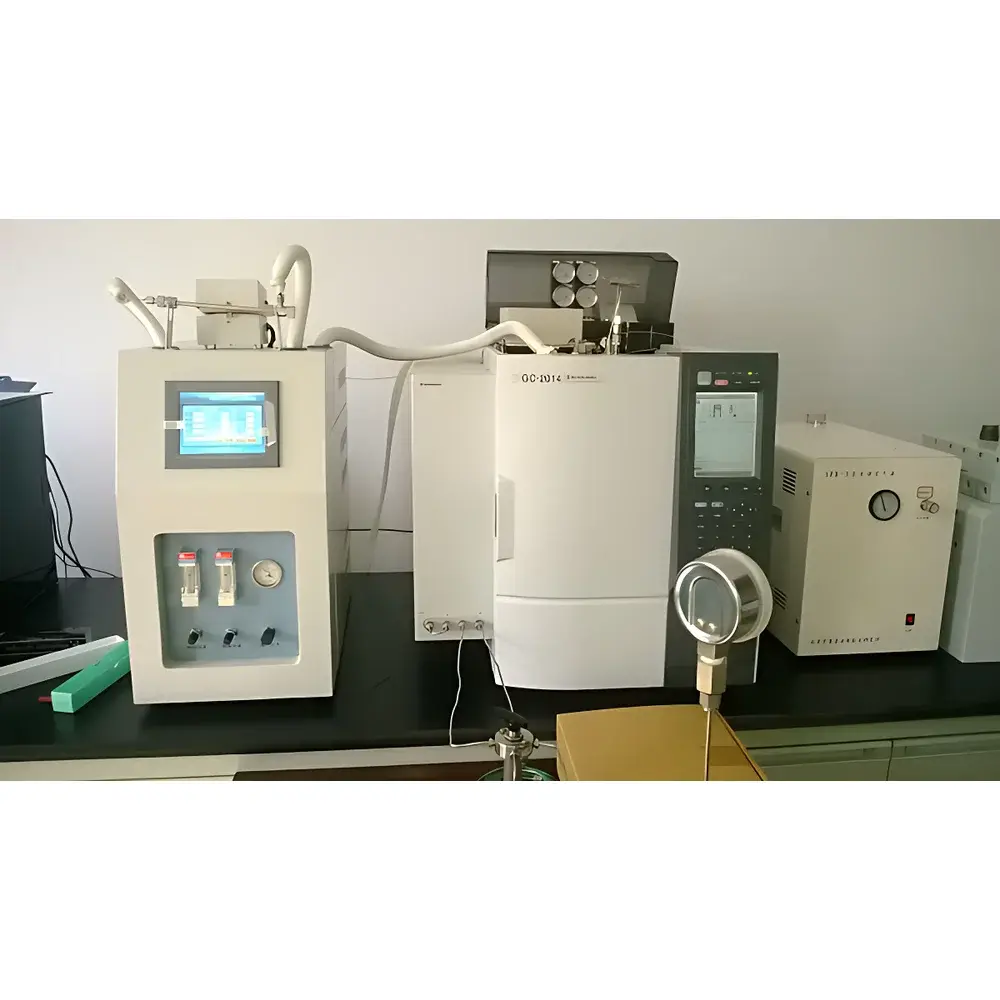
Beifen Sanpu AutoTDS-III Dual-Stage Thermal Desorber
| Brand | Beifen Sanpu |
|---|---|
| Origin | Beijing, China |
| Manufacturer Type | Direct Manufacturer |
| Product Category | Domestic |
| Model | AutoTDS-III |
| Instrument Type | Dual-Stage Thermal Desorber / Thermal Desorber |
| Automation Level | Semi-Automatic |
| Primary Desorption Temp Range | 50–380 °C |
| Cold Trap Temp Range | −30 °C (electronic Peltier cooling) |
| Secondary Desorption Temp Range | 150–380 °C |
| Secondary Desorption Ramp Rate | >1800 °C/min |
| Valve & Transfer Line Temp Range | Room Temp to 200 °C |
| Temperature Control Accuracy | <±0.1 °C |
| Desorption Recovery Rate | ≥90% |
| Sample Position Capacity | 1 |
Overview
The Beifen Sanpu AutoTDS-III Dual-Stage Thermal Desorber is a precision-engineered sample introduction system designed for trace-level volatile and semi-volatile organic compound (VOC/SVOC) analysis in environmental, occupational health, and public health laboratories. It operates on the principle of dual-stage thermal desorption—first releasing analytes from sorbent tubes via controlled heating (primary desorption), then refocusing them onto a cryogenically cooled trap (electronic Peltier cold trap, down to −30 °C), followed by rapid resistive heating (>1800 °C/min) for sharp, narrow-band secondary desorption directly into the GC or GC-MS inlet. This two-step process significantly improves chromatographic peak shape, sensitivity, and quantitative reproducibility compared to single-stage desorption—particularly critical for regulated analyses of benzene, toluene, ethylbenzene, xylenes (BTEX), and total volatile organic compounds (TVOC) per ISO 16000-6, EPA TO-17, and HJ 644–2013.
Key Features
- Dual-stage desorption architecture with integrated electronic Peltier cold trap (−30 °C), eliminating reliance on liquid nitrogen or mechanical chillers
- High-fidelity temperature control: ±0.1 °C stability across all heated zones (primary furnace, secondary heater, valve manifold, transfer lines)
- Rapid secondary desorption ramp rate (>1800 °C/min) ensures minimal band broadening and optimal transfer efficiency to GC columns
- Modular, tool-free sorbent tube handling: quick-release mechanism enables safe, repeatable tube insertion and removal—ideal for field sampling and lab throughput
- Full software-driven operation via embedded touchscreen interface (large-format LCD) with real-time monitoring of all thermal zones and sequence status
- Gas flow simulation mode (0–1000 mL/min, continuously adjustable) supports calibration standard preparation and method validation without external flow controllers
- Universal GC/GC-MS compatibility: standardized 1/16″ stainless steel transfer line with heated valve interface; compliant with Agilent, Thermo Fisher, Shimadzu, PerkinElmer, and other major GC platforms
Sample Compatibility & Compliance
The AutoTDS-III accepts standard 6 mm OD × 89 mm length stainless steel or quartz sorbent tubes packed with common media including Tenax TA, Carbopack B/C, Carboxen, and multi-bed configurations. It meets functional requirements for ISO 16000-6 (indoor air), EPA Method TO-17 (ambient air), and Chinese standard HJ 644–2013 (environmental air—determination of VOCs). While the instrument itself does not carry CE or UL certification, its thermal and pneumatic design adheres to IEC 61010-1 safety principles. Data acquisition and method storage support audit-ready workflows compatible with GLP and GMP environments when paired with validated LIMS or chromatography data systems (CDS).
Software & Data Management
Operation is governed by dedicated embedded firmware with a graphical touchscreen interface. All methods—including primary/secondary temperature ramps, hold times, valve timing, cold trap equilibration, and carrier gas flow profiles—are programmable and stored with timestamped versioning. The system logs full thermal history (per run) and error events with persistent memory retention. Exportable CSV reports include desorption efficiency metrics, temperature deviation traces, and recovery validation data. For integration into regulated labs, the firmware supports manual audit trail generation; full 21 CFR Part 11 compliance requires pairing with a validated CDS platform that provides electronic signatures, role-based access control, and immutable record archiving.
Applications
- Indoor air quality (IAQ) testing for BTEX, aldehydes, and TVOC in residential, commercial, and school buildings
- Occupational exposure assessment in manufacturing, petrochemical, and printing facilities per OSHA and NIOSH guidelines
- Environmental monitoring of ambient air near industrial sites, landfills, and traffic corridors
- Method development and validation for sorbent tube-based sampling in CDC, provincial CDCs, and third-party environmental testing labs
- Reference material analysis and proficiency testing where high recovery (>90%) and inter-lab reproducibility are mandatory
FAQ
Is the AutoTDS-III fully automated or semi-automated?
It is classified as semi-automatic: sample tube loading/unloading is manual, but all thermal programming, valve actuation, gas flow control, and sequence execution are software-controlled without user intervention during runtime.
What cold trap technology does it use, and why is −30 °C significant?
It employs solid-state Peltier cooling—not liquid nitrogen or compressor-based refrigeration—enabling stable, maintenance-free cryofocusing at −30 °C, sufficient to retain C2–C12 VOCs with high trapping efficiency and minimal breakthrough.
Can it be used with GC-MS systems requiring inert flow paths?
Yes. All internal surfaces contacting sample vapor are electropolished stainless steel or fused silica-lined; optional deactivated transfer lines and low-bleed valves ensure compatibility with sensitive MS detection.
Does it support multiple tube formats or only standard 6 mm tubes?
It is optimized for 6 mm OD × 89 mm sorbent tubes. Adapters for alternative diameters are not included but may be custom-engineered upon request.
How is desorption recovery validated on this system?
Recovery validation follows EPA TO-17 protocol: spiked sorbent tubes are aged, desorbed, and quantified against liquid standards. The ≥90% average recovery across target analytes is verified using certified reference materials and documented in factory performance reports.
Related Products





