
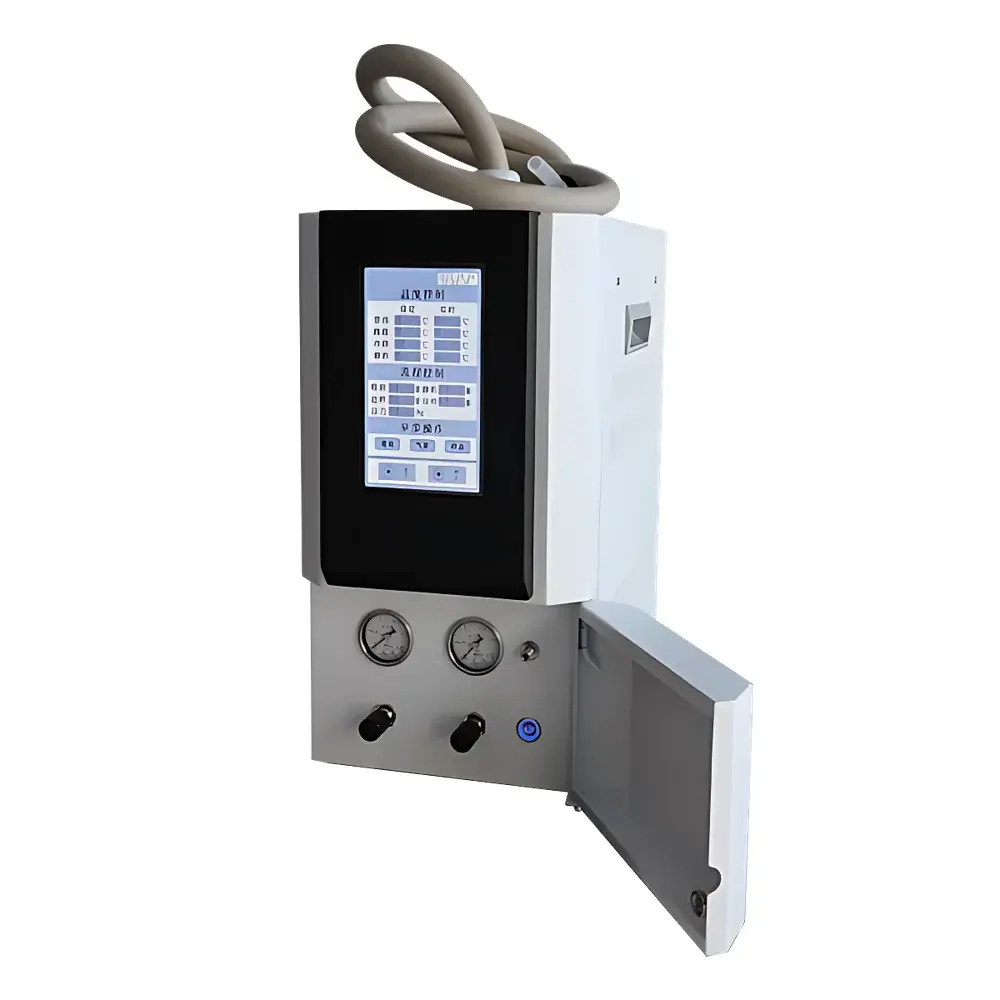
Beifen Sanpu HP-6900N Automated Cryo-Focused Thermal Desorber for Hydrogen Sulfide and Odorous Sulfur Compounds
| Brand | Beifen Sanpu |
|---|---|
| Origin | Beijing, China |
| Manufacturer Type | OEM Manufacturer |
| Model | HP-6900N |
| Instrument Type | Dual-Stage Thermal Desorber |
| Desorption Temperature Range | Ambient to 350 °C |
| Cold Trap Temperature Range | −35 °C to Ambient (1 °C increments) |
| Temperature Control Accuracy | < ±0.5 °C |
| Sample Loop Capacity | Not Applicable (Direct Air Sampling System) |
Overview
The Beifen Sanpu HP-6900N Automated Cryo-Focused Thermal Desorber is an engineered solution for trace-level quantification of volatile sulfur compounds—including hydrogen sulfide (H₂S), methanethiol (CH₃SH), dimethyl sulfide (CH₃SCH₃), and dimethyl disulfide (CH₃SSCH₃)—in ambient air and industrial emission streams. Designed in strict compliance with the Chinese national standard GB/T 14678–1993, the system integrates cryogenic preconcentration and programmable thermal desorption into a single automated platform. It operates on the principle of adsorptive sampling onto inert sorbent tubes (e.g., Tenax TA/Carbograph dual-bed), followed by rapid cold trapping at −35 °C to enhance analyte focusing prior to high-speed thermal desorption (>2000 °C/min ramp rate) and transfer to a gas chromatograph equipped with a flame photometric detector (GC-FPD). This two-stage concentration strategy achieves sub-pptv (0.2–1.0 × 10⁻³ mg/m³) method detection limits for 1-L air samples—significantly surpassing direct injection sensitivity while maintaining matrix robustness across complex odorant profiles.
Key Features
- Full-featured 7-inch capacitive touchscreen interface with intuitive Chinese-English bilingual navigation and real-time status monitoring (temperature setpoints, elapsed time, date/time stamp, and active protocol stage)
- Independent four-zone temperature control: desorption oven (ambient–350 °C), valve manifold (ambient–220 °C), transfer line (ambient–220 °C), and cryogenic trap (−35 °C to ambient), all adjustable in 1 °C increments with stability < ±0.5 °C
- Integrated mass flow sensor enables precise volumetric sampling (0–300 mL/min); software-calculated sample volume ensures reproducible loading regardless of ambient pressure or humidity fluctuations
- Automated sequence programming supports fully unattended operation: adsorption → cryo-trapping → thermal desorption → GC injection → post-run valve/line backflush (0.01–999 min duration, 0–160 mL/min flow)
- Inertized internal pathways—including electropolished stainless-steel lines, silonite-treated valves, and deactivated transfer tubing—to eliminate analyte adsorption, memory effects, or catalytic degradation of reactive sulfur species
- Dual-mode calibration support: liquid standard injection via integrated syringe port and certified gas standard delivery through calibrated permeation tube or dynamic dilution system
- Hardware-synchronized GC start trigger and data acquisition handshake compatible with Agilent, Thermo Fisher, Shimadzu, and domestic GC/GC-MS platforms via TTL/RS-232/USB protocols
Sample Compatibility & Compliance
The HP-6900N is validated for use with standardized sorbent tubes compliant with ISO 16017-1 and ASTM D6196 methodologies. Its cryo-focusing architecture ensures quantitative recovery of thermally labile and highly volatile sulfur compounds that degrade or elute poorly under conventional single-stage thermal desorption. The instrument meets functional requirements outlined in GB/T 14678–1993 and supports method development aligned with EPA TO-15, EN 13649-1, and ISO 16000-6 for indoor/outdoor air quality monitoring. All temperature zones are traceably calibrated against NIST-traceable reference probes; system suitability testing includes breakthrough volume verification, desorption efficiency assessment (<95% recovery for H₂S at 100 ppbv), and carryover evaluation (<0.1% between consecutive high-concentration runs).
Software & Data Management
Control and method configuration are performed via PC-based Beifen Sanpu ThermalDesorp v3.x software (Windows 10/11 compatible), supporting audit-trail-enabled parameter logging per GLP guidelines. Each run records full thermal profile metadata—including actual vs. setpoint temperatures, flow rates, timing events, and hardware fault flags—for seamless integration into LIMS environments. Raw method files (.tdm) include embedded calibration curves, QC checklists, and user-defined pass/fail criteria. Software export options include CSV, PDF report generation, and direct injection into Chromatography Data Systems (CDS) such as OpenLab CDS, Chromeleon, or Empower via configurable ASCII output mapping.
Applications
- Regulatory monitoring of odor-emitting facilities (wastewater treatment plants, pulp & paper mills, livestock operations, landfill sites)
- Workplace exposure assessment per OSHA ID-192 and ACGIH TLV® guidelines for H₂S and organic sulfides
- Method validation and interlaboratory comparison studies targeting sulfur compound speciation in urban and industrial atmospheres
- Source apportionment modeling using sulfur compound ratio fingerprints (e.g., CH₃SH/H₂S, (CH₃)₂S/(CH₃)₂S₂)
- Validation of sensor-based continuous emission monitoring systems (CEMS) through periodic grab-sample correlation
FAQ
Is the HP-6900N compatible with non-Chinese GC systems?
Yes. It features universal analog/digital I/O ports and configurable TTL triggers for synchronization with Agilent 7890/8890, Thermo ISQ EC, Shimadzu GC-2030, and other third-party chromatographs.
What sorbent tubes are recommended for sulfur compound analysis?
Dual-bed tubes containing Carbograph 1TD and Tenax TA (60/40 mg) are optimal for broad volatility coverage; alternative configurations with graphitized carbon black (Carboxen) may be used for enhanced H₂S retention.
Does the system support unattended overnight operation?
Yes. Up to 16 sequential sample runs can be queued with independent parameter sets; built-in thermal safety cutoffs and flow fault detection prevent hardware damage during extended operation.
How is calibration traceability maintained?
The system accepts certified gas standards from NIST-traceable sources (e.g., Scott-Marrin, AccuStandard); liquid calibrants are introduced via the integrated syringe port with gravimetric verification per ISO/IEC 17025 requirements.
Can cold trap temperature be stabilized below −30 °C for ultra-trace work?
The Peltier-based cooling module maintains −35 °C continuously at ambient temperatures ≤30 °C; performance degrades linearly above this threshold, requiring laboratory HVAC control for optimal low-temperature fidelity.
Related Products





