
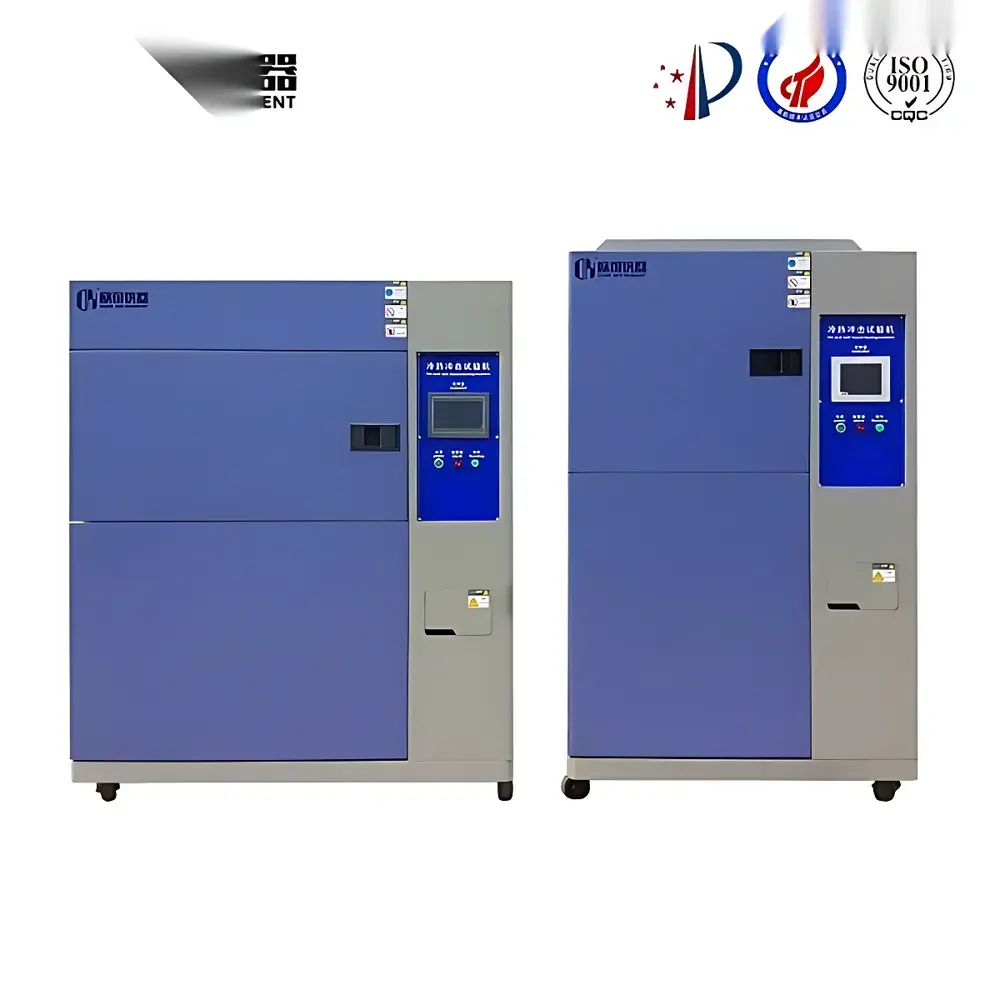
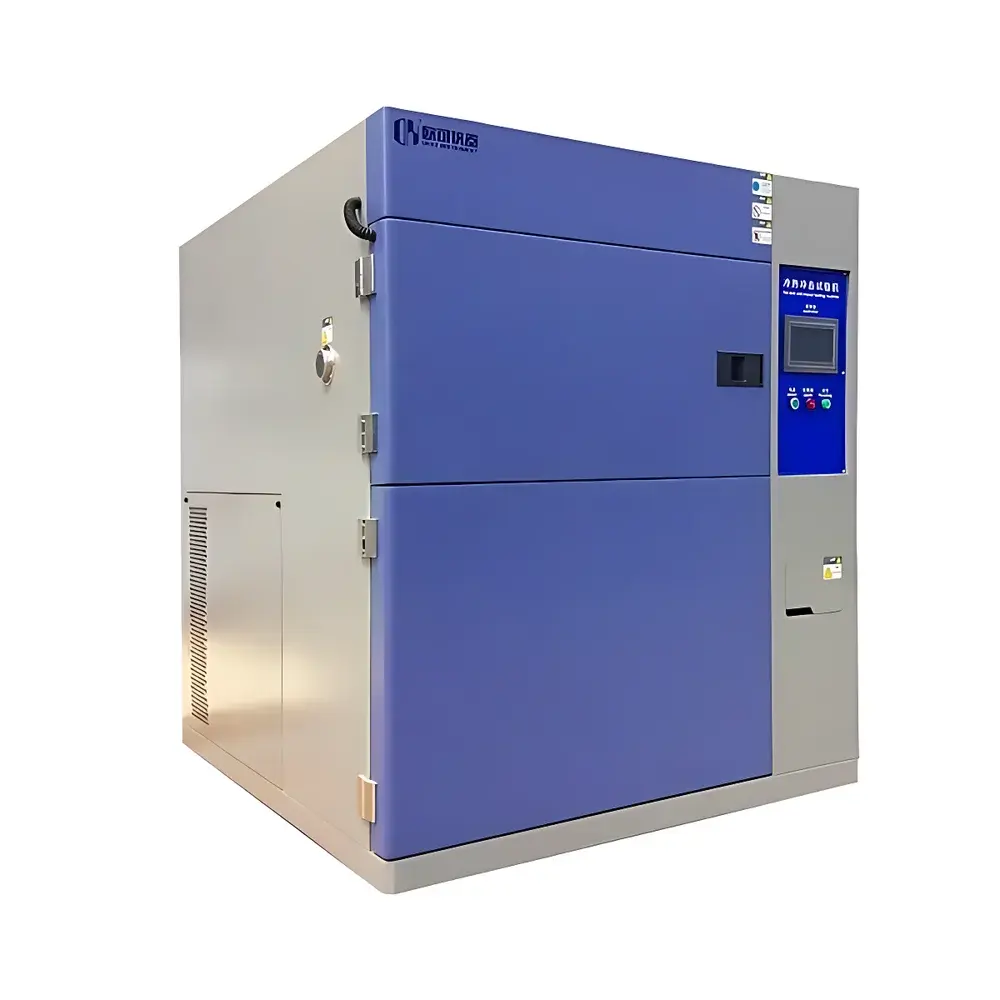
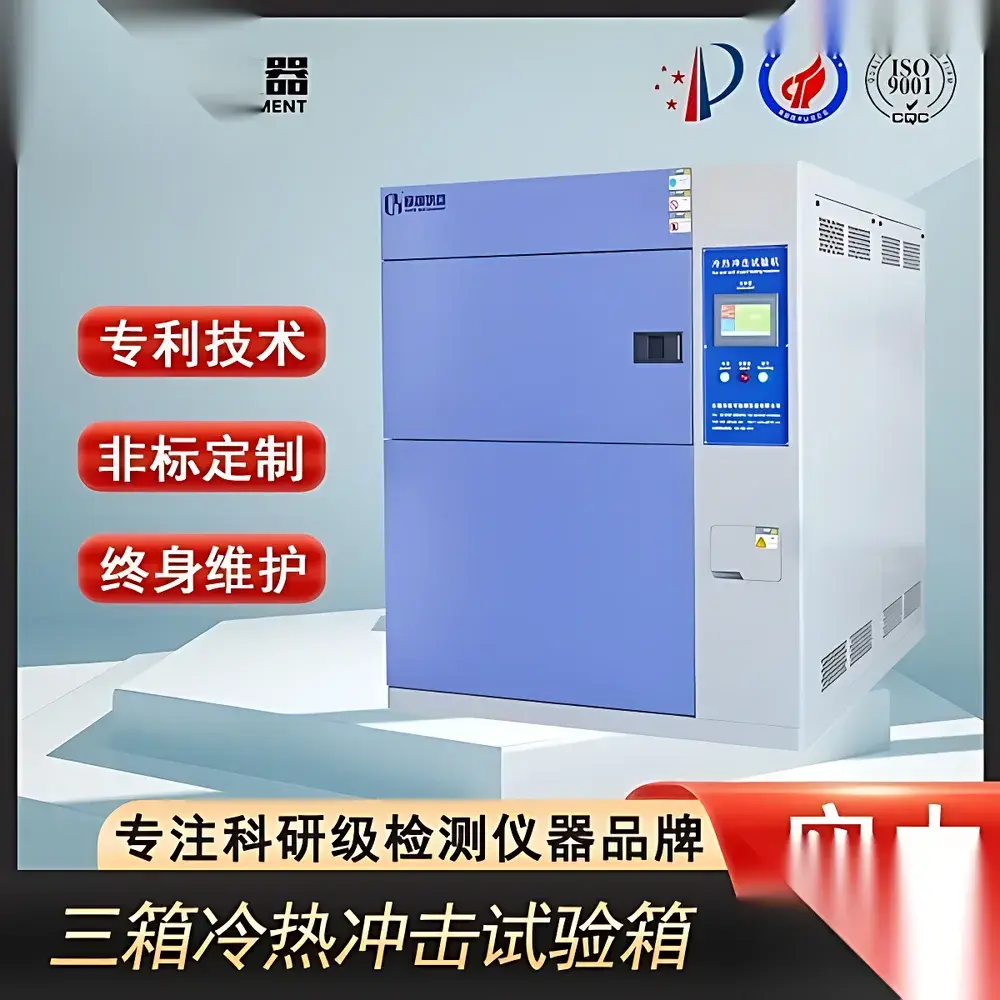
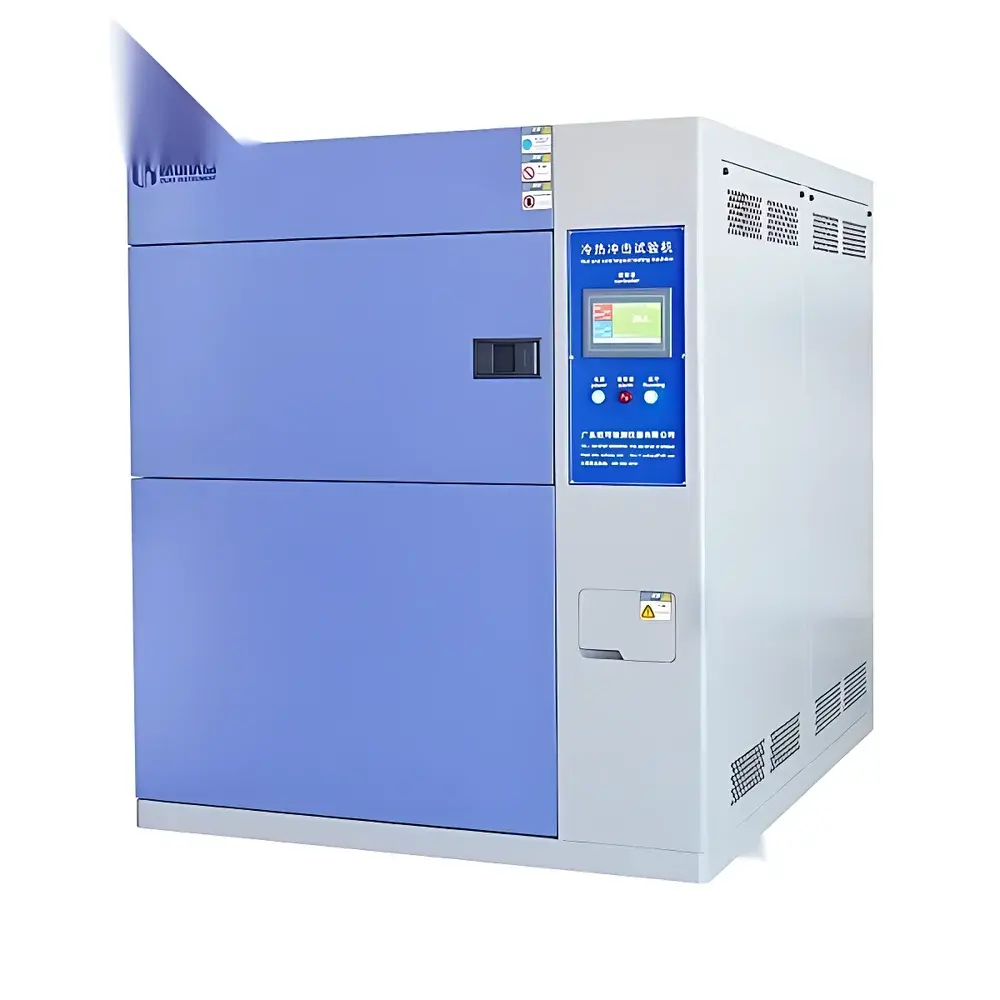
Thermal Shock Test Chamber – Generic Industrial Model
| Brand | Other Brands |
|---|---|
| Origin | Imported |
| Manufacturer Type | Authorized Distributor |
| Price | USD 11,200 (FOB) |
| Temperature Range | −70°C to +180°C |
| Thermal Transition Time (5-min dwell) | ≤15 s (−40°C ↔ +125°C) |
| Internal Volume | 100 L |
| Control System | TEMI880 Color Touchscreen Controller (EN/CN Switchable) or TEMI300 Keypad-Based Controller (English Only) |
| Compliance | IEC 60068-2-14, MIL-STD-810H Method 503.7, GB/T 2423.22 |
Overview
The Thermal Shock Test Chamber is an engineered environmental simulation system designed to evaluate material and component reliability under rapid, extreme temperature transitions. Operating on the principle of two-chamber (hot/cold) or single-chamber with cryogenic and heating zones, it subjects test specimens to abrupt thermal cycling—typically between −70°C and +180°C—with transition times as fast as 15 seconds (per IEC 60068-2-14). This capability enables accelerated stress testing of electronic assemblies, automotive ECUs, aerospace composites, PCB laminates, and polymer encapsulants—revealing latent defects such as interfacial delamination, solder joint fatigue, and coefficient-of-thermal-expansion (CTE) mismatch failure. Unlike steady-state thermal chambers, this system replicates real-world field conditions where devices experience repeated thermal shock during power-on/off cycles, altitude changes, or operational duty shifts.
Key Features
- Two-zone independent control architecture with dual refrigeration circuits (optional single-zone configuration with high-speed air diverters)
- TEMI880 full-color 7-inch touchscreen controller with multi-language support (English/Chinese), real-time trend graphing, and programmable profile storage (≥100 segments)
- Backup TEMI300 membrane-key controller for redundancy and simplified operation in regulated environments
- Robust safety interlock system: compressor overheat/overcurrent/overpressure protection; dry-run prevention for humidifier; chamber overtemperature cutoff; low-water level alarm; door-open thermal recovery optimization
- Forced-air circulation via forward-curved centrifugal blower with wide-band airflow distribution—ensuring ±1.5°C uniformity (at 100 mm from walls) per IEC 60068-3-5
- Structural integrity: outer shell in electrostatically coated cold-rolled steel or optional SUS304 brushed stainless steel; inner chamber in seamless SUS304 mirror-finish stainless steel; insulation comprising 120 mm polyurethane rigid foam (λ = 0.022 W/m·K) plus layered fiberglass matting
- High-reliability refrigeration: original French Tecumseh (or equivalent) hermetic scroll compressors; cascade or dual-refrigerant (R404A/R23) low-temperature circuit design for stable sub-zero performance
Sample Compatibility & Compliance
This chamber accommodates standard test specimens up to 450 × 450 × 450 mm (W×D×H) with adjustable stainless-steel sample racks (two sets, height-adjustable via M6 threaded posts). A 50 mm diameter through-hole (left-side mounted, sealed with silicone grommet) supports sensor cabling or external monitoring interfaces. Dual-pane tempered observation window (argon-filled, anti-fog coating) ensures optical clarity without thermal distortion. The system meets essential regulatory requirements for qualification testing—including IEC 60068-2-14 (Change of Temperature), MIL-STD-810H Method 503.7 (Temperature Shock), and GB/T 2423.22 (Environmental Testing—Part 2: Tests—Test N: Change of Temperature). Optional validation packages include IQ/OQ documentation templates aligned with ISO/IEC 17025 and GMP Annex 15 guidelines.
Software & Data Management
Bundled PC-based control software (Windows 10/11 compatible) provides remote setup, real-time parameter logging (temperature, humidity, cycle count, alarm history), and CSV export for traceability. Audit trail functionality records operator ID, timestamp, setpoint changes, and manual overrides—supporting compliance with FDA 21 CFR Part 11 when paired with Windows domain authentication and electronic signature modules. Data encryption (AES-256) and configurable retention policies ensure secure long-term archiving. All controllers retain ≥30 days of internal event logs (power loss, safety trips, calibration alerts) with non-volatile memory backup.
Applications
- Qualification of semiconductor packaging (QFN, BGA, CSP) per JEDEC JESD22-A106B
- Validation of conformal coatings and potting compounds under thermal cycling stress
- Testing of battery cell thermal runaway propagation barriers
- Aerospace avionics box qualification per RTCA DO-160 Section 4.9
- Automotive ADAS sensor housing integrity assessment (IP6K9K + thermal shock synergy)
- Medical device sterilization packaging seal strength evaluation after cyclic thermal exposure
FAQ
What is the typical thermal transition time between extreme setpoints?
Standard models achieve −40°C ↔ +125°C transitions within 15 seconds (5-minute dwell), verified per IEC 60068-2-14 Clause 6.2.
Can the chamber operate continuously at −70°C?
Yes—equipped with cascade refrigeration and enhanced oil management, continuous operation at −70°C is supported for ≥1,000 hours without degradation in cooling capacity.
Is third-party calibration certification included?
Factory calibration with NIST-traceable sensors is provided; ISO/IEC 17025-accredited calibration certificates are available as a value-added service.
How is data integrity ensured during extended unattended runs?
Redundant SD card logging (primary) + internal flash memory (backup) + optional Ethernet-based server sync ensure zero data loss—even during unexpected power interruption.
Does the system support automated pass/fail reporting per test standards?
Yes—the software includes configurable tolerance bands and auto-flagging of deviations against ASTM E1545 or IEC 60747-18 criteria, generating PDF summary reports with embedded graphs and metadata.



