
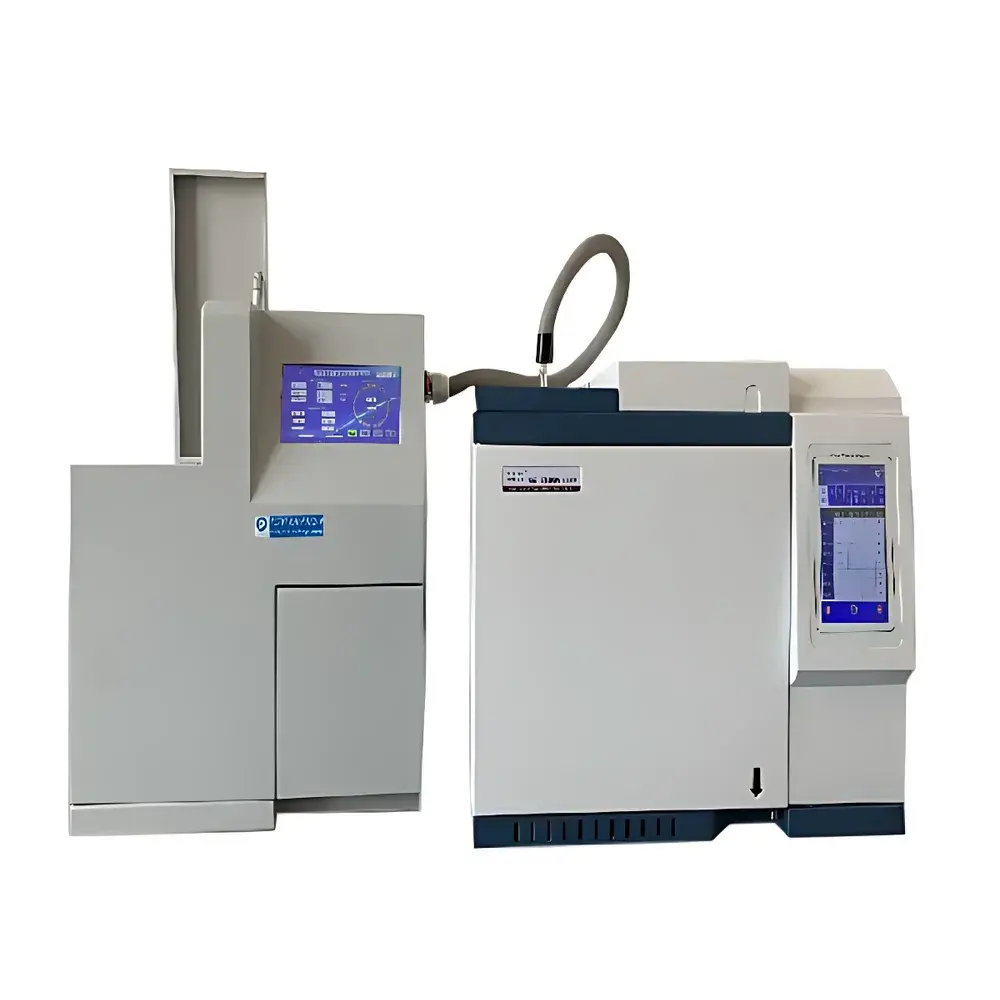
Beifen Sanpu AHS-20A PLUS Fully Automated Static Headspace Sampler for HJ 1067-2019 Water Quality Analysis of BTEX and Styrene
| Brand | Beifen Sanpu |
|---|---|
| Origin | Beijing, China |
| Manufacturer Type | OEM Manufacturer |
| Regional Category | Domestic (China) |
| Model | AHS-20A PLUS |
| Instrument Type | Static Headspace Sampler |
| Automation Level | Fully Automatic |
| Vial Heating Range | Ambient to 200 °C (1 °C increments) |
| Valve & Transfer Line Temperature Control Range | 40–220 °C (±1 °C accuracy) |
| Sample Loop Volume | 1 mL |
| Vial Capacity | 20 positions |
| Compatible Vial Sizes | 10 mL or 20 mL |
Overview
The Beifen Sanpu AHS-20A PLUS is a fully automated static headspace sampler engineered for regulatory-compliant analysis of volatile aromatic hydrocarbons in aqueous matrices per China’s national standard HJ 1067–2019. It operates on the thermodynamic principle of phase equilibrium: when an aqueous sample is sealed in a thermostatted vial and heated, volatile analytes—including benzene, toluene, ethylbenzene, xylenes (o-, m-, p-), cumene, and styrene—partition into the headspace above the liquid phase. At equilibrium, the vapor-phase concentration exhibits a linear relationship with the aqueous-phase concentration under controlled temperature, pressure, and ionic strength conditions. The AHS-20A PLUS precisely extracts a fixed volume (1 mL) of this equilibrated headspace gas and injects it directly into a gas chromatograph equipped with a flame ionization detector (FID). This method eliminates solvent use, minimizes matrix interference, and delivers high reproducibility for trace-level quantification in complex environmental water samples.
Key Features
- Fully automated 20-position carousel with programmable vial selection and sequential analysis—enabling unattended operation for up to 20 samples per batch.
- Independent, high-stability temperature control for vial oven (ambient to 200 °C, ±1 °C), injection valve (40–220 °C), and transfer line (40–220 °C), ensuring consistent equilibrium kinetics and minimal carryover.
- 1 mL fixed-volume sampling loop with inert, low-dead-volume pathway—optimized for quantitative transfer and compatibility with FID response linearity across the 8–12 μg/L lower quantitation limit range specified in HJ 1067–2019.
- Support for dual vial formats: standardized 10 mL and 20 mL crimp-top or screw-cap headspace vials with PTFE/silicone septa—ensuring seal integrity during thermal pressurization.
- Integrated agitation function (optional mechanical shaking) prior to equilibration—enhancing mass transfer for viscous or particulate-containing wastewater samples.
- Rugged industrial-grade construction with corrosion-resistant internal surfaces and electromagnetic shielding—designed for long-term reliability in QC laboratories operating under GLP-aligned workflows.
Sample Compatibility & Compliance
The AHS-20A PLUS is validated for direct integration with GC-FID systems used in compliance testing for HJ 1067–2019, covering surface water, groundwater, domestic wastewater, and industrial effluents. Its thermal precision (±1 °C) meets the method’s requirement for vial heating (60 °C ± 1 °C) and valve/transfer line conditioning (100 °C ± 1 °C). The system supports mandatory sample preparation steps including NaCl salting-out (3 g/vial), pH adjustment (≤2), and ascorbic acid addition to suppress oxidation—procedures aligned with Sections 6.1 and 6.4 of the standard. All hardware materials are inert to common solvents (methanol, HCl) and do not leach interfering VOCs, satisfying blank integrity requirements per Section 6.5 and Appendix A. While not certified to ISO/IEC 17025 out-of-the-box, the instrument’s deterministic timing, thermal stability, and repeatable loop injection support full auditability required for laboratory accreditation under CNAS or equivalent frameworks.
Software & Data Management
The AHS-20A PLUS operates via a dedicated Windows-based control interface supporting method storage, sequence definition, real-time temperature monitoring, and event logging. Each run records timestamped parameters—including vial ID, equilibration time/temperature, valve heat zone setpoints, and injection trigger—exportable as CSV for LIMS integration. Audit trails capture operator login, method modification history, and calibration events, enabling alignment with basic data integrity expectations under GLP and preliminary FDA 21 CFR Part 11 readiness (electronic signature capability requires third-party validation software). Raw method files are compatible with major GC data systems (e.g., Shimadzu GCsolution, Agilent OpenLab CDS), facilitating seamless peak integration and calibration curve generation using external standards per Section 7.2.
Applications
Primary applications include routine monitoring of BTEX compounds in municipal drinking water sources, landfill leachate, petrochemical discharge streams, and remediation site groundwater. The system supports method adaptation for other volatile analytes regulated under related Chinese standards—including HJ 620 (chlorobenzenes), HJ 686 (chlorinated hydrocarbons), and HJ 741 (halogenated benzenes)—via parameter reconfiguration. Its robustness in high-salt, low-pH matrices makes it suitable for wastewater influent/effluent QA/QC where chloride concentrations exceed 10,000 mg/L. Environmental testing laboratories performing contract analysis for provincial EPBs or third-party certification bodies utilize the AHS-20A PLUS to maintain turnaround times ≤24 h for priority pollutant screening without compromising detection sensitivity.
FAQ
What is the maximum allowable carryover between injections?
Carryover remains below 0.1% for benzene and toluene when using recommended bake-out protocols (valve at 220 °C for 2 min post-injection) and PTFE-lined transfer lines.
Can the AHS-20A PLUS be used with split/splitless GC inlets?
Yes—the 1 mL gas loop output is compatible with standard split inlets; optimal split ratios (e.g., 10:1) are defined in HJ 1067–2019 Section 7.1.2 and maintained via GC inlet pressure tuning.
Is calibration verification required before each analytical batch?
Per HJ 1067–2019 Section 7.3, initial calibration verification (ICV) and continuing calibration verification (CCV) must be performed at the start and end of each batch, respectively, using independent standard solutions.
Does the system support EPA Method 502.2 or ISO 15681-2?
While optimized for HJ 1067–2019, its thermal control fidelity and loop precision meet the instrumental performance criteria of EPA 502.2 (BTEX in drinking water) and ISO 15681-2 (volatile organics in water) with minor method adjustments.
How is vial pressurization managed during sampling?
The system uses balanced pressure venting via a dedicated purge/vent valve—maintaining near-atmospheric headspace pressure during loop fill to ensure accurate volumetric sampling and prevent vial deformation.
Related Products




