
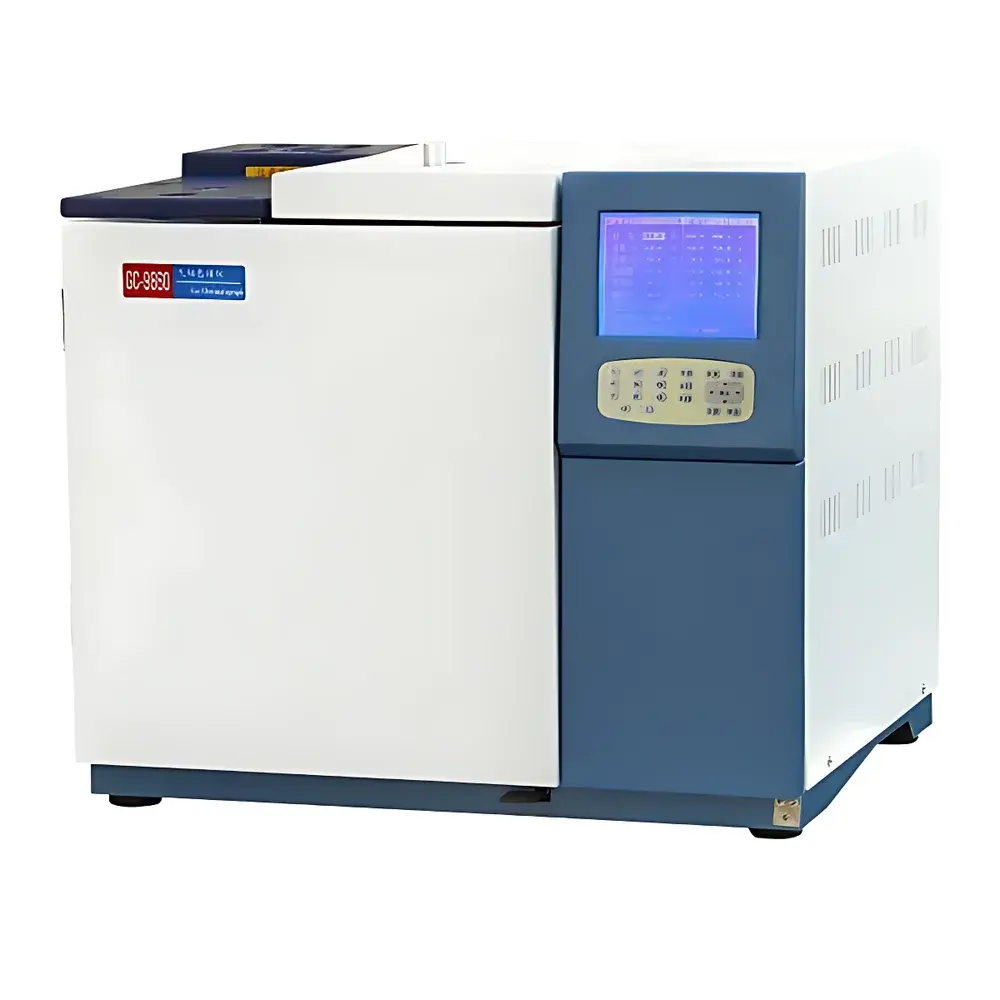
BF-9860 Advanced Gas Chromatograph – Manufactured by Beifen Sanpu
| Brand | Beifen Sanpu |
|---|---|
| Origin | Beijing, China |
| Manufacturer Type | Direct Manufacturer |
| Country of Origin | China |
| Model | BF-9860 |
| Pricing | Upon Request |
Overview
The BF-9860 Advanced Gas Chromatograph is a high-performance, fully integrated benchtop GC system engineered for precision, stability, and operational flexibility in regulated and research-intensive laboratory environments. Built upon the proven architecture of the GC-9660 platform, the BF-9860 incorporates significant hardware and firmware enhancements—including dual-language (English/Chinese) graphical interface, microcurrent amplification circuitry for enhanced FID sensitivity, and a 5× improved thermal conductivity detector (TCD) response—delivering analytical capabilities that align closely with international mid-to-high-end GC benchmarks. Its core separation principle relies on differential partitioning of volatile and semi-volatile analytes between a mobile gas phase (carrier gas: He, H₂, or N₂) and a stationary phase coated inside fused-silica capillary or packed columns. Temperature-programmed elution—enabled by an 8-step linear ramping system and intelligent dual rear-door cooling—is precisely controlled to ±0.1 °C across a 5–400 °C column oven range, supporting complex mixture resolution from environmental volatiles to pharmaceutical impurities.
Key Features
- Industrial-grade chassis with ergonomic layout, 5.7-inch high-resolution LCD (320 × 240), supporting 20 customizable display interfaces and onboard storage for up to 20 chromatographic methods.
- Dual rear-door temperature control enabling true near-ambient column oven operation (down to ~5 °C above ambient), critical for early-eluting compound retention and method robustness.
- Comprehensive hardware protection suite: gas-flow interruption detection, platinum RTD open/short circuit alarms, overtemperature cutoff, and real-time self-diagnostic reporting with contextual Chinese-language fault prompts.
- Flash-based nonvolatile memory eliminates battery-dependent data retention—ensuring method integrity and audit trail continuity during power loss or extended downtime.
- Microprocessor-controlled FID with automatic ignition sequence and high-stability gas flow regulation via precision pressure/flow controllers (±0.1 psi accuracy).
- Modular detector configuration: supports simultaneous installation and independent operation of up to four detectors—including dual FID, dual TCD, dual ECD, or hybrid combinations (e.g., FID + ECD)—with full electrical and thermal isolation.
- Universal inlet design accommodating split/splitless, on-column, and PTV injection; compatible with standard 6-inch (152.4 mm) column spacing and column diameters from 3–5 mm (packed) or 0.1–0.53 mm ID (capillary).
- Expandable architecture: integrates seamlessly with optional accessories including methanizer ovens, thermal desorbers, auto-samplers (up to 150 vials), headspace samplers, pyrolyzers, and online process monitoring interfaces.
Sample Compatibility & Compliance
The BF-9860 accommodates a broad spectrum of sample matrices—including hydrocarbon fractions, residual solvents, pesticide residues, environmental pollutants (VOCs/SVOCs), flavor/aroma compounds, and synthetic intermediates—across liquid, gaseous, and solid-phase extracts. Its detector configurations meet performance thresholds required for routine compliance with ASTM D3606 (benzene/toluene in gasoline), USP (residual solvents), EPA Method 8021B (organophosphorus pesticides), and ISO 11843-2 (detection limit validation). The instrument’s firmware architecture supports GLP/GMP-aligned workflows, including user-access level management, electronic signature readiness, and event-logged audit trails—facilitating alignment with FDA 21 CFR Part 11 requirements when deployed with validated LIMS or chromatography data systems (CDS).
Software & Data Management
The BF-9860 operates with embedded firmware controlling all acquisition, processing, and reporting functions. Raw data are stored in vendor-neutral formats (e.g., ASCII .csv for peak tables; binary .dat for raw signal traces), ensuring long-term accessibility without proprietary software dependency. Method files include complete instrument state parameters (oven program, detector settings, valve events, gas flows), enabling full traceability and reproducibility. While the base system does not include PC-based CDS, it provides RS-232 and USB interfaces for integration with third-party platforms compliant with ASTM E1394 or ASTM E1918 standards. All calibration curves, integration parameters, and report templates are editable and exportable—supporting internal SOP documentation and external regulatory submission packages.
Applications
This system serves as a primary analytical tool in quality control laboratories across petroleum refining (hydrocarbon fingerprinting, sulfur speciation), pharmaceutical manufacturing (residual solvent quantitation per ICH Q3C), food safety testing (mycotoxin screening, adulterant detection), environmental monitoring (soil/water VOC analysis per EPA SW-846), public health surveillance (tobacco smoke constituents, indoor air toxics), and academic research (reaction kinetics, polymer degradation profiling). Its multi-detector capability allows concurrent targeted analysis—for example, simultaneous hydrocarbon profiling via TCD and trace-level chlorinated pesticide detection via ECD—reducing instrument downtime and cross-contamination risk.
FAQ
What carrier gases are supported?
Helium, hydrogen, and nitrogen are fully supported; hydrogen enables faster analysis and higher efficiency but requires leak-checked gas lines and appropriate safety interlocks.
Can the BF-9860 be used for unattended overnight analysis?
Yes—equipped with programmable run sequences, auto-shutdown logic, and thermal protection, it supports scheduled batch runs up to 6000 minutes (100 hours) with stable baseline retention.
Is method transfer possible from Agilent or Shimadzu GC systems?
Retention time alignment and peak shape fidelity are achievable through equivalent column selection, flow optimization, and temperature program scaling; detector response factors may require re-calibration due to hardware-specific gain characteristics.
Does the instrument support 21 CFR Part 11 compliance out-of-the-box?
The embedded firmware provides foundational audit trail logging and user authentication; full Part 11 compliance requires deployment with a validated third-party CDS and documented procedural controls.
What maintenance intervals are recommended for the FID and TCD?
FID jet cleaning every 2–4 weeks (depending on sample cleanliness); TCD filament inspection and cell purging quarterly; GC inlet liner replacement every 50–100 injections or per SOP-defined contamination threshold.






