
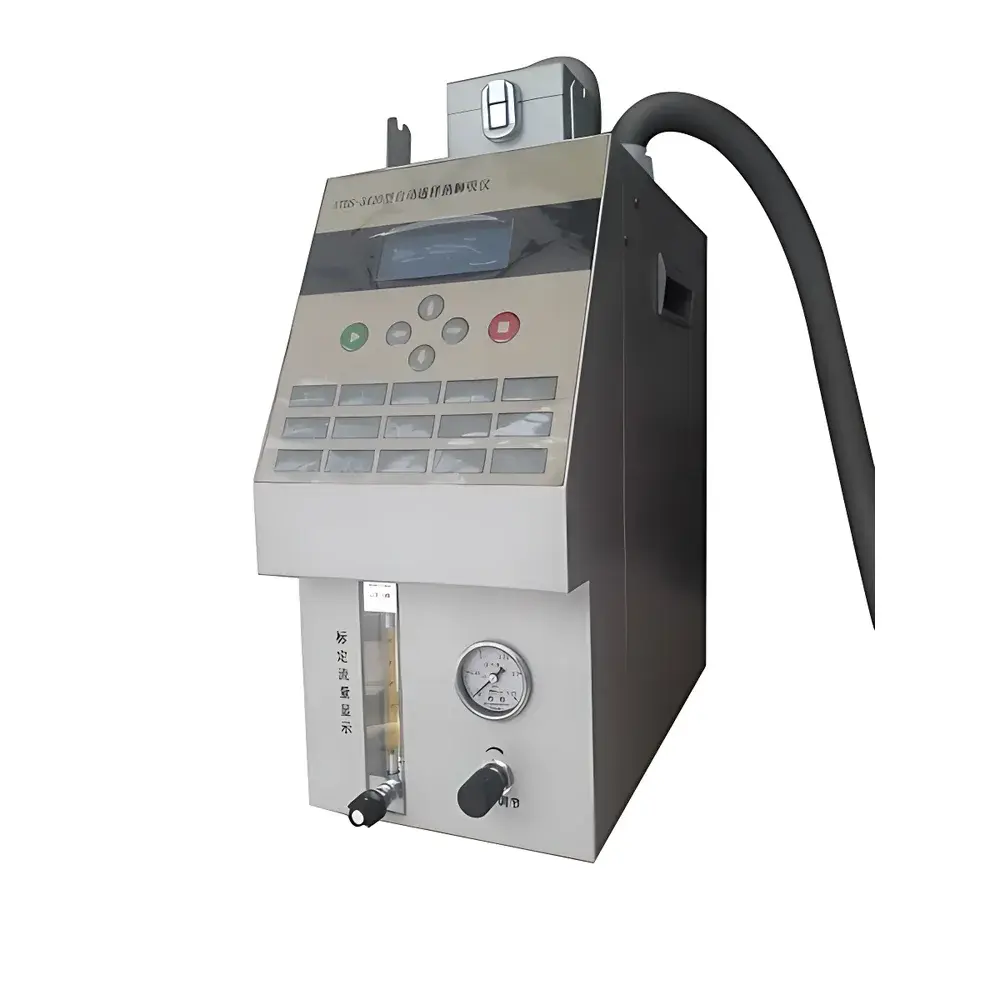
Beifen Sanpu ATDS-3420 Automated Thermal Desorber for Industrial Hygiene and VOC Analysis
| Brand | Beifen Sanpu |
|---|---|
| Origin | Shanghai, China |
| Manufacturer Type | OEM Manufacturer |
| Product Category | Domestic |
| Model | ATDS-3420 |
| Instrument Type | Dual-Stage Thermal Desorber |
| Primary Desorption Temperature Range | Ambient to 400 °C |
| Secondary Desorption Temperature Range | 100–400 °C |
| Cold Trap Temperature Range | Down to –35 °C |
| Desorption Recovery Rate | >90% |
| Sample Capacity | 20 adsorption tubes |
Overview
The Beifen Sanpu ATDS-3420 is a fully automated, dual-stage thermal desorption system engineered for high-sensitivity, quantitative analysis of volatile organic compounds (VOCs) and semi-volatile organic compounds (SVOCs) in air, breath, and solid-phase microextraction (SPME) samples. It operates on the principle of controlled thermal desorption—first releasing analytes from sorbent-packed tubes under inert gas flow at precisely regulated temperatures, then refocusing them onto a cryogenically cooled trap (down to –35 °C), followed by rapid flash desorption into a gas chromatograph (GC) or GC–MS inlet. This two-step process minimizes band broadening, maximizes sensitivity (detection limits down to sub-ppb levels in air), and ensures reproducible transfer of thermally labile and polar compounds. Designed for compliance with international ambient and occupational monitoring protocols, the ATDS-3420 serves as a critical front-end sample introduction module for regulatory-grade VOC analysis across environmental, industrial hygiene, forensic, and pharmaceutical laboratories.
Key Features
- Dual-zone thermal control architecture: independently programmable primary desorption oven (ambient to 400 °C), secondary desorption/focusing zone (100–400 °C), and heated transfer line (ambient to 160 °C), all with ±0.5 °C temperature stability and gradient control.
- Integrated cryogenic cold trap capable of reaching –35 °C, enabling efficient analyte refocusing and improved chromatographic resolution for low-boiling and reactive species.
- 20-position autosampler carousel with automatic tube handling, including robotic arm-assisted tube insertion, sealing, and post-desorption purging.
- Programmable 8-step time-sequence control supporting up to 9 user-defined methods, with external event triggering capability for synchronized GC start and data acquisition software launch.
- Gas management system featuring adjustable carrier gas flow (0–20 mL/min) for tube backflushing and optional integration with native GC carrier gas—no instrument modification required.
- Modular design allows one ATDS-3420 unit to serve multiple GC systems via time-shared sample introduction, enhancing laboratory throughput without hardware duplication.
- Configurable sample transfer line options, including 0.53 mm i.d. fused silica tubing for enhanced compatibility with active or polar analytes.
- Industrial-grade pneumatic actuators and solenoid valves sourced from internationally certified suppliers ensure long-term reliability and leak-tight operation.
- Intuitive 4.3-inch LCD interface with Chinese/English bilingual support, real-time parameter display (temperature setpoints, elapsed time, method status), and adjustable screen brightness for varied lighting environments.
Sample Compatibility & Compliance
The ATDS-3420 supports standard 6 mm o.d. × 89 mm length sorbent tubes (e.g., Tenax TA, Carbopack B/C, Carboxen series) and accommodates both single- and multi-bed configurations. It is validated for use with EPA TO-17, ISO 16017-1, and Chinese national standards including HJ 644–2013 (VOCs in ambient air by TD–GC–MS), HJ 583–2010 (benzene homologues), HJ 734–2014 (stationary source emissions), GB/T 18883–2002 (indoor air quality), and GB 50325–2020 (civil building indoor pollution control). Its performance meets GLP-aligned operational requirements, with full audit trail capability when paired with compliant chromatography data systems (CDS) supporting 21 CFR Part 11 electronic signatures and secure method storage.
Software & Data Management
The ATDS-3420 operates autonomously via embedded firmware but integrates seamlessly with third-party GC and CDS platforms—including Agilent OpenLab, Thermo Chromeleon, Shimadzu GC Solutions, and Waters Empower—through TTL-level external trigger signals and RS232/USB communication. All method parameters (temperature ramps, timing sequences, gas flows) are stored internally with timestamped execution logs. When used with validated CDS environments, the system supports full traceability: method versioning, user login tracking, electronic signature capture, and raw data integrity per FDA 21 CFR Part 11 and ISO/IEC 17025 documentation requirements.
Applications
- Occupational exposure assessment per OSHA and NIOSH methodologies for benzene, formaldehyde, and other workplace VOCs.
- Indoor air quality (IAQ) screening in residential, commercial, and healthcare facilities per GB 50325 and ISO 16000 series standards.
- Automotive cabin air testing (HJ/T 400–2007) for aldehydes, hydrocarbons, and plasticizer emissions.
- Pharmaceutical residual solvent analysis (ICH Q3C) and packaging leachables profiling.
- Forensic toxicology: detection of volatile drugs and metabolites in breath or headspace samples.
- Environmental emergency response: rapid identification of unknown airborne contaminants following chemical incidents.
- Materials off-gassing studies in polymer, adhesive, and composite manufacturing QA/QC workflows.
FAQ
Can the ATDS-3420 be used with GC–MS systems?
Yes—it delivers sharp, narrow-band injections compatible with mass spectrometric detection and supports electron ionization (EI) and chemical ionization (CI) source optimization.
Does it support unattended overnight operation?
Yes—the 20-tube carousel and programmable 8-stage sequence enable fully automated batch processing with built-in fault detection and error logging.
Is method validation documentation available?
Beifen Sanpu provides IQ/OQ documentation templates aligned with ISO/IEC 17025 and GMP Annex 15 guidelines; installation and operational qualification support is available upon request.
What maintenance intervals are recommended?
Cold trap cleaning every 200 runs; valve and seal inspection every 6 months; annual calibration verification using NIST-traceable reference standards.
Can I upgrade from single-stage to dual-stage desorption?
The ATDS-3420 is natively dual-stage; no field upgrade path exists for earlier single-stage models due to fundamental differences in thermal architecture and gas routing design.






