
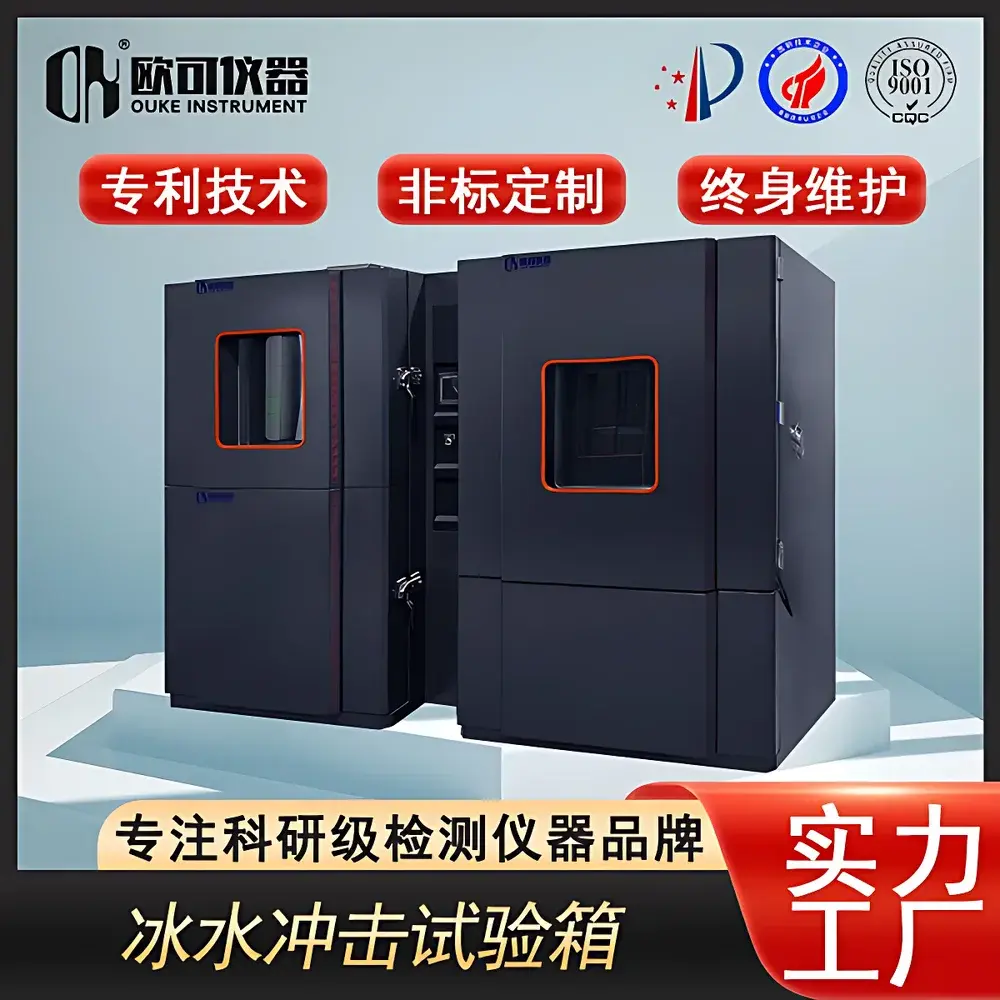
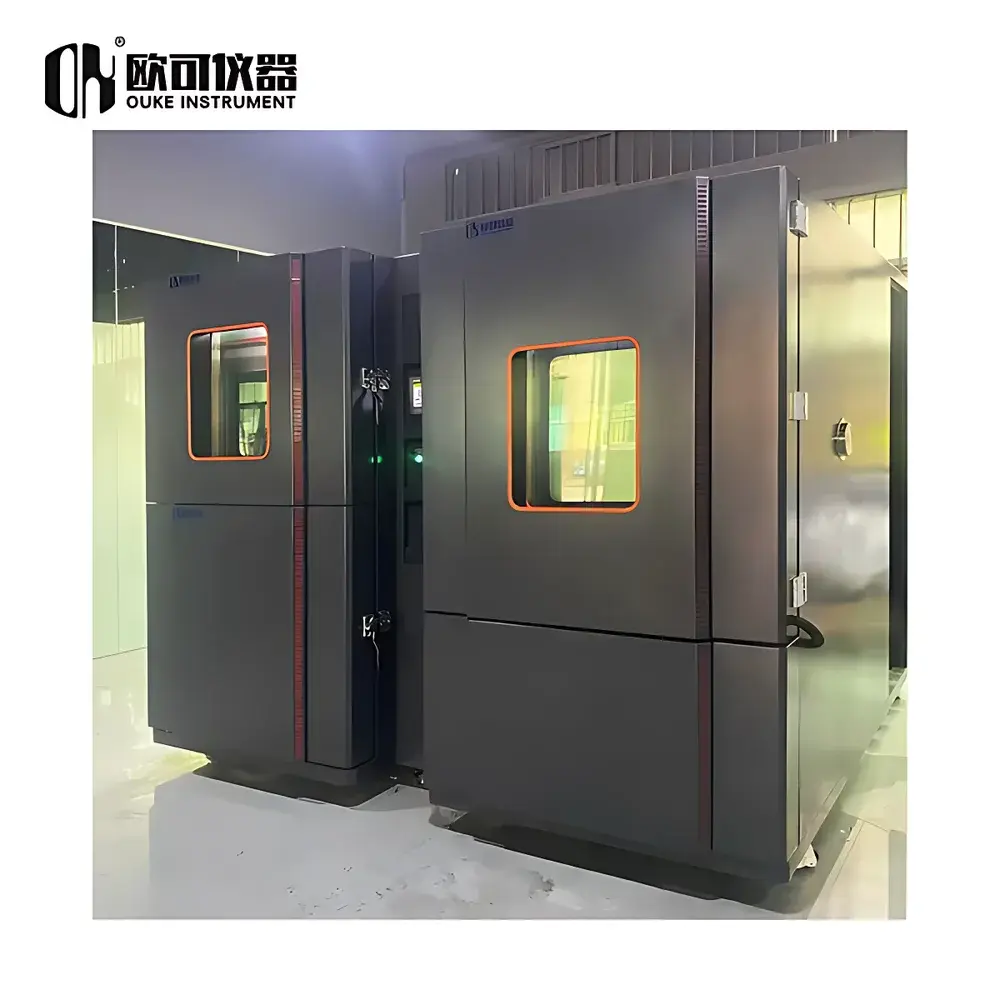
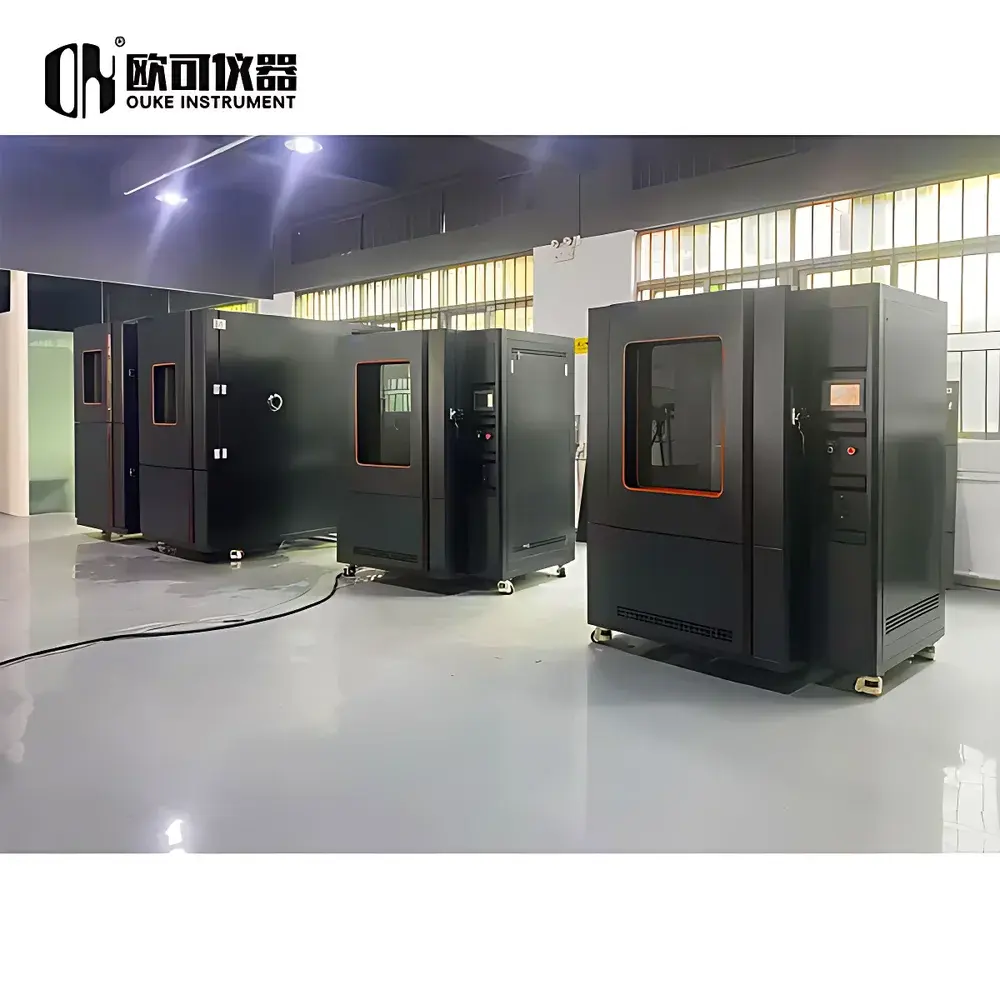
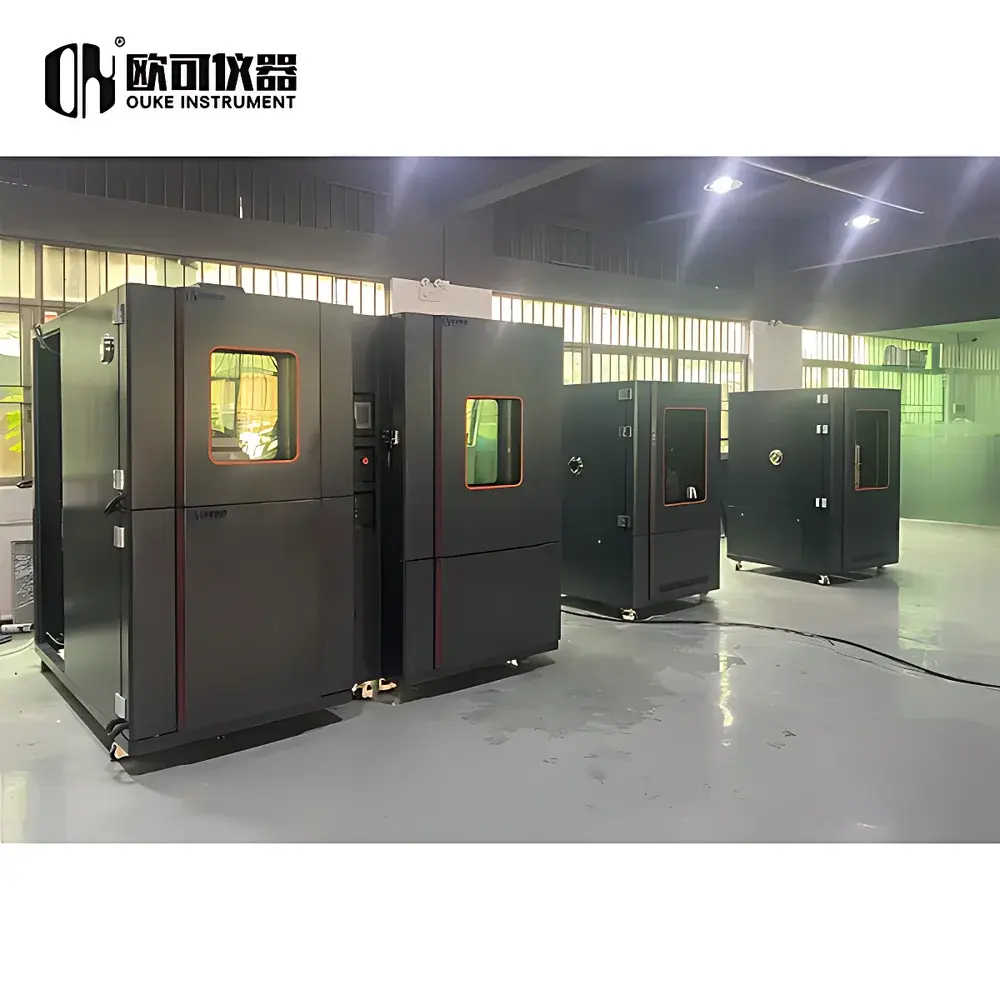
OK-BSCJ-1001 Ice-Water Thermal Shock Test Chamber
| Brand | OK Instruments |
|---|---|
| Origin | Guangdong, China |
| Manufacturer Type | Direct Manufacturer |
| Model | OK-BSCJ-1001 |
| High-Temperature Range | +150 °C |
| Low-Temperature Range | −140 °C |
| Thermal Shock Range | −40 °C to +150 °C |
| Temperature Stability | ±2 °C |
Overview
The OK-BSCJ-1001 Ice-Water Thermal Shock Test Chamber is an engineered environmental reliability testing system designed to replicate the extreme transient thermal-mechanical stress induced when a high-temperature component is subjected to sudden impingement by sub-zero aqueous media. Unlike conventional thermal shock chambers that rely on air or liquid immersion between temperature extremes, this chamber implements a precisely controlled, two-zone dynamic process: rapid preheating of test specimens in a stabilized high-temperature zone (up to +150 °C), followed by automated transfer and targeted high-pressure ice-water spray (0–4 °C) under defined flow rate, pressure, and dwell time. The underlying physical principle combines convective heat transfer acceleration with localized thermal gradient-induced stress—capable of inducing interfacial delamination, microcracking in cast alloys, sealant extrusion, and solder joint fatigue. It is purpose-built for validation against automotive OEM standards such as VW PV 1210, GMW 15200, and MBN 10546, where failure modes are driven not by steady-state conditions but by the magnitude and rate of thermal transients at material interfaces.
Key Features
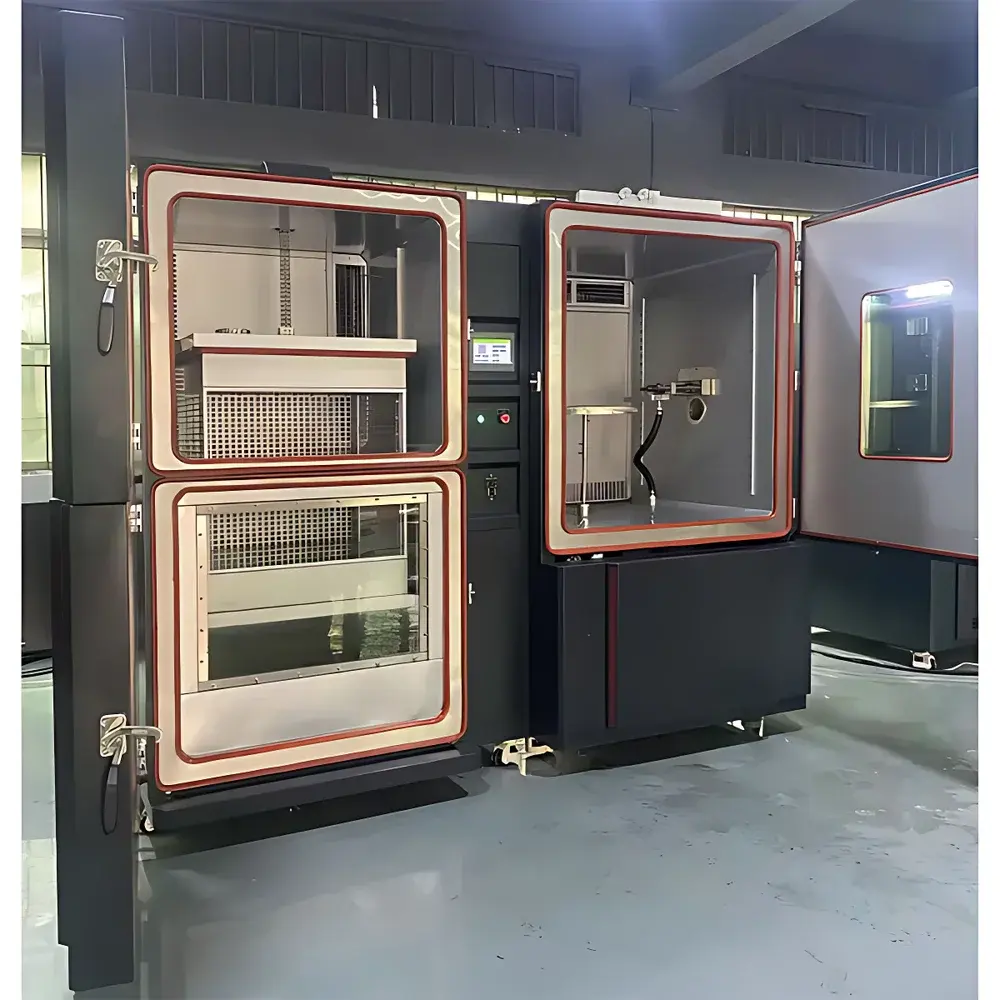
- Two-stage integrated architecture: independent high-temperature pre-conditioning chamber (+150 °C max) and dedicated ice-water impact zone with programmable nozzle array
- Cryogenic water circulation system maintaining stable 0–4 °C supply via dual-stage refrigeration and ice-slush mixing capability
- High-precision servo-driven sample transfer mechanism achieving ≤10 s transition time from hot zone to impact position
- Adjustable multi-axis spray nozzles supporting variable impact angles, flow rates (up to 1000 kPa), and coverage patterns per IEC/ISO-defined spray footprints
- Integrated drainage, filtration, and optional hot-air drying subsystem for repeatable multi-cycle operation
- PLC-based control platform with audit-trail-capable logging compliant with GLP/GMP data integrity requirements (21 CFR Part 11 ready)
Sample Compatibility & Compliance
The OK-BSCJ-1001 accommodates components up to 1000 mm × 800 mm × 600 mm (W×D×H) and supports mounting fixtures for engine blocks, brake calipers, ECU housings, lighting assemblies, and aerospace structural brackets. Its operational envelope aligns with internationally recognized test protocols including:
Volkswagen PV 1210 (Ice-Water Impact Test)
Mercedes-Benz MBN 10546
General Motors GMW 15200
Ford FLTM BO 162-04
VDA 621-415
ISO 19453-5 (Electric Drive Systems)
All critical parameters—including water temperature stability (±0.5 °C), transfer timing accuracy (±0.2 s), spray pressure repeatability (±15 kPa), and thermal soak uniformity (±2 °C)—are traceably validated per ISO/IEC 17025-accredited procedures. Calibration certificates and uncertainty budgets are provided with each unit shipment.
Software & Data Management
The embedded OK-TestSuite™ software enables full cycle definition, real-time parameter monitoring (temperature, pressure, flow, position), and synchronized event logging at 100 ms resolution. All test sequences are stored with digital signatures and timestamped metadata. Export formats include CSV, PDF test reports, and XML-compatible datasets for integration into LIMS or PLM systems. Audit trail functionality records user actions, parameter modifications, and calibration events—meeting FDA 21 CFR Part 11 requirements for electronic records and signatures. Remote diagnostics and firmware updates are supported via secure TLS 1.2 encrypted Ethernet connection; no cloud dependency or third-party telemetry is implemented.
Applications
- Automotive powertrain validation: cylinder heads, turbocharger housings, transmission casings, and battery module enclosures exposed to road splash after high-load operation
- Aerospace landing gear and nacelle components undergoing de-icing fluid impact following high-altitude thermal soak
- Outdoor-rated electronics: photovoltaic inverters, 5G base station cabinets, and EV charging modules subjected to solar heating followed by rain/snow melt exposure
- Industrial sensors and actuators deployed in thermal cycling environments where condensation or direct coolant contact may occur
- Material qualification of thermoplastics, elastomeric seals, conformal coatings, and adhesive bonds under combined thermal shock and hydraulic loading
FAQ
What distinguishes ice-water thermal shock testing from standard thermal shock or IPX9K testing?
The OK-BSCJ-1001 applies simultaneous thermal and mechanical stress: a specimen remains at elevated temperature during impact, generating steep interfacial gradients unattainable via immersion or air-based cycling. IPX9K uses 80 °C water at high pressure but lacks thermal preconditioning; conventional thermal shock chambers do not introduce liquid-phase mechanical loading.
Can the chamber meet VW PV 1210’s requirement for ≤5 s transfer time?
The standard configuration achieves ≤10 s; optional high-speed transfer upgrade (mechanical arm + vacuum-assisted positioning) reduces transfer to ≤4.5 s with NIST-traceable verification report.
Is water filtration and particulate control included?
Yes—integrated 5 µm absolute filtration, UV sterilization loop, and conductivity monitoring ensure compliance with PV 1210’s stipulation for “particle-free, non-corrosive water.”
Does the system support custom test profiles beyond published standards?
Yes—user-defined sequences may specify variable soak durations, ramp rates, spray pressures, and iteration counts, all saved as reusable protocol templates with version control.
What maintenance intervals are recommended for the refrigeration and spray systems?
Compressor oil and refrigerant analysis every 12 months; nozzle inspection and calibration every 200 cycles or 6 months (whichever occurs first); full system performance verification annually per ISO 17025 guidelines.



